


Business leaders yesterday welcomed an agreement between Taiwan and China to allow regular and faster cross-strait shipping and flight services, saying it would boost bilateral trade.
Envoys from the two countries inked a pact yesterday afternoon that will allow direct, regular air and sea links for both cargo and passenger services between designated sites.
Rock Hsu (許勝雄), chairman of Kinpo Group (金仁寶集團), said the opening would substantially enhance Taiwanese makers’ logistic competitiveness and allow them to deliver goods to customers within two days.
Cross-strait flights have been limited to the weekend and to five designated sites and planes have to pass over the airspace of a third country or region before heading to their destination. No direct cargo service by sea or air is available.
The new pact will make passenger flights available seven days a week, increase the number of flights from 36 to 108, add 16 more airports and eliminate the need to cross over a third area.
Hsu, who owns Compal Electronics Inc (仁寶電腦), the world’s second-largest notebook computer maker on contract basis, said the government’s plan to create free trade zones would have proved an empty slogan if it did not get China to open more airports to direct cross-strait flights.
“Taiwan and China can work together and emerge from the global economic slowdown unscathed by cashing in on the former’s design edge and the latter’s manufacturing capacity,” Hsu said.
Farglory Group (遠雄集團) chairman Chao Teng-hsiung (趙藤雄) said the two sides had taken a first and critical step by signing the accord.
Chao said the agreement could benefit cross-strait commerce, which could witness quick and significant growth in the near future. The construction tycoon urged the government to honor its pledge soon to allow foreign investors, including Chinese, to buy real estate in Taiwan, arguing the move will help bolster the economy.
“With capital inflows to the property market, real estate prices will go up,” Chao said. “Owners will enjoy greater wealth and spend more. The cycle will induce more business potential.”
Evertrust Rehouse Co (永慶房屋), the leading real estate agency, said the expanded direct links would help cut operation costs for Taiwanese and foreign firms with business across the Taiwan Strait.
Jeffrey Huang (黃增福), an assistant manager at Evertrust’s research and development department, said the opening will increase the willingness of foreign investors and Taiwanese businesspeople in China to set up operation offices in Taiwan.
The speedier cross-strait flights make one-day travel between Taiwan and China more convenient, Huang said, predicting that demand for office buildings will rise once the accord goes into practice.
Phoenix Tours Inc (鳳凰旅遊) said it expected easier cross-strait travel to bring in more Chinese tourists, starting next month.
Anthony Liao (廖文澄), general manager of the travel agency, said he expected the number of Chinese tourists to jump between three and five times after the two sides agreed to loosen restrictions for trips to Taiwan. Among the new changes, Chinese tourists may stay here from 10 days to 15 days.
Separately, local marine companies expected the much-anticipated opening up of direct cross-strait transportation to help local shipping companies lower their costs because of the more direct route.
Shippers said they were glad that the direct cross-strait shipping issue had finally been listed on the agenda, and predicted the agreement would have a positive impact on the cross-strait market worth US$120 billion a year.
At present, ships from Taiwan and China must navigate via a third destination, such as Japan’s Ishigaki Island, which adds up to US$20,000 in costs per voyage.
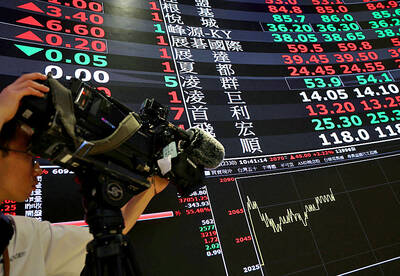
After several years flying high as Asia’s best Nvidia Corp proxy, Taiwan Semiconductor Manufacturing Co (TSMC, 台積電) is increasingly vying with other artificial intelligence (AI) stocks for investor attention. Stock traders are chasing a wider array of beneficiaries as mainstream usage of AI creates demand for hardware beyond the most-advanced chips TSMC makes for Nvidia. Subthemes from the deepening memory crunch to advances in robotics are also luring bids. At the same time, investment caps on single stocks are pushing funds to diversify, while retail investors long familiar with TSMC through its US depositary receipts are being offered a broader set of
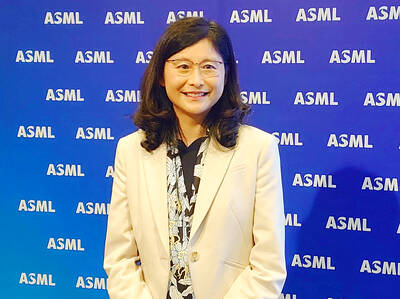
Netherlands-based semiconductor equipment supplier ASML Holding NV yesterday said that it is planning to hire an additional 1,000 people in Taiwan this year in response to growing demand from clients. ASML had previously planned to recruit 600 people this year, but that the plan has been adjusted upward, ASML vice president and ASML Taiwan general manager Grace Wang (汪佳慧) told reporters. ASML has a workforce of more than 4,500 in Taiwan, accounting for about 10 percent of its global total, Wang said. This year’s recruitment campaign would focus on adding people in the customer support, manufacturing and supply chain domains to assist ASML
UNDER MICROSCOPE: Taiwan detained three people who allegedly conspired to buy servers in Taiwan and export them using fraudulent documentation, prosecutors said Nvidia Corp chief executive officer Jensen Huang (黃仁勳) on Saturday urged Super Micro Computer Inc to tighten up on compliance after Taiwan detained three people this week for allegedly making fraudulent declarations about artificial intelligence (AI) servers made by its US partner. The development marked the nation’s first crackdown on semiconductor smuggling, which grew after the US slapped restrictions on exports of high-end chips such as Nvidia AI accelerators to China. Nvidia is “rigorous” in explaining regulations to all of its partners, Huang told reporters after arriving in Taipei. “Ultimately Super Micro has to run their own company,” he said in response to

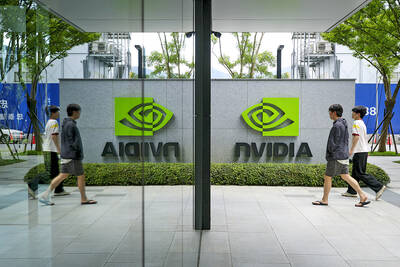
Nvidia Corp yesterday announced that CEO Jensen Huang (黃仁勳) would attend an employee meeting in Taipei tomorrow to celebrate the launch of the company’s Taiwan headquarters project. Huang would attend a gathering at the site of Nvidia’s planned headquarters in Beitou Shilin Technology Park (北投士林科技園區), the company said in a statement. After arriving in Taiwan on Saturday last week, Huang told reporters that he plans to meet with Quanta Computer Inc (廣達) chairman Barry Lam (林百里) and Taiwan Semiconductor Manufacturing Co (TSMC, 台積電) chairman C.C. Wei (魏哲家), and would attend the groundbreaking ceremony for Nvidia’s Taiwan headquarters tomorrow. Nvidia has not yet applied


 RSS
RSS