


The board of Mega Financial Holding Co (兆豐金控) decided in an emergency meeting late last night to inject capital to restore the dwindling fund size of Diamond Bond Fund (寶鑽基金), managed by its subsidiary Mega International Investment Trust Co (兆豐國際投信), after investors redeemed more than NT$19.1 billion (US$598 million) one day earlier.
“The company has no option but to come to its subsidiary’s rescue,” the company said in a filing to the Taiwan Stock Exchange late yesterday.
The trust unit faced a credit crunch because of massive redemption out of the more than NT$30 billion fund, forcing it to seek liquidity support from its parent company after cashing its bond and time deposits.
Mega Financial also gave its approval yesterday to the trust unit’s transfer of Diamond Bond Fund’s NT$939.2 million in asset-backed commercial paper (ABCP) investments to its banking subsidiary, Mega International Commercial Bank Co (ICBC, 兆豐商銀).
EXPOSURE
The fund’s ABCP investments are exposed to financially troubled Lehman Brothers Holdings Inc and may suffer great losses. The trust unit’s shareholders, including the parent holding company and the banking subsidiary, had agreed to absorb the losses — a measure that the Financial Supervisory Commission approved on Tuesday.
The board meeting yesterday upheld the decision for ICBC to acquire the ABCP.
The board does not expect any losses from the liabilities since “the bank shall incur no losses once the trust unit clears the fund and follows through its recapitalization plan,” the statement said.
But opposition to the decision is intense, with the bank’s labor union strongly defending the rights of the bank’s shareholders and investors.
ACCOUNTABILITY
Hsu Chen-chiang (許鎮強), chairman of the ICBC labor union, said yesterday that the union disagreed with the trust unit’s decision to dump its liabilities on the bank, sacrificing the interests of bank shareholders to protect fund investors.
The labor union urged the bank’s policymakers who finalized the decision to show accountability by stepping down, Hsu said over the phone yesterday.
The union is expected to hold a meeting today to discuss possible action to relay their anger over the fund transfer.
Taiwan Ratings Corp (中華信評) yesterday placed its 'twAAf' fixed-income fund rating on Mega Diamond Bond Fund on Credit Watch with negative implications, following investors' larger-than-expected redemption.
“The rating action reflects our expectation that the fund will face challenges to restore its fund size and liquidity position,” the rating agency said in a statement yesterday.
It added that its rating could be lowered if the fund size fails to stabilize or if it fails to restore its liquidity position above 40 percent in the next few months.
According to Taiwan Ratings, the fund's managed assets declined to some NT$9 billion yesterday from NT$36.6 billion on August 30.
Taiwan Ratings expects the fund's liquidity position to weaken to about 30 percent despite its disposal of bond holdings to fulfill the redemption requirements, the statement said.
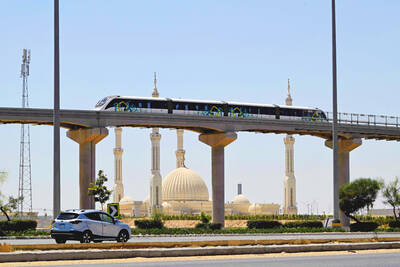
Cairo’s new monorail slices across the city skyline, running above the familiar chaos of blaring horns and aging buses’ exhaust fumes that mark rush hour below. The US$4.5 billion monorail, opened this month, is among Egypt’s most prominent new transport projects, part of a debt-funded infrastructure drive criticized for sapping state finances while bringing limited benefits to most of the country’s 109 million people. “It feels like you’re in a different country,” said Ramy Sayed, a restaurant manager, aboard a driverless Innovia 300 train. “No noise, no traffic, we’re not used to this.” The eastern line runs 56km from the bustling middle-class

Taiwanese firms have increased investment in the Philippines in recent years as Manila’s ties with Washington deepen and global supply chains continue to shift away from China, an expert at the Chung-Hua Institution for Economic Research (CIER, 中華經濟研究院) said yesterday. The Philippines had not been among Taiwanese investors’ top choices in Southeast Asia, CIER Taiwan ASEAN Studies Center director Kristy Hsu (徐遵慈) said at a seminar in Taipei. However, Taiwan’s investment in the country has grown significantly since the COVID-19 pandemic, reaching US $257 million last year, a high in recent years, she said. Although Taiwan’s total investment in the Philippines still lags

Intel Corp regards Taiwan Semiconductor Manufacturing Co (TSMC, 台積電) as a longstanding partner, as the US chipmaker would continue outsourcing production of advanced chips to TSMC, Intel chief executive officer Lip-Bu Tan (陳立武) said yesterday. “I don’t look at people as competitors. I look at the collaboration... Nvidia is also, you know, a good friend,” Tan told a news conference following his keynote speech at the Computex trade show in Taipei. “It’s a very trusted partnership for us... We are a big, top customer for them, and we’re going to continue doing that,” he said, referring to TSMC, the world’s largest foundry
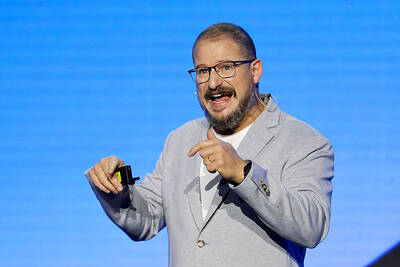
Artificial intelligence (AI) agents would supplant smartphones as the center of people’s digital lives, fundamentally reshaping personal devices and driving a major computing upgrade cycle, Qualcomm Inc CEO Cristiano Amon said yesterday. In his keynote speech for this year’s Computex trade show in Taipei, Amon said that the rise of "agentic AI" — AI systems capable of reasoning, planning and carrying out tasks autonomously — would transform how people interact with technology across phones, PCs, vehicles and wearable devices. Describing the technology as the next major evolution in computing, Amon said that "2026 is the year of agents.” For decades, smartphones have sat


 RSS
RSS