


The US financial crisis is expected to delay capital market reforms in China and other developing Asian economies stunned by the colossal damage unleashed by complex financial contracts on the US, experts say.
Flush with cash reserves, many developing Asian nations have been prodded by Western financial institutions to deepen their capital markets by introducing sophisticated financial derivatives to hedge against various risks.
But as derivatives tied to housing mortgages-backed securities were blamed for the US turmoil, whose losses could reach US$1 trillion, Asian economies would tread more cautiously in adopting complex financial trading contracts, the experts said.
“I think that is going to be the takeaway by the bank regulator in China, for example,” Asian expert Nicholas Lardy of the Washington-based Peterson Institute for International Economics said.
“I think they are going to say to themselves, ‘We were right to resist the opening up of our financial system to Western financial institutions that wanted to add in supposedly more sophisticated products into our market,’” he said.
China has not introduced any of the risk-carrying exotic derivative products, such as the unregulated credit default swap contracts, which are at the center of the current US financial chaos.
These private contracts allow companies to trade bets on whether a borrower will default.
A top new player in the swaps game was troubled US insurance giant American Insurance Group (AIG), bailed out last week by the US Federal Reserve following a similar rescue of two debt ridden mortgage giants Freddie Mac and Fannie Mae.
Top investment house Lehman Brothers, however, filed for bankruptcy in the biggest corporate debt default in history, sending global markets reeling.
“The sudden downfall of several prominent global institutions has authorities concerned about ripple effects and is prompting a reassessment of the pace of China’s financial sector reforms,” Jing Ulrich, chairman of China equities at J.P. Morgan, wrote in a report last week, the Washington Post said.
The reforms were meant to give market forces more sway.
Asian economies were alerted to the risks of derivative trading way back in 1995 when a British trader’s wrong bets in Japanese stock futures in Singapore led to the high-profile collapse of British bank Barings.
Two years later, the region plunged into a severe financial crisis resulting from a currency meltdown blamed by some on hedge funds.
The US crisis has exposed systemic missteps by banking overseers, securities regulators, the US Congress and corporate executives — all of whom underestimated the risks of leveraging and now are paying the price, the Washington Post quoted securities officials as saying.
“What is unique is that during that time, there was a sense that a well regulated financial system, like the US, would never experience a kind of trouble that Asia experienced in the 1990s and unfortunately that has proven [not] to be the case,” Brad Setser, a former US Treasury official, said.
“Maybe the US system wasn’t as well regulated as many thought and certainly it has taken on an enormous amount of risk and sees enough in ways that have uncomfortable parallels to the Asian crisis,” said Setser, now with the Council on Foreign Relations, a US think tank.
The Asian crisis roiled banks that took enormous risks by financing a high level of investments, often using foreign currency-denominated loans. It forced governments to take over the institutions by injecting public money to keep the banking system from completely collapsing.
Rather than venturing into complicated financial products with hidden risks, Asian nations should give priority to adopting key financial reforms vital to fueling their rapidly growing economies, experts said.
In China, for example, financial reforms such as interest rate liberalization, a more market determined exchange rate and a more developed “plain vanilla” domestic bond market are critical, Lardy said.
“I think the main lesson for everybody is leverage is risky,” he said. “People had forgotten that, especially with the low cost of money in the last few years.”
The Fair Trade Commission’s (FTC) ongoing review of Grab Holdings Ltd’s US$600 million acquisition of Foodpanda Taiwan’s operations, announced on March 23, has taken on fresh urgency as industry experts warn that the transaction could embed significant Chinese cybersecurity vulnerabilities into Taiwan’s digital infrastructure through Grab’s deep ties to autonomous-driving firm WeRide (文遠知行). Less than 16 months after the FTC blocked Uber Eats’ direct attempt to acquire Foodpanda Taiwan — citing potential combined market shares of 80 to 90 percent — the emergence of Grab as the buyer has prompted questions about whether the same competitive harm is simply being rerouted
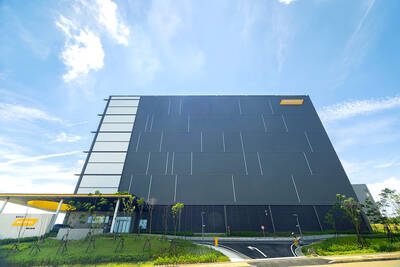
POWER BUILDUP: Powered by Nvidia’s B200 Blackwell chips, the data center would support MediaTek’s computing power demand and business growth, the company said Smartphone chip designer MediaTek Inc (聯發科) yesterday launched a new artificial intelligence (AI) data center with a maximum capacity of 45 megawatts to meet its rising demand for computing power required to develop new advanced chips for AI applications. The company has completed the first-phase computing power buildup at the data center in Miaoli County’s Tongluo Township (銅鑼), providing 15 megawatts of capacity to support its research and development (R&D) capabilities, despite an industrywide shortage of key components, MediaTek said. Supply constraints have plagued a wide range of key components, including memory chips, solid-state drives, power supply units and central
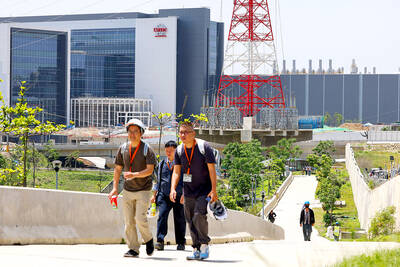
IMAGE SENSORS: The Japanese company would be the controlling shareholder of the venture, with development and production lines to be set up in Kumamoto Taiwan Semiconductor Manufacturing Co (TSMC, 台積電) yesterday said it has signed a non-binding memorandum of understanding (MOU) with Sony Semiconductor Solutions Corp to create a joint venture to develop and produce next-generation images sensors. The partnership seeks to explore and address emerging opportunities in physical artificial intelligence (AI) applications, such as automotive and robotics, paving the way for innovations and expanded technological advancements, TSMC said in a statement. Sony would be the majority and controlling shareholder of the joint venture, the statement said, adding that the company would set up development and production lines in its newly constructed fab in Kumamoto Prefecture’s
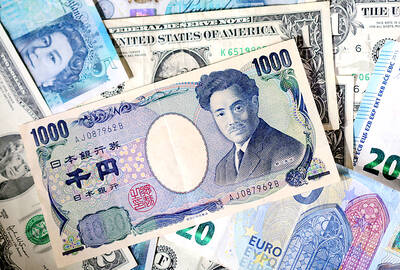
The nation’s foreign exchange reserves climbed back above US$600 billion at the end of last month, as investment gains, currency valuation effects and renewed foreign inflows offset volatility seen earlier in the month, the central bank said yesterday. Reserves stood at US$602.49 billion, up US$5.6 billion from the previous month, the central bank said. The rebound reflected returns on reserve assets, fluctuations in major currencies against the US dollar and the central bank’s market operations aimed at maintaining orderly trading conditions, Department of Foreign Exchange Director-General Eugene Tsai (蔡炯民) said. Financial markets were volatile early last month, with foreign investors recording net purchases


 RSS
RSS