

Formosa Plastics Corp (台塑), Asia’s second-biggest maker of polyvinyl chloride, posted a 42 percent gain in second-quarter profit on higher prices driven by Chinese demand and earnings contributed by a refining affiliate.
Net income climbed to NT$13.3 billion (US$423 million) in the three months ended June 30 from NT$9.33 billion a year earlier. That’s higher than the NT$10.5 billion median estimate in a Bloomberg survey of three analysts.
The figure was derived by deducting first-quarter profit from six-month earnings the company announced yesterday.
Operating profit climbed to NT$8.7 billion in the first half from NT$8.38 billion a year earlier, the company said in a filing to the Taiwan Stock Exchange yesterday. Non-operating income rose to NT$13.5 billion from NT$11.9 billion.
“A big boost to Formosa Plastics’ profit was contribution from Formosa Petrochemical, which reported strong earnings because of exports, especially those to China,” said Huang Lan-ying, a Taipei-based analyst at Capital Securities Corp (群益證券).
Huang has a “hold” rating on Formosa Plastics’ shares.
Formosa Petrochemical Corp (台塑石化), Taiwan’s only publicly traded oil refiner, last week reported a 22 percent gain in second-quarter profit.
Formosa Plastics fell 0.8 percent to NT$60.2 in Taipei trading before the earnings announcement. The stock has dropped 34 percent this year, compared with a 17 percent decline in the TAIEX.
First-half net income climbed 21 percent to NT$20.2 billion, or NT$3.54 per share, the company said in an e-mail yesterday.
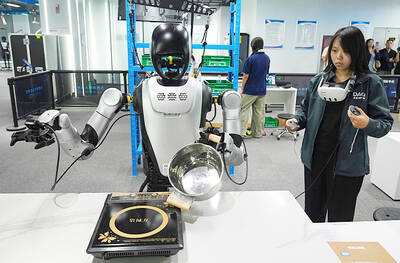
Taiwan and other technology democracies have a "golden but narrowing" three-to-five-year window to lay the foundations for an advanced robotics supply chain outside China, particularly for humanoid robots, a Taiwan-based researcher said yesterday. A report released on Monday by the Research Institute for Democracy, Society and Emerging Technology (DSET) examines China-West competition in physical artificial intelligence (AI) and Taiwan’s potential role in developing alternatives to Chinese robot supply chains. Humanoid robots remain unproven, meaning China’s lead in shipments currently has a limited impact on the real economy, Nathanael Cheng (鄭秉信), a policy analyst in the DSET Economic Security Program, said in a
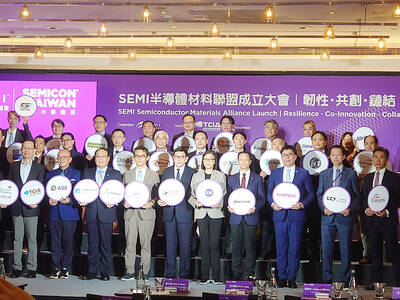
SPECIALTY SUPPLIES: Taiwan is ushering in a major shift in industrial upgrades and a local alliance will reinforce supply chain resilience, SEMI president Terry Tsao said SEMI Taiwan launched a semiconductor materials alliance yesterday to fortify industry resilience, capitalizing on surging domestic demand fueled by advanced nodes and next-generation packaging. Taiwan has been the world’s largest semiconductor materials consumer for 16 years in a row, the industry association said. Taiwan purchased about US$21.7 billion of semiconductor materials last year, driven by artificial intelligence (AI)-related demand, SEMI data showed. The spending accounted for 30 percent of global semiconductor materials consumption, totaling US$73.2 billion, the data showed. “Demand for specialty gases, chemicals and key raw materials are rising in Taiwan, fueled by the technology advancements to 2-nanometer and advanced packaging technologies,” SEMI

YouTube is offering millions of dollars to popular channels if they upload their videos to the site exclusively for a certain period of time, in an effort to halt Netflix Inc’s pursuit of its biggest stars, people familiar with the conversations said. The payment would come in a couple of different forms. YouTube has discussed directly financing some programs, and it has also offered to allot a portion of major brand deals to creators. Although YouTube has not finalized deals with any creators, it is close an agreement with several partners, said the people, who declined to be identified because

HAND-IN-HAND: Nvidia’s inability to hold the line on prices reflects how much leverage memorychip makers have amid the surge in demand for AI infrastructure Some of Nvidia Corp’s biggest customers have been told that the prices of servers containing its artificial intelligence (AI) chips are going up more than 15 percent in many cases with memory costs soaring. The price hikes would go into effect on systems shipped early next year and impact systems including those with the flagship Vera Rubin and Grace Blackwell chips, people familiar with the process said on condition of anonymity. The increases would depend on the generation of Nvidia chips and the memory configurations, they said. Companies who build the servers under contract for large data center operators such as Microsoft


 RSS
RSS