


State-owned oil refiner CPC Corp, Taiwan (CPC, 台灣中油) announced yesterday that domestic oil prices will remain at their current levels and that the company would absorb rising gasoline and diesel costs, which are predicted to increase by NT$0.5 per liter and NT$0.6 per liter respectively this month, based on the current floating oil price mechanism.
“CPC’s decision was in light of the two typhoons [Tropical Storm Kalmaegi and Typhoon Fung-wong] that hit the nation last month; a lot of families are still struggling to rebuild their homes and the company feels the public’s pain and is willing to absorb the rising costs,” CPC vice president Chu Shao-hua (朱少華) said at a press conference yesterday.
CPC will have to absorb an additional NT$600 million (US$19.58 million) in losses per month as a result of the decision, Chu said.
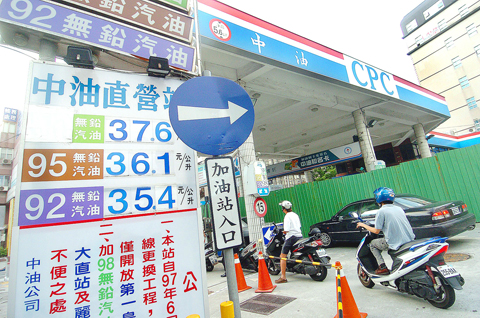
PHOTO: CHANG CHIA-MING, TAIPEI TIMES
Following CPC’s announcement, Formosa Petrochemical Corp (台塑石化), the nation’s only privately-owned oil refiner, also announced on its Web site that it would not adjust its domestic gasoline and diesel prices.
But the two may still have to adjust their wholesale prices a week from now, because the Ministry of Economic Affairs announced last night that beginning this month, the floating oil price mechanism will be revised to adjust domestic oil prices on a weekly basis, rather than the current monthly revision.
In other words, the next adjustment of domestic oil prices will be announced on Friday, Aug. 8 at 5pm, with prices effective on Saturday at midnight.
“This seems like a smart move, but the question remains whether it [CPC} will follow the rules of the game [and adjust domestic oil prices this month],” Liang Chi-yuan (梁啟源), a research fellow at Academia Sinica’s Institute of Economics, said about CPC’s decision in a telephone interview yesterday.
Despite this, Liang said he could sympathize with the government, as it is under pressure not to increase oil prices this month.
The Taipei-based Consumers’ Foundation (消基會) said yesterday that it was glad to see the government has begun to pay attention to public opinion.
However, the foundation said the real problem was not whether oil prices should be adjusted on a monthly or weekly basis, but rather that the current floating oil pricing formula is too simple.
“It is only a short-term solution … I do not think this is a good resolution. The government tried it before [last year], but it failed,” acting foundation chairman Hsieh Tien-jen (謝天仁) said by phone yesterday.
Meanwhile, domestic new car sales declined 30 percent from a year ago to around 23,000 units last month, a Hotai Motor Co (和泰汽車) official said yesterday.
“People have become more cautious on spending their disposable income, especially for goods such as cars that require a large amount of money,” Steven Yang (楊湘泉), a Hotai spokesman, said by phone.
The company has not seen any signs of optimism as of yet and predicts that the nation’s new car sales this year will drop to 250,000 units, down 21.88 percent from 320,000 units last year, Yang said.
href="ExxonMobil profit hits record on oil price surge">http://www.taipeitimes.com/News/worldbiz/archives/2008/08/02/2003419188

HSBC Holdings PLC is deepening its commitment to Taiwan as the economy emerges as one of the bank’s fastest-growing markets globally, driven by an artificial intelligence (AI) investment boom, expanding cross-border trade, and rising wealth creation. “The advantage that Taiwan has is a growth story linked to the semiconductor and broader AI industries, strong underlying corporate performance, and wealth creation,” said Surendra Rosha, HSBC’s co-chief executive for Asia and the Middle East, in an exclusive interview with the Taipei Times on June 2, during this year’s HSBC Taiwan Conference. That combination has helped HSBC cement its position as the most profitable international
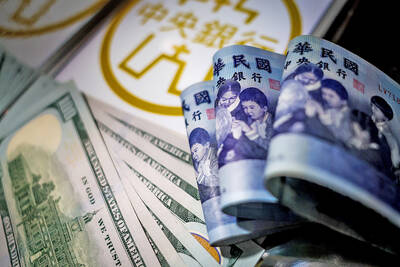
The New Taiwan dollar yesterday fell sharply against the US dollar to close at its lowest level since May 22 amid a massive outflow of funds from the country because of investors panicking over global equity markets. The NT dollar ended at NT$31.580 against the US dollar, slightly lower than its close of NT$31.568 on May 22, after moving between NT$31.5 and NT$31.648 on combined turnover of US$3.062 billion on the Taipei Foreign Exchange and the Cosmos Foreign Exchange. The NT dollar received a significant hit in the morning session, slumping as much as NT$0.173 at a time when other Asian currencies
Taiwan Semiconductor Manufacturing Co (TSMC, 台積電) is now ranked ninth among the world’s 100 most valuable companies after its market capitalization more than doubled over the past year, PricewaterhouseCoopers (PwC) Taiwan said in a report last month. TSMC’s market capitalization surged 101 percent year-on-year to US$1.427 trillion as of March 31, the accounting and consulting firm’s 2026 Global Top 100 Companies by Market Capitalization report said. The gain catapulted the world’s largest contract chipmaker from 12th place to ninth in the rankings, and it was the fastest-growing among the global top 10, it said. TSMC was the only Taiwanese company among the top
Taiwan Semiconductor Manufacturing Co (TSMC, 台積電) yesterday reported record revenue of NT$416.975 billion (US$13.17 billion) for last month, putting the world’s largest contract chipmaker on track to set a record for quarterly revenue. Last month’s figure surpassed March’s record NT$415.19 billion and represented increases of 1.5 percent from April and 30.1 percent from a year earlier. For the first five months of the year, TSMC generated NT$1.96 trillion in revenue, up 30 percent year-on-year, it said in a statement. TSMC has forecast second-quarter revenue of between US$39 billion and US$40.2 billion, representing sequential growth of about 10 percent and year-on-year growth of about


 RSS
RSS