

Taiwan’s business cyclical indicators continued to flash a “yellow-blue” light last month, reaffirming signs of a slowdown in the economy, the Council for Economic Planning and Development said yesterday.
This was the second consecutive month government monitoring indicators shifted downward, mainly over import-related inflation that is expected to climb higher later this year, the council said in a report on its Web site.
The leading index and the trend-adjusted coincident index dropped 0.1 percent and 0.5 percent respectively last month from the previous month, reflecting a downside risk in economic growth, the report said.
The composite leading index remained at 106.6 points — the same as in May — but the annualized six-month rate of change dropped 0.1 point.
Among the seven indicators making up the composite index, real monetary aggregates, the stock price index, the index of export orders, the index of producer’s inventory and average monthly overtime hours in industry and services all had negative cyclical movements from a month earlier, the report showed.
Only the semiconductor industry’s book-to bill ratio and building permits for the construction sector displayed positive movements, compared with May, the report said.
The coincident index slipped 0.1 percent to stand at 108.9 points from a month earlier, while its trend-adjusted series lowered 0.5 percent to 98.3 points, the report said, adding that only power consumption showed positive cyclical movement from May.
Sales indexes for the wholesale, retail and food services, manufacturing sales, imports of machinery and electrical equipment, the indexes of industrial production, customs-cleared exports and nonagricultural employment all posted negative cyclical movements from the previous month, the report said.
The council had been scheduled to present the report at a media briefing, but had to cancel because of Typhoon Fung-wong and instead published the indicators online.

Taiwan Semiconductor Manufacturing Co (TSMC, 台積電) yesterday dismissed concerns about a deeper correction of the artificial intelligence (AI) market, saying that soaring global demand AI applications continues to outstrip its supply of advanced chips. The world’s largest contract chipmaker said in a statement that it continues to observe challenges facing the consumer and price-sensitive end-market segments posed by rising component prices and economic uncertainties, TSMC chairman and chief executive officer C.C. Wei’s (魏哲家) remarks during an earnings conference on Oct. 15. “Global demand for AI continues to grow, with its long-term outlook remaining upbeat,” TSMC said in the statement. “Demand
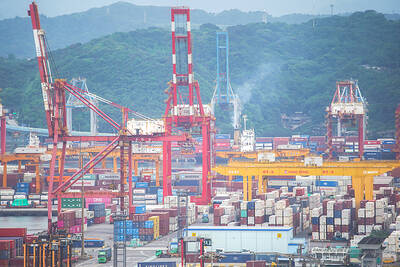
BOOM DRIVEN: The third-quarter current account surplus was the second-highest on record, well up from last year, and lagging only behind last year’s fourth quarter Taiwan’s current account surplus in the third quarter of this year reached its second-highest level on record, as exports hit new highs on the back of robust global demand for artificial intelligence (AI)-related applications, the central bank said on Friday. The surplus rose by US$22.04 billion from a year earlier to US$68.79 billion in the third quarter, second only to the US$69.69 billion recorded in the fourth quarter of last year, the bank said. The current account mainly measures a country’s transactions in goods and services, as well as primary and secondary income flows with the rest of the world. Taiwan’s merchandise trade

CHINA LEANING? The US has greenlit the sale of less-than-cutting-edge Nvidia chips to China, amidst national security and technology control concerns US Secretary of the Treasury Scott Bessent said on Friday that no more restrictions on the sale of older Nvidia Corp chips to China were needed following US President Donald Trump administration’s move earlier last week to block China’s remote access to the latest semiconductors. The ability of Chinese tech firms to access Nvidia’s technology came under scrutiny after CEO Jensen Huang (黃仁勳) stepped down amid allegations of his affair with an executive at Megaspeed International Pte Ltd, a Singapore-based company that uses advanced chips to generate computing power that Chinese firms access remotely. “The proper chip restrictions are in place,” Bessent

China’s Z.AI Co (智譜) has fallen behind schedule on its next flagship artificial intelligence (AI) model, while rival Moonshot AI Technology Co (月之暗面) expects the interval between major releases could double from six months to a year or longer if it loses access to overseas computing power, people familiar with the matter said. The previously unreported details show how efforts by US AI companies OpenAI and Anthropic PBC to prevent distillation, a technique in which developers train models using answers generated by more capable ones, have slowed Chinese AI development. Washington’s latest chip restrictions threaten further delays. The measures jeopardize a key


 RSS