


Yahoo-Kimo Inc (雅虎奇摩) announced a partnership with Mozilla Online Ltd yesterday, allowing Taiwanese users to download an exclusive browser — Firefox 3.0 Yahoo-Kimo Edition — which opens up to the Yahoo Search engine on its homepage.
The launch of the new Firefox browser service is part of Yahoo-Kimo’s efforts to introduce user-friendly services in the past two years, that included Yahoo Widget in April 2006, the Yahoo mini-pen in December and the Yahoo key in May.
“Our goal is to provide the best Yahoo-Kimo services and the best content to Firefox users so they can enjoy a high-quality Internet experience,” Rose Tsou (鄒開蓮), Yahoo Inc’s managing director for the Asia region, said at a press conference yesterday.
By following Yahoo Headquarters’ “Start Point” and “Open” initiatives, Yahoo-Kimo made the decision to add all the popular local services for Taiwanese users to the Firefox browser.
Gong Li (宮力), chairman and chief executive officer of Mozilla Online Ltd, said: “Yahoo-Kimo has taken a leading position on the island. Its local services are the most popular, so the cooperation between both sides is set to draw as much attention as possible from local users to Firefox.”
Mozilla set a Guinness world record on June 17 as the developer of open-source Firefox saw 8,002,530 people download Firefox 3 worldwide in 24 hours. To date, there have been more than 30 million downloads, company data showed.
Firefox holds 20 percent of the global browser market and 10 percent market share in Taiwan. Whether its collaboration with Yahoo-Kimo will boost the browser’s popularity, however, remains to be seen.
Lai Fei-pei (賴飛罷), chairman of Taiwan Network Information Center (台灣網路資訊中心), viewed the collaboration as a merging of resources between the two sides, but said it would take time before it was known whether users were comfortable with the new system.
“When it comes to search engines, it is a matter of personal preference. Yahoo has become the No. 1 search engine in Taiwan because it was first to market here. Yahoo-Kimo understands the Taiwanese market well,” Lai told the Taipei Times in a telephone interview yesterday.
Sources at Taipei-based market researcher Market Intelligence Center (資訊市場情報中心) echoed Lai’s views, saying that the success of this collaboration would depend heavily on the number of Taiwanese Firefox browser users and how many of them would switch over to Yahoo-Kimo.
Google ranks No. 2 in Taiwan’s search engine war. It lags behind its counterpart by between 5 percent and 10 percent, but has been closing the gap, Lai said.
Firefox 3.0 Yahoo-Kimo edition is available for download for Windows users only. The Firefox browser tabs are preset, but the links are fully customizable.
The browser/search engine is not like an iGoogle homepage. Moreover, as Yahoo-Kimo Firefox 3.0 is not portable, access to certain news sites, blogs and tools on public computers may be limited.
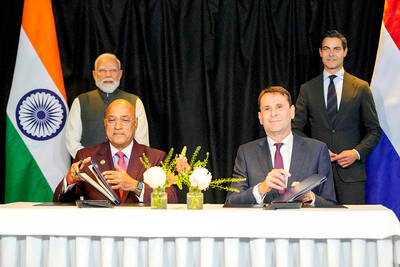
NEW MARKET: The partnership opens up India to the Dutch company, which already has a strong hold in the semiconductor market of South Korea, Taiwan and China ASML Holding NV entered into a partnership agreement with Tata Electronics Pvt Ltd aimed at ramping up India’s goal to develop domestic chip-manufacturing capabilities. The Dutch company’s technology would help power Tata Electronics’ planned 300 millimeter (mm) semiconductor foundry in Gujarat, according to a joint statement from the two companies on Saturday. The signing of a memorandum of understanding coincides with a visit by Indian Prime Minister Narendra Modi to the Netherlands, which is looking to deepen bilateral relations with New Delhi. ASML, whose top customers include Taiwan Semiconductor Manufacturing Co (台積電) and Samsung Electronics Co, makes lithography machines that can print
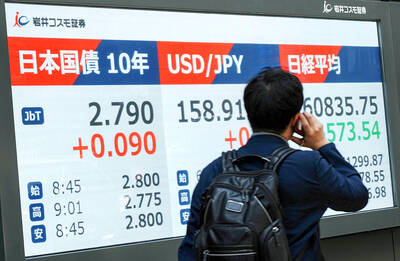
ROUGH RECORDS: Bonds in Japan, as well is in New Zealand, Australia and the US, are seeing the effects of a nervy market as stock exchanges across Asia edge down A deepening slump in Japanese government bonds added fuel to the selloff in global debt markets as rising oil prices stoked inflation fears and pushed yields to multi-decade highs. Japan’s 30-year yield yesterday surged as much as 20 basis points to the highest level since the tenor’s debut in 1999, before paring some of the move. Shorter-maturity Japanese debt was also under pressure, underscored by weak demand at a sale of five-year notes that offered a record-high coupon of 2 percent. Concerns over inflation and government spending rippling through markets including the US, Australia and New Zealand are being amplified in Japan,
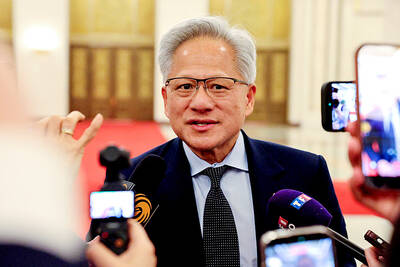
The US has cleared about 10 Chinese firms to buy Nvidia Corp’s second-most powerful artificial intelligence (AI) chip, the H200, but not a single delivery has been made so far, three people familiar with the matter said, leaving a major technology deal in limbo as chief executive officer Jensen Huang (黃仁勳) seeks a breakthrough in China this week. Huang, who was not initially listed in a White House delegation to Beijing, joined the trip after an invitation from US President Donald Trump, a source said. Trump picked him up in Alaska en route to a summit with Chinese President Xi Jinping

Wall Street is licking its chops over an unprecedented slate of massive initial public offerings (IPOs) set to arrive in the coming months, beginning with Elon Musk’s Space Exploration Technologies Corp (SpaceX) next month. That is expected to be followed by artificial intelligence (AI) rivals OpenAI and Anthropic PBC. The trio of mega listings, each eyeing valuations around US$1 trillion or more, constitutes a heady period of elevated risk and reward. SpaceX is targeting an IPO that would raise up to US$80 billion — about double the funds generated from all IPOs last year. OpenAI and Anthropic are eyeing IPOs raising US$60 billion. “We’re


 RSS
RSS