


Vietnamese consumer prices rose 26.8 percent this month compared with the same month last year, driven mainly by sharply higher food prices, government statistics showed yesterday.
Prices rose an estimated 2.1 percent between last month and this month, a slowdown from a 3.9 percent rise a month earlier, the General Statistics Office (GSO) said in an early estimate.
Vietnam, which experienced 8.5 percent economic growth last year, has been hit by double-digit inflation since November — a spike that has caused public anger and triggered a series of labor disputes.
Inflation for the first six months of the year has reached 18.4 percent, the GSO said.
The Vietnamese government has made fighting inflation its top priority and has cut its economic growth target this year to 7 percent.
Authorities have also raised interest rates, while reducing public investment and introducing temporary price caps on some goods, in a bid to bring the galloping inflation under control.
The GSO also said Vietnam’s trade deficit has more than tripled to an estimated US$14.8 billion for the first half of this year.
The Ministry of Planning and Investment earlier this month had estimated the trade deficit for the first half at US$16.9 billion, state media reported.
Meanwhile, an official said yesterday that Vietnam could fail to realize its target of attracting 5 million foreign visitors this year because of high inflation.
Vietnam has so far attracted 2.29 million foreign visitors this year, up 8.1 percent year-on-year, said Vu The Binh, director of the Vietnam National Administration’s Travel Department.
“The growth in the first half of this year is much lower than in the same period last year, which saw growth of 18 percent,” Binh said. “The slowdown in the number of foreign visitors can be pinned to several factors, including high inflation.”
Binh said the cost of hotel rooms grew significantly late last year and early this year, adding that prices are now cooling somewhat as the number of foreign visitors is not growing as expected.
The cost of hotel rooms in central Vietnam in the first three months of this year grew between 5 percent and 15 percent from the same period last year, local newspaper Tuoi Tre said.
The cost of three to five-star hotel rooms in Hanoi rose 68 percent, while in Ho Chi Minh City prices have increased by up to 40 percent annually over recent years.
“In this context of inflation, Vietnam may not be able to attract 5 million foreign visitors as targeted,” Binh said.
Last year, Vietnam attracted 4.2 million foreign tourists. Most came from China, Japan and South Korea.

Apple Inc increased iPhone production in India by about 53 percent last year and now makes a quarter of its marquee devices there, reflecting the US company’s efforts to avoid tariffs on China. The company assembled about 55 million iPhones in India last year, up from 36 million a year earlier, people familiar with the matter said, asking not to be named because the numbers aren’t public. Apple makes about 220 million to 230 million iPhones a year globally, with India’s share of the total increasing rapidly. Apple has accelerated its expansion in the world’s most populous country in recent years, bolstered

HEADWINDS: The company said it expects its computer business, as well as consumer electronics and communications segments to see revenue declines due to seasonality Pegatron Corp (和碩) yesterday said it aims to grow its artificial intelligence (AI) server revenue more than 10-fold this year from last year, driven by orders from neocloud solutions clients and large cloud service providers. The electronics manufacturing service provider said AI server revenue growth would be driven primarily by the Nvidia Corp GB300 server platform. Server shipments are expected to increase each quarter this year, with the second half likely to outperform the first half, it said. The AI server market is expected to broaden this year as more inference applications emerge, which would drive demand for system-on-chip, application-specific integrated circuits
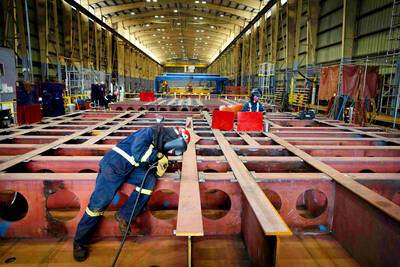
At a massive shipyard in North Vancouver, Canadian workers grind metal beams for a powerful new icebreaker crucial to cementing the country’s presence in the increasingly contested arctic. Icebreakers are specialized, expensive vessels able to navigate in the frozen far north. And “this is the crown jewel,” said Eddie Schehr, vice president of production at the Seaspan shipyard. For Canadian Prime Minister Mark Carney, who heads to Norway next Friday to observe arctic defense drills involving troops from 14 NATO states, Canada’s extreme north has emerged as a strategic priority. “Canada is and forever will be an Arctic nation,” he said ahead of

Chinese entrepreneur Frank Gao used to spend long hours running his social media accounts but now outsources the chore to artificial intelligence (AI) agent tool OpenClaw, which is taking China by storm despite official warnings over cybersecurity. OpenClaw, created in November by an Austrian coder, differs from bots such as ChatGPT because it can execute real-life tasks such as sending e-mails, organizing files or even booking flight tickets. “Since January, I’ve spent hours on the lobster every day,” Gao said in an interview, referring to OpenClaw’s red crustacean mascot. “We’re family.” After downloading OpenClaw, users connect it to artificial intelligence models of their


 RSS
RSS