

■ ENERGY
TNK-BP sees end to dispute
The head of British-Russian oil giant TNK-BP yesterday said a dispute within the company seen as a test of Russia’s investment climate would be resolved soon. “I am sure the dispute will be resolved within days,” Robert Dudley was quoted by Russian news agencies as saying on the sidelines of an economic forum in Saint Petersburg. TNK-BP is Russia’s third-largest oil producer and is jointly held by British oil major BP and three Russian billionaires, who have called for Dudley to step down, accusing him of working solely in BP’s interests. Dudley was also summoned this week by Russian authorities in a tax investigation.
■AUTOMOBILES
Toyota plans more hybrids
Toyota Motor Corp plans to produce hybrid cars in Australia and Thailand as demand for fuel-efficient vehicles surges along with oil prices, Japan’s top business daily said yesterday. Toyota, the world’s second-biggest automaker by annual vehicle sales, will roll out the hybrid version of the popular Camry sedan in Thailand at the end of next year and in Australia as early as 2010, the Nihon Keizai newspaper said. Officials at Toyota could not be reached for comment. Toyota is hoping to sell 1 million hybrids a year sometime after 2010.
■FINANCE
Credit card borrowing slows
Americans relied a lot less on their credit cards in April with debt in that area rising at the slowest pace in nearly three years. The Federal Reserve said on Friday that consumer borrowing increased at an annual rate of 4.2 percent in April, slower than the 6.2 percent increase of March. The slowdown reflected the fact that borrowing in the category that includes credit cards rose at an annual rate of just 0.4 percent, the weakest performance since borrowing in this area actually declined at a 1.8 percent rate in May 2005.
■AUTOMOBILES
Firms take state to court
General Motors Corp and other automakers said California was trying to enforce carbon-reduction rules not yet approved by the Environmental Protection Agency and asked a judge for an order blocking the regulations. Without an injunction, automakers will have to spend billions of dollars by the end of this year, said the filing to the federal court in Fresno, California. The companies are seeking a court order that would prevent California from requiring companies to take any steps toward compliance before 2017. In December the EPA blocked California’s efforts to require cuts in greenhouse gas exhaust starting with next year’s models, saying a nationwide regulation was needed. It was the first time the EPA rejected a California pollution program.
■AGRICULTURE
Farmers to end strike
Argentine farm leaders said they would end their latest strike against a new export tax plan tomorrow in order to enter talks with the government and calm fears of food shortages. Argentina’s four biggest farming groups said on Friday that they were willing to enter talks aimed at ending the dispute, which started when the taxes were introduced on March 11. Farmers will remain “on alert” along roadsides as talks begin, said an e-mailed statement drafted after an eight-hour meeting in Buenos Aires. Blockades by truck drivers, who are protesting the farmers’ actions, have raised the threat of food shortages in the South American country for the second time since March.

Taiwan Semiconductor Manufacturing Co (TSMC, 台積電) yesterday dismissed concerns about a deeper correction of the artificial intelligence (AI) market, saying that soaring global demand AI applications continues to outstrip its supply of advanced chips. The world’s largest contract chipmaker said in a statement that it continues to observe challenges facing the consumer and price-sensitive end-market segments posed by rising component prices and economic uncertainties, TSMC chairman and chief executive officer C.C. Wei’s (魏哲家) remarks during an earnings conference on Oct. 15. “Global demand for AI continues to grow, with its long-term outlook remaining upbeat,” TSMC said in the statement. “Demand
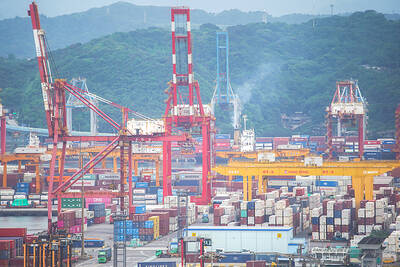
BOOM DRIVEN: The third-quarter current account surplus was the second-highest on record, well up from last year, and lagging only behind last year’s fourth quarter Taiwan’s current account surplus in the third quarter of this year reached its second-highest level on record, as exports hit new highs on the back of robust global demand for artificial intelligence (AI)-related applications, the central bank said on Friday. The surplus rose by US$22.04 billion from a year earlier to US$68.79 billion in the third quarter, second only to the US$69.69 billion recorded in the fourth quarter of last year, the bank said. The current account mainly measures a country’s transactions in goods and services, as well as primary and secondary income flows with the rest of the world. Taiwan’s merchandise trade

CHINA LEANING? The US has greenlit the sale of less-than-cutting-edge Nvidia chips to China, amidst national security and technology control concerns US Secretary of the Treasury Scott Bessent said on Friday that no more restrictions on the sale of older Nvidia Corp chips to China were needed following US President Donald Trump administration’s move earlier last week to block China’s remote access to the latest semiconductors. The ability of Chinese tech firms to access Nvidia’s technology came under scrutiny after CEO Jensen Huang (黃仁勳) stepped down amid allegations of his affair with an executive at Megaspeed International Pte Ltd, a Singapore-based company that uses advanced chips to generate computing power that Chinese firms access remotely. “The proper chip restrictions are in place,” Bessent

China’s Z.AI Co (智譜) has fallen behind schedule on its next flagship artificial intelligence (AI) model, while rival Moonshot AI Technology Co (月之暗面) expects the interval between major releases could double from six months to a year or longer if it loses access to overseas computing power, people familiar with the matter said. The previously unreported details show how efforts by US AI companies OpenAI and Anthropic PBC to prevent distillation, a technique in which developers train models using answers generated by more capable ones, have slowed Chinese AI development. Washington’s latest chip restrictions threaten further delays. The measures jeopardize a key


 RSS