


Visiting French Prime Minister Francois Fillon insisted on Friday that the French and European economies are sound, but that the US economic slowdown would affect Europe’s growth.
“Our fundamentals are globally sound in the euro zone,” Fillon said on the second day of a US trip.
“But the slowing down of growth in the United States, the overvaluation of the euro and the rising energy and food prices will weigh on European growth,” Fillon said.
“It is obvious that when the American economy is not going well, all of the world economy feels it, particularly the European economy,” said Fillon, whose country takes over the EU’s rotating presidency for six months on July 1.
He stressed the need to stop the turmoil in the financial markets.
“It is absolutely essential to bring an end to the current financial turbulence,” he said, in reference to the US subprime mortgage crisis that has sent waves across the globe.
The French minister called for implementing measures recommended by the G7 industrial economies — which include France — and the International Monetary Fund at their meetings early last month.
The G7 called on financial institutions around the world to account for the extent of their exposure to subprime securities within 100 days.
Fillon also expressed concern over the possible effects of the US problems on trade, pointing out that US-European trade constituted 40 percent of the world’s total and supported 14 million jobs.
“It is a worrisome situation,” he said. “The American crisis has repercussions on growth in the euro zone.”
EURO VS DOLLAR
On the euro’s sharp climb against the plummeting dollar, the French leader said that the euro zone “cannot support by itself the adjustment of all currencies.”
“The strong volatility of currencies represents a danger for Europe, for the United States, for the global economy,” he said.
Fillon arrived in Washington this week to meet US Treasury Secretary Henry Paulson and Federal Reserve chairman Ben Bernanke to discuss the credit crunch sparked by the US subprime crisis and the dollar-euro exchange rate.
A US Treasury official said after the meeting that Paulson “reaffirmed our support for the FSF [the G7’s financial stability forum] Report and international cooperation to tackle financial turmoil.”
They discussed moves to push banks to disclose losses and to raise capital, and also the importance of helping poor countries deal with higher food costs, the official said.
SLOW RECOVERY
In related news, International Monetary Fund chief Dominique Strauss-Kahn said on Friday that he did not see the US economy recovering from its doldrums this year.
Describing a US labor report on Friday that showed fewer than expected job losses as a “flash in the pan,” the IMF managing director said “the medium-term trend remains what has been forecast and the US economy would not be on the road to recovery before the end of the year.”
The IMF has forecast a “mild recession” in the US, with annual growth a paltry 0.5 percent.
Strauss-Kahn, speaking to reporters after meeting with Fillon at IMF headquarters, cautioned that “one must wait to see the next US data.”

NEW MARKET: The partnership opens up India to the Dutch company, which already has a strong hold in the semiconductor market of South Korea, Taiwan and China ASML Holding NV entered into a partnership agreement with Tata Electronics Pvt Ltd aimed at ramping up India’s goal to develop domestic chip-manufacturing capabilities. The Dutch company’s technology would help power Tata Electronics’ planned 300 millimeter (mm) semiconductor foundry in Gujarat, according to a joint statement from the two companies on Saturday. The signing of a memorandum of understanding coincides with a visit by Indian Prime Minister Narendra Modi to the Netherlands, which is looking to deepen bilateral relations with New Delhi. ASML, whose top customers include Taiwan Semiconductor Manufacturing Co (台積電) and Samsung Electronics Co, makes lithography machines that can print
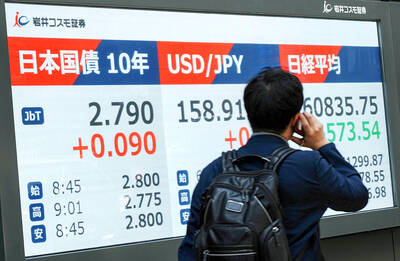
ROUGH RECORDS: Bonds in Japan, as well is in New Zealand, Australia and the US, are seeing the effects of a nervy market as stock exchanges across Asia edge down A deepening slump in Japanese government bonds added fuel to the selloff in global debt markets as rising oil prices stoked inflation fears and pushed yields to multi-decade highs. Japan’s 30-year yield yesterday surged as much as 20 basis points to the highest level since the tenor’s debut in 1999, before paring some of the move. Shorter-maturity Japanese debt was also under pressure, underscored by weak demand at a sale of five-year notes that offered a record-high coupon of 2 percent. Concerns over inflation and government spending rippling through markets including the US, Australia and New Zealand are being amplified in Japan,

Tokyo Electron's Taiwan unit today said in a written response that it respects the judicial process, takes the court ruling seriously and would not appeal in the Taiwan Semiconductor Manufacturing Co (TSMC, 台積電) trade secrets case. Last month, a court fined the Taiwan unit of Japan's Tokyo Electron NT$150 million (US$4.74 million) in a case involving trade secrets related to TSMC's sensitive chip technology.
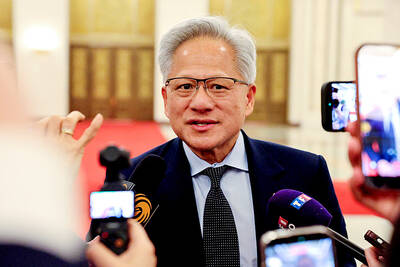
The US has cleared about 10 Chinese firms to buy Nvidia Corp’s second-most powerful artificial intelligence (AI) chip, the H200, but not a single delivery has been made so far, three people familiar with the matter said, leaving a major technology deal in limbo as chief executive officer Jensen Huang (黃仁勳) seeks a breakthrough in China this week. Huang, who was not initially listed in a White House delegation to Beijing, joined the trip after an invitation from US President Donald Trump, a source said. Trump picked him up in Alaska en route to a summit with Chinese President Xi Jinping


 RSS
RSS