


US video game industry sales rocketed to a record high of US$17.9 billion last year, with Nintendo reigning as champion of the console battle with Microsoft and Sony, research group NPD said.
US sales of video game consoles, software and accessories rose "an astounding" 43 percent, with each category reaching a new "personal best," NPD said.
Nintendo DS handheld game devices and Wii consoles were the top hardware sellers, ranking first and second respectively. The Japanese company's gadgets accounted for 52 percent of the video game devices sold in the US.
"Nintendo has certainly been the belle of the hardware ball," NPD analyst Anita Frazier said on Friday. "The DS has driven portable gaming to a new level, and for the second year in a row, the DS has been the top-selling hardware platform."
Nearly 8.5 million Nintendo DS devices were sold in the US last year, while buyers snatched up approximately 6.3 million Wii game consoles.
"By the end of 2007 we were sold out of virtually all hardware, and much of our stock of software and accessories was sold out as well," said Cammie Dunaway, the executive vice president of marketing at Nintendo of America. "And that momentum continues here in the early weeks of 2008."
Sony sold 3.97 million PS2 consoles and 2.56 million of its newer PS3 consoles in the US last year, NPD reported.
Microsoft last year sold 4.62 million Xbox 360 consoles, which debuted in the market in November of 2005, a year before Wii and PS3 were released.
Video game hardware sales were boosted by the fact that it was the first full year that the Wii and PS3 consoles were on the market.
Daunting prices on PS3 consoles and the speed with which Wii models vanished from store shelves made Sony's previous-generation PlayStation 2 a "fall-back" for buyers, according to NPD.
Sony trimmed PS3 prices last year in the face of floundering sales blamed on its high cost and a dearth of coveted games for the consoles.
"Both the PS3 and the Xbox 360 realized strong month-over-month hardware sales increases," Frazier said.
Frazier predicts that the video game industry will continue to flourish in the US this year, but not at the stellar rate of growth seen last year.
"I expect to see 2008 increase over 2007, with more growth, proportionately, coming from software sales," Frazier said. "While we will continue to see strong hardware sales, particularly if prices come down again, the spotlight now turns from hardware to software."
Xbox 360 sales surged with help from the releases of highly coveted games such as Halo 3, which is tailored exclusively for Microsoft's consoles.
Analysts maintain that the availability of fun, well-crafted gaming software is a key factor influencing console purchases.
"The 360 in particular seems to have benefited from a killer slate of hardware-acquisition-driving content including Call of Duty 4, Assassin's Creed and Halo 3," Frazier said.
Approximately US$8.64 billion was spent in the US on game software for consoles and portable devices, NPD said.
Halo 3 was the top video game title, with 4.8 million copies sold.
But Nintendo's Mario Brothers holds the throne as top-selling franchise of all time.
"Mario was the second-best selling video games property for the year and remains the historically best-selling property in the video games industry," Frazier said.

SECOND-RATE: Models distilled from US products do not perform the same as the original and undo measures that ensure the systems are neutral, the US’ cable said The US Department of State has ordered a global push to bring attention to what it said are widespread efforts by Chinese companies, including artificial intelligence (AI) start-up DeepSeek (深度求索), to steal intellectual property from US AI labs, according to a diplomatic cable. The cable, dated Friday and sent to diplomatic and consular posts around the world, instructs diplomatic staff to speak to their foreign counterparts about “concerns over adversaries’ extraction and distillation of US AI models.” Distillation is the process of training smaller AI models using output from larger, more expensive ones to lower the costs of training a powerful new

Shares of Taiwan Semiconductor Manufacturing Co (TSMC, 台積電) have repeatedly hit new highs, but an equity analyst said the stock’s valuation remains within a reasonable range and any pullback would likely be technical. The contract chipmaker’s historical price-to-earnings (P/E) ratio has ranged between 20 and 30, Cathay Futures Consultant Co (國泰證期) analyst Tsai Ming-han (蔡明翰) told Central News Agency. With market consensus projecting that TSMC would post earnings per share of about NT$100 (US$3.17) this year, supported by strong global demand for artificial intelligence (AI) applications, and the stock currently trading at a P/E ratio of below 25, Tsai said the valuation
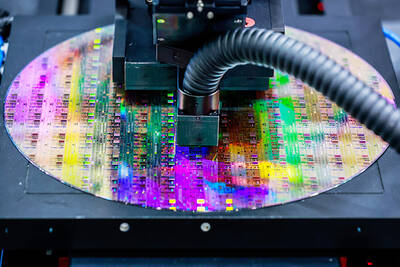
The artificial intelligence (AI) boom has triggered a seismic reshuffling of global equity markets, with Taiwan and South Korea muscling past European nations one by one. With its stock market now valued at nearly US$4.3 trillion, Taiwan surpassed the UK, Europe’s biggest market, earlier this month, data compiled by Bloomberg showed. South Korea is about US$140 billion away from doing the same. The tech-heavy Asian markets have shot past Germany and France in the past seven months. The shift is largely down to massive gains in shares of three companies that provide essential hardware for AI: Taiwan Semiconductor Manufacturing Co (TSMC, 台積電),

The US Department of Commerce last week ordered multiple chip equipment companies to halt shipments of certain tools to China’s second-largest chipmaker, Hua Hong Semiconductor Ltd (華虹半導體), its latest action to slow the country’s development of advanced chips, two people familiar with the matter said. The department sent letters to at least a handful of companies informing them of restrictions on tools and other materials destined for two Hua Hong facilities US officials believe make China’s most sophisticated chips, the people said. Top US chip equipment companies Lam Research Corp, Applied Materials Inc and KLA Corp, each of which has significant


 RSS
RSS