

The number of Chinese tourists visiting Taiwan last year decreased by 18 percent due to tensions in cross-strait relations and sluggish market liberalization progress, according to the Travel Agent Association of Taiwan (TAA), the organization that negotiates with Chinese authorities and manages visa applications for tourist groups.
TAA secretary general Roget Hsu (
According to the TAA's preliminary statistics, about 81,000 Chinese residents visited Taiwan via a foreign city (excluding Hong Kong and Macau) last year, a decrease of about 18 percent from a year ago.
Although the overwhelming victory of the Chinese Nationalist Party (KMT) in the parliament election spurred stocks in the tourism category to surge almost 7 percent yesterday, travel agents said the sector is unlikely to see a sudden boost in the number of Chinese tourists in the short run.
"Whether the policy [for opening the tourism market] will experience significant change depends on who will be our new president," Hsu said.
The recent referendum initiatives have also seriously riled China, taking a toll on cross-strait tourism development, another tourism group said.
"Our 10 meetings with mainland authorities have already settled all technical problems. Now the only obstacle is purely political," said Eric Chang (
The current policy of demanding a transit point for Chinese tourists instead of direct flights is resulting in multiple fees and poor quality in local services.
"We received lots of complaints from mainland tourists who visited Taiwan during 2005 and 2006. Those who have not yet come wanted to wait until direct flights and consumer protection measures are in place but these policy implementations will have to wait until official negotiations are completed," Chang said.
According to Hsu, the nation's Tourism Bureau set an US$80 per night bottom line for Chinese tourist fees to ensure quality, but after tourists handed in their fees to travel agents in Shenzhen or Hong Kong, the money was split between operators in the transit city and the Taiwanese agents.
"In the end Taiwanese agents only get US$40 per person per night, which is unprofitable," Hsu said. "But when agents cover their costs by taking tourists to shopping areas and using cheap hotels and shuttle buses, the quality of service suffers."
Hsu said the reputation of services for Chinese tourists in Taiwan needs to be restored by a slew of improvements.
Taiwan now caps the number of Chinese tourists at 1,000 per day. According a Tourism Bureau estimate, opening the market to Chinese tourists will create a maximum of NT$60 billion (US$1.86 billion) in business per year for the local economy.

Taiwan Semiconductor Manufacturing Co (TSMC, 台積電) is accelerating capacity expansion fivefold this year, but it is still unable to keep up with the booming demand for artificial intelligence (AI), TSMC deputy cochief operating officer Cliff Hou (侯永清) said yesterday. This year alone, the company is building 25 chip manufacturing fabs and advanced packaging facilities worldwide, including 13 plants in Taiwan, which is unprecedented, Hou said at a CEO Summit fireside chat at Semicon Taiwan in Taipei. In the past, the company was able to build five or six factories a year, said Hou, who is also chairman of the Taiwan Semiconductor Industry
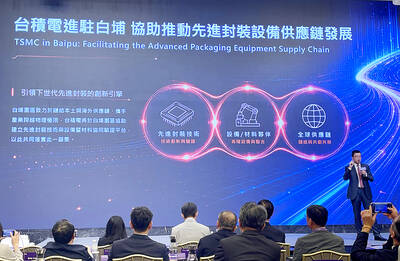
EXPANSION: The 3-hectare site would include small clean rooms and laboratories as well as a world-class training base for advanced packaging talent, the company said Taiwan Semiconductor Manufacturing Co (TSMC, 台積電) is to establish a presence in the Baipu Industrial Park (白埔產業園區) in Kaohsiung to accelerate the testing and validation of semiconductor materials and equipment, a company executive said on Tuesday. The company is working with the Ministry of Economic Affairs and the Kaohsiung City Government on the plan, which is expected to improve validation efficiency by 25 to 50 percent, TSMC vice president of advanced packaging technology and service Jun He (何軍) said at a 3D IC global summit held ahead of the Semicon Taiwan trade show, which opened in Taipei yesterday. TSMC would also conduct
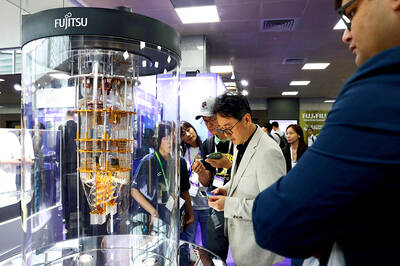
Visitors look at a 64-qubit superconducting quantum computer on display at the Fujitsu booth at the Semicon Taiwan trade show in Taipei yesterday.

Silicon photonics would play a dominant role next year and make chip-level co-packaged optics (CPO) packaging possible, Taiwan Semiconductor Manufacturing Co (TSMC, 台積電) said yesterday. “For years, critics questioned the reliability of CPO. The doubts are being thoroughly dismantled by real-world data and market validation,” TSMC vice president of advanced packaging technology development K.C. Hsu (徐國晉) said at a SEMI forum in Taipei. The company is on track to enter production of CPO later this year, Hsu said in another forum arranged by Imec in Taipei yesterday, about four months after TSMC announced its progress in CPO development in May.


 RSS
RSS