


Stocks were sold off on Friday after a jump in inflation raised concerns about how much freedom the Federal Reserve has to continue cutting interest rates. The Dow Jones Industrial Average lost more than 178 points.
The Labor Department said the consumer price index rose 0.8 percent last month amid a spike in gasoline prices. The report also found large increases in the cost of clothing, airline tickets and prescription drugs.
The report raises questions about the Fed's options for priming the economy. The Fed this week lowered interest rates and announced a plan to align with other key central banks and offer loans to pressed lenders around the world. But while it wants to stimulate the US economy and make lending easier among banks wary of faltering debt, the Fed also has to keep a watchful eye on inflation.
Robert Dye, senior economist at PNC Financial Services Group, said the economic readings this week painted a mixed picture for investors, spurring some of the market's volatility.
"If you take the stronger-than-expected economic data we saw this week in the form of retail sales and add to that the inflation data and then combine that with a somewhat ambiguous statement from the Fed, you get a picture as clear as mud," he said.
The uncertainty weighed on the markets on Friday, a day after stocks finished mixed. The Dow Jones industrial average fell 178.11, or 1.32 percent, to 13,339.85.
Broader stock indicators also fell. The Standard & Poor's 500 index dropped 20.46, or 1.37 percent, to 1,467.95, and the NASDAQ composite index fell 32.75, or 1.23 percent, to 2,635.74.
Bond prices fell for the third straight day. The yield on the benchmark 10-year Treasury note, which moves opposite its price, rose to 4.23 percent from 4.21 percent late on Thursday.
Friday's report on inflation follows a reading on Thursday that showed the biggest jump in inflation at the wholesale level in 34 years.
The 0.8 percent increase in consumer prices topped the 0.6 percent rise economists had been expecting. The report also showed so-called core inflation, which excludes often-volatile food and energy prices, had its biggest increase in 10 months, rising 0.3 percent.
Dye said the Fed could be proven wise for cutting interest rates by just a quarter of a percentage point on Tuesday rather than by a half point as some investors had hoped. Stocks fell sharply on Tuesday after the Fed's rate decision and staged a partial rebound on Wednesday after the Fed announced its liquidity plan with other central banks.
The uptick in core inflation is unnerving, Dye said, because it makes it harder for the Fed to justify further rate cuts.
Also on Friday, the Federal Reserve said industrial production rebounded last month, increasing 0.3 percent after a steep 0.7 percent decline in October.
But beyond economic reports, investors faced more news from the troubled banking sector.
Citigroup Inc fell 31 cents to US$30.70 after the bank announced late on Thursday it plans to move assets from seven "structured investment vehicles" onto its books and put up US$49 billion to help the SIVs repay their debts.
The bank had said earlier it had no plans to bring the SIVs onto its books. Citigroup's Vikram Pandit, who on Tuesday became chief executive, said taking control of the SIVs was the best way to guard their credit ratings and help them sell their investments at decent prices.
SIVs are complex investments set up by banks and sold to investors and have come under pressure in recent months because of their investment strategy, which involves the use of mortgage investments and other now-risky debt. The resulting drop in demand hurt the value of the SIVs.
Declining issues outnumbered advancers by more than two to one on the New York Stock Exchange, where volume came to 1.12 billion shares.
The Russell 2000 index of smaller companies fell 15.53, or 2.02 percent, to 753.93.

SECOND-RATE: Models distilled from US products do not perform the same as the original and undo measures that ensure the systems are neutral, the US’ cable said The US Department of State has ordered a global push to bring attention to what it said are widespread efforts by Chinese companies, including artificial intelligence (AI) start-up DeepSeek (深度求索), to steal intellectual property from US AI labs, according to a diplomatic cable. The cable, dated Friday and sent to diplomatic and consular posts around the world, instructs diplomatic staff to speak to their foreign counterparts about “concerns over adversaries’ extraction and distillation of US AI models.” Distillation is the process of training smaller AI models using output from larger, more expensive ones to lower the costs of training a powerful new

Shares of Taiwan Semiconductor Manufacturing Co (TSMC, 台積電) have repeatedly hit new highs, but an equity analyst said the stock’s valuation remains within a reasonable range and any pullback would likely be technical. The contract chipmaker’s historical price-to-earnings (P/E) ratio has ranged between 20 and 30, Cathay Futures Consultant Co (國泰證期) analyst Tsai Ming-han (蔡明翰) told Central News Agency. With market consensus projecting that TSMC would post earnings per share of about NT$100 (US$3.17) this year, supported by strong global demand for artificial intelligence (AI) applications, and the stock currently trading at a P/E ratio of below 25, Tsai said the valuation
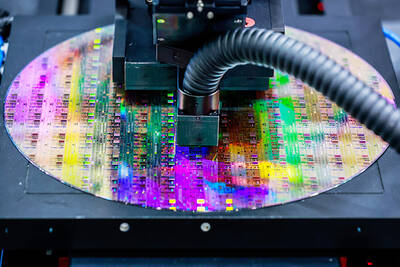
The artificial intelligence (AI) boom has triggered a seismic reshuffling of global equity markets, with Taiwan and South Korea muscling past European nations one by one. With its stock market now valued at nearly US$4.3 trillion, Taiwan surpassed the UK, Europe’s biggest market, earlier this month, data compiled by Bloomberg showed. South Korea is about US$140 billion away from doing the same. The tech-heavy Asian markets have shot past Germany and France in the past seven months. The shift is largely down to massive gains in shares of three companies that provide essential hardware for AI: Taiwan Semiconductor Manufacturing Co (TSMC, 台積電),

The US Department of Commerce last week ordered multiple chip equipment companies to halt shipments of certain tools to China’s second-largest chipmaker, Hua Hong Semiconductor Ltd (華虹半導體), its latest action to slow the country’s development of advanced chips, two people familiar with the matter said. The department sent letters to at least a handful of companies informing them of restrictions on tools and other materials destined for two Hua Hong facilities US officials believe make China’s most sophisticated chips, the people said. Top US chip equipment companies Lam Research Corp, Applied Materials Inc and KLA Corp, each of which has significant


 RSS
RSS