


The dollar firmed on Friday amid renewed optimism about the outlook for the US economy as prospects for a cut in interest rates appeared to rise.
The euro was quoted at US$1.4632 at 2200 GMT after 1.4742 late on Thursday in New York.
The week's gains in equity prices helped boost the greenback, as did the publication of an index measuring manufacturing activity in the Chicago area.
The index last month rose to 52.9 points from 49.7 in October, with analysts having expected a reading of 50.5.
The index offset a lackluster report on US personal income and spending which showed both rising 0.2 percent in October, below most forecasts.
The markets focused on prospects for a cut in US rates after Federal Reserve chairman Ben Bernanke said Americans are facing "headwinds" that could hurt the economy.
Yet many traders viewed the comments as hinting at a cut in rates that would keep the world's biggest economy growing.
"Lower rates would typically make dollar denominated assets less attractive, reducing demand for the currency and until recently this was one of the main ingredients of the weaker dollar," said Patricia Lifson at PNC Bank.
"But instead, investors are looking at the possibility of a rate cut positively. The perception is that a rate cut could help achieve a soft landing for the US economy, which has been strickened by credit market problems and a severe downturn in the housing sector," she said.
"This would then give the markets a base from which to build and move forward in the New Year," Lifson said.
Also helping sentiment were reports that US Treasury Secretary Henry Paulson was making progress on a plan with major banks to help homeowners renegotiate adjustable rate mortgages and blunt the impact of the subprime housing mess, Lifson said.
David Rodriguez at Forex Capital Markets said some of the dollar's strength came from multinational companies buying greenbacks to square positions for the end of the month or fiscal year.
The price action "suggests that renewed euro and British Pound selling pressures are merely a function of month-end and year-end position squaring -- hardly an endorsement for further greenback gains," he said.
In late New York trade, the dollar stood at 1.1318 Swiss francs from 1.1179. The pound was at US$2.0565 from US$2.0610.
The dollar rose against the yen in Asia trading at ¥110.30 midafternoon, up from ¥109.84 late on Thursday in New York.
In the Asian session, buying by Japanese importers and financial institutions moving cash into foreign bonds also helped the US currency rally.
Still, Tokyo traders remain on guard against renewed falls in the greenback. They say lingering concerns over the fallout from the subprime mortgage meltdown and uncertainties about the US economy's health could halt the dollar's advance.
The dollar was mixed against other regional currencies. It rose to HK$7.7888 from HK$7.7870 the previous day, and to 39.675 Indian rupees from 39.63. It fell to S$1.4470 from S$1.4486, and to NT$32.259 from NT$32.298.

Apple Inc increased iPhone production in India by about 53 percent last year and now makes a quarter of its marquee devices there, reflecting the US company’s efforts to avoid tariffs on China. The company assembled about 55 million iPhones in India last year, up from 36 million a year earlier, people familiar with the matter said, asking not to be named because the numbers aren’t public. Apple makes about 220 million to 230 million iPhones a year globally, with India’s share of the total increasing rapidly. Apple has accelerated its expansion in the world’s most populous country in recent years, bolstered
HEADWINDS: The company said it expects its computer business, as well as consumer electronics and communications segments to see revenue declines due to seasonality Pegatron Corp (和碩) yesterday said it aims to grow its artificial intelligence (AI) server revenue more than 10-fold this year from last year, driven by orders from neocloud solutions clients and large cloud service providers. The electronics manufacturing service provider said AI server revenue growth would be driven primarily by the Nvidia Corp GB300 server platform. Server shipments are expected to increase each quarter this year, with the second half likely to outperform the first half, it said. The AI server market is expected to broaden this year as more inference applications emerge, which would drive demand for system-on-chip, application-specific integrated circuits
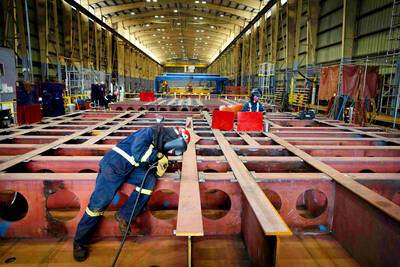
At a massive shipyard in North Vancouver, Canadian workers grind metal beams for a powerful new icebreaker crucial to cementing the country’s presence in the increasingly contested arctic. Icebreakers are specialized, expensive vessels able to navigate in the frozen far north. And “this is the crown jewel,” said Eddie Schehr, vice president of production at the Seaspan shipyard. For Canadian Prime Minister Mark Carney, who heads to Norway next Friday to observe arctic defense drills involving troops from 14 NATO states, Canada’s extreme north has emerged as a strategic priority. “Canada is and forever will be an Arctic nation,” he said ahead of

Chinese entrepreneur Frank Gao used to spend long hours running his social media accounts but now outsources the chore to artificial intelligence (AI) agent tool OpenClaw, which is taking China by storm despite official warnings over cybersecurity. OpenClaw, created in November by an Austrian coder, differs from bots such as ChatGPT because it can execute real-life tasks such as sending e-mails, organizing files or even booking flight tickets. “Since January, I’ve spent hours on the lobster every day,” Gao said in an interview, referring to OpenClaw’s red crustacean mascot. “We’re family.” After downloading OpenClaw, users connect it to artificial intelligence models of their


 RSS
RSS