


Citigroup Inc's Charles Prince will offer to quit as chief executive officer of the biggest US bank, the Wall Street Journal reported on Friday, a move that may foreshadow other top-level departures at the world's largest financial companies.
"This might become a weekly occurrence -- getting rid of a Wall Street CEO," said James Ellman, who manages about US$200 million as president of Seacliff Capital in San Francisco.
The board was to hold an emergency meeting this weekend, the newspaper said, citing unidentified people familiar with the situation.
Michael Hanretta, a spokesman for New York-based Citigroup, declined to comment when contacted by Bloomberg News.
Citigroup, the biggest US bank, reported US$6.5 billion in writedowns and losses in the third quarter, casting doubt on the length of Prince's tenure. The CEO's departure would be the second in a week among the world's biggest financial institutions. Merrill Lynch & Co ousted Stan O'Neal after his New York-based firm disclosed US$8.4 billion of writedowns.
"The board may have simply reached the point where they can't take the pressure from stockholders and they have to remove him," Punk Ziegel & Co analyst Richard Bove said in an interview on Friday. "They have to have some issue which is huge, pregnant and wasn't previously considered to justify removing him. The only issue that they could utilize is that there's a big writedown."
The Securities and Exchange Commission (SEC) is looking into how Citigroup accounted for certain transactions in a banking-industry rescue plan, the Journal reported, citing people familiar with the matter. Specifically, it's reviewing whether the company properly accounted for US$80 billion in structured investment vehicles (SIVs), the newspaper said, citing one of those people.
The result of the review, still in early stages, could include no action or a referral to the SEC's enforcement division, the Journal said.
The company's SIV accounting is "in thorough accordance with all applicable rules and regulations," bank spokeswoman Christina Pretto told the newspaper.
Robert Rubin, the former US Treasury Secretary and chairman of Citigroup's executive committee, may be asked to serve temporarily as CEO, Dow Jones reported. Rubin is "reluctant" to take the job, the news service said.
Other possible replacement candidates, the Journal said, include Richard Parsons, a Citigroup board member who is expected to step down as CEO of Time Warner Inc later this year, and NYSE Euronext CEO John Thain.
On Thursday, Citigroup said third-quarter profit fell about 60 percent because of "weak" credit markets and losses on leveraged loans and mortgage-backed securities. The bank said it would write down US$1.4 billion before taxes on leverage finance commitments, and that it had lost US$1.3 billion on subprime assets and about US$600 million in fixed-income trading.
Citigroup's board was also expected to discuss this weekend whether the company should update the amount of writedowns to reflect the decreasing value of certain securities, the Journal said.
Prince would join a growing list of investment bank executives who have lost their jobs because of losses in the fixed-income markets. UBS AG, the biggest Swiss bank, dismissed CEO Peter Wuffli in July and said earlier this month that finance chief Clive Standish and investment-banking head Huw Jenkins were stepping down. Others ousted include Bear Stearns Co-President Warren Spector and Citigroup Inc trading head Thomas Maheras.
Other chief executives who have come under fire include Bear Stearns Cos' James "Jimmy" Cayne. The Journal, in a front-page story earlier this week, said he spent 10 of 21 working days in July outside the office while two of the company's hedge funds collapsed. Cayne denied that he "engaged in inappropriate conduct" in a memo sent to employees.
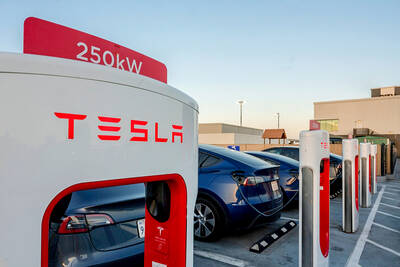
NEW IMPORTS: Car dealer PG Union Corp said it would consider introducing US-made models such as the Jeep Grand Cherokee and Stellantis’ RAM 1500 to Taiwan Tesla Taiwan yesterday said that it does not plan to cut its car prices in the wake of Washington and Taipei signing the Agreement on Reciprocal Trade on Thursday to eliminate tariffs on US-made cars. On the other hand, Mercedes-Benz Taiwan said it is planning to lower the price of its five models imported from the US after the zero tariff comes into effect. Tesla in a statement said it has no plan to adjust the prices of the US-made Model 3, Model S and Model X as tariffs are not the only factor the automaker uses to determine pricing policies. Tesla said

OpenAI has warned US lawmakers that its Chinese rival DeepSeek (深度求索) is using unfair and increasingly sophisticated methods to extract results from leading US artificial intelligence (AI) models to train the next generation of its breakthrough R1 chatbot, a memo reviewed by Bloomberg News showed. In the memo, sent on Thursday to the US House of Representatives Select Committee on China, OpenAI said that DeepSeek had used so-called distillation techniques as part of “ongoing efforts to free-ride on the capabilities developed by OpenAI and other US frontier labs.” The company said it had detected “new, obfuscated methods” designed to evade OpenAI’s defenses
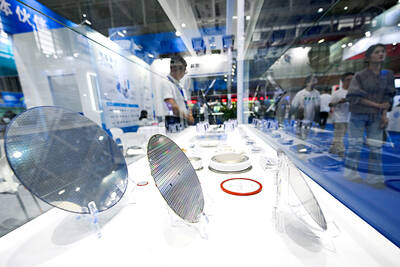
China’s top chipmaker has warned that breakaway spending on artificial intelligence (AI) chips is bringing forward years of future demand, raising the risk that some data centers could sit idle. “Companies would love to build 10 years’ worth of data center capacity within one or two years,” Semiconductor Manufacturing International Corp (SMIC, 中芯) cochief executive officer Zhao Haijun (趙海軍) said yesterday on a call with analysts. “As for what exactly these data centers will do, that hasn’t been fully thought through.” Moody’s Ratings projects that AI-related infrastructure investment would exceed US$3 trillion over the next five years, as developers pour eye-watering sums

Bank of America Corp nearly doubled its forecast for the nation’s economic growth this year, adding to a slew of upgrades even after a rip-roaring last year propelled by demand for artificial intelligence (AI). The firm lifted its projection to 8 percent from 4.5 percent on “relentless global demand” for the hardware that Taiwanese companies make, according to a note dated yesterday by analysts including Xiaoqing Pi (皮曉青). Taiwan’s GDP expanded 8.63 percent last year, the fastest pace since 2010. The increase “reflects our sustained optimism over Taiwan’s technology driven expansion and is reinforced by several recent developments,” including a more stable currency,


 RSS
RSS