


Consumer confidence rebounded this month, rising to a five-month high as receding gasoline prices and a mostly solid employment climate made people feel better about the economy's prospects and their own financial situations.
The improved attitudes come even as Wall Street has been enduring a turbulent spell, which has sent stocks on wild upward and downward swings. Investors are worried that mounting problems in the housing and home mortgage markets will hurt the broader financial system and short-circuit economic expansion.
The RBC Cash Index showed that consumer confidence rose to 89.3 this month. That marked a bounceback from last month's 76.1, the worst reading in almost a year. The new reading was the best since March. The index is based on the results of the international polling firm Ipsos.
"This indicates that there is a significant disconnect between Wall Street and Main Street," said Lynn Reaser, chief economist at Bank of America's Investment Strategies Group.
Peoples' feelings about the current economic conditions climbed to 105.6 this month, up from 95.8 last month. Their feelings also brightened about how the economy and their own financial fortunes will fare over the next six months. This expectations index rose to 43.9 this month, nearly double the reading of 23.1 for last month.
Economists believe lower gasoline prices were probably a big factor behind the improvements.
Gasoline prices nationwide continued to ease early this month, falling to US$2.84 a gallon (3.8 liters), according to information compiled by the Energy Department. Three months earlier, prices had spiked past US$3.
Another factor believed to be behind the brighter consumer attitudes: a job market that is still good. The nation's unemployment rate inched up to 4.6 percent last month, the government reported last week. Even though that was a six month high, the jobless rate is still considered low by historical standards.
A measure tracking consumers' sentiments about the nation's employment conditions rose to 124.5 in August, up from 116.8 in July.
"Consumers seem to be fairly upbeat," said Richard Yamarone, economist at Argus Research Corp. "It looks like they are ignoring the warnings on Wall Street."
Yamarone said the recent increase in the federal minimum wage -- the first bump up in a decade -- also may have helped to lift peoples' spirits. The country's lowest-paid workers got a US$0.70 boost last month to $5.85 an hour. By 2009, the wage will rise to $7.25 an hour.
Another gauge which measures peoples' attitudes about investing -- including their comfort in making major purchases -- also picked up this month. That measure rose to 97.9 from 83.6 for last month.
The overall confidence index is benchmarked to a reading of 100 on January 2002, when Ipsos started the survey.
The RBC consumer confidence index was based on responses from 1,003 adults surveyed Monday through Wednesday about their attitudes on personal finance and the economy. Results of the survey had a margin of sampling error of plus or minus 3 percentage points.

Apple Inc increased iPhone production in India by about 53 percent last year and now makes a quarter of its marquee devices there, reflecting the US company’s efforts to avoid tariffs on China. The company assembled about 55 million iPhones in India last year, up from 36 million a year earlier, people familiar with the matter said, asking not to be named because the numbers aren’t public. Apple makes about 220 million to 230 million iPhones a year globally, with India’s share of the total increasing rapidly. Apple has accelerated its expansion in the world’s most populous country in recent years, bolstered
HEADWINDS: The company said it expects its computer business, as well as consumer electronics and communications segments to see revenue declines due to seasonality Pegatron Corp (和碩) yesterday said it aims to grow its artificial intelligence (AI) server revenue more than 10-fold this year from last year, driven by orders from neocloud solutions clients and large cloud service providers. The electronics manufacturing service provider said AI server revenue growth would be driven primarily by the Nvidia Corp GB300 server platform. Server shipments are expected to increase each quarter this year, with the second half likely to outperform the first half, it said. The AI server market is expected to broaden this year as more inference applications emerge, which would drive demand for system-on-chip, application-specific integrated circuits
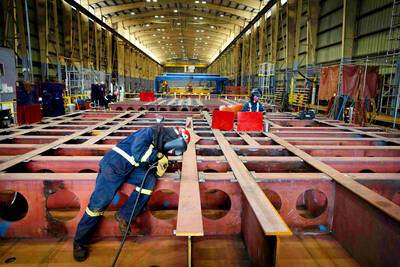
At a massive shipyard in North Vancouver, Canadian workers grind metal beams for a powerful new icebreaker crucial to cementing the country’s presence in the increasingly contested arctic. Icebreakers are specialized, expensive vessels able to navigate in the frozen far north. And “this is the crown jewel,” said Eddie Schehr, vice president of production at the Seaspan shipyard. For Canadian Prime Minister Mark Carney, who heads to Norway next Friday to observe arctic defense drills involving troops from 14 NATO states, Canada’s extreme north has emerged as a strategic priority. “Canada is and forever will be an Arctic nation,” he said ahead of

Chinese entrepreneur Frank Gao used to spend long hours running his social media accounts but now outsources the chore to artificial intelligence (AI) agent tool OpenClaw, which is taking China by storm despite official warnings over cybersecurity. OpenClaw, created in November by an Austrian coder, differs from bots such as ChatGPT because it can execute real-life tasks such as sending e-mails, organizing files or even booking flight tickets. “Since January, I’ve spent hours on the lobster every day,” Gao said in an interview, referring to OpenClaw’s red crustacean mascot. “We’re family.” After downloading OpenClaw, users connect it to artificial intelligence models of their


 RSS
RSS