


A number of Taiwanese computer manufacturers have started low-cost PC production lines in a bid to tap into the new niche market, but industry watchers said the prospects for the sector may not be as rosy as they seem.
"Low-cost computers, along with desktops and notebook computers, will become the three most important product segments in the future of the PC industry," said Jerry Shen (沈振來), a deputy general manager at Asustek Computer Inc (華碩電腦), at an investor conference last Monday.
Asustek, the world's largest motherboard maker, is set to produce its first batch of budget PCs running on Intel Corp's Classmate PC platform in July, which consist of a low-cost PC design and chips that support a wireless Internet connection.
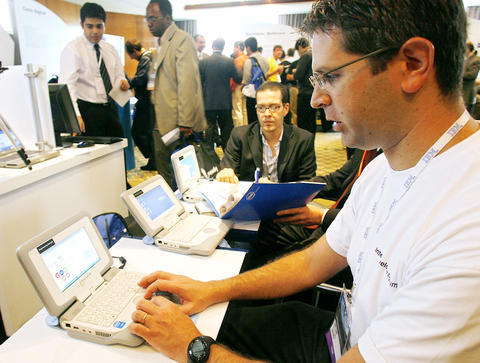
PHOTO: AP
The company will contract manufacture the PCs for Intel, as well as making them for its own Asus brand.
Total Classmate PC shipments are set to hit 10 million units next year and those made by Asustek will account for as many as 5 million, Shen said.
In July, he said Asustek will roll out four own-brand budget PCs -- tentatively called Easy PCs -- with price tags ranging from US$249 to US$549.
The machines will employ Intel's Solid State Disk with flash memory from 1 gigabyte to 40 gigabytes, instead of the standard mechanical hard drive. And the 7-inch panels will be sourced from AU Optronics Corp (友達光電), Asustek said.
Elitegroup Computer Systems Co (精英電腦), another of the nation's first-tier motherboard makers, will also manufacture contract Classmate PCs, with shipments expected to start in the third quarter, mainly to the Chinese market.
"The low-cost PC sector will enable Taiwanese computer makers to secure market share, judging from the large volumes expected to be produced each year," said Sean Ryan (蕭文良), a researcher with Fubon Securities Investment Services Co (富邦證券投顧).
But it doesn't mean that all the players would secure a solid foothold in the market by rushing into production, he added.
Only those with economies of scale and excellent control of their supply chain would survive and take a controlling share of the market, he said.
For Quanta Computer Inc (廣達電腦), the world's largest contract notebook computer maker, the One Laptop per Child (OLPC) project will only strengthen its market leadership.
Quanta announced on April 26 a delay in shipments until the fourth quarter from the third quarter, caused by changes to components, including a faster central processing unit and a larger hard drive and memory, it said.
The OLPCs will cost US$175 per machine, with Quanta taking a profit of US$3 per machine, Nicholas Negroponte, the former director of the Massachusetts Institute of Technology Media Lab who now heads the nonprofit OLPC, said last month.
The profit is less than what Quanta receives from its mainstream PC business, but it would still be a lucrative unit if the first-year shipments reached 10 million as projected.
But industry watchers remained skeptical on whether these low-cost projects would really take off.
Some of the countries importing the PCs want to have an OLPC assembly line set up within their borders, to create local jobs, said an analyst who requested anonymity.
Managing sales channels for the PCs would be another challenge, he said.
"The distribution of budget computers will not be via conventional distributors or resellers. It will involve the government or large domestic enterprises, which is a totally different ball game," he said.
Despite the hype, Quanta's smaller rival, Compal Electronics Inc (仁寶電腦), has decided to pass on low-cost PCs.
"Low-cost notebook computers are not our focus," Compal spokesman Gary Lu (呂清雄) said.
The average price of portable computers has been on a downward trend over the past few years, and has now fallen to a comfortable level for most consumers, he said.
"Children in these countries are waiting to fill up their stomach, not play computers," he said.

Cairo’s new monorail slices across the city skyline, running above the familiar chaos of blaring horns and aging buses’ exhaust fumes that mark rush hour below. The US$4.5 billion monorail, opened this month, is among Egypt’s most prominent new transport projects, part of a debt-funded infrastructure drive criticized for sapping state finances while bringing limited benefits to most of the country’s 109 million people. “It feels like you’re in a different country,” said Ramy Sayed, a restaurant manager, aboard a driverless Innovia 300 train. “No noise, no traffic, we’re not used to this.” The eastern line runs 56km from the bustling middle-class

Taiwanese firms have increased investment in the Philippines in recent years as Manila’s ties with Washington deepen and global supply chains continue to shift away from China, an expert at the Chung-Hua Institution for Economic Research (CIER, 中華經濟研究院) said yesterday. The Philippines had not been among Taiwanese investors’ top choices in Southeast Asia, CIER Taiwan ASEAN Studies Center director Kristy Hsu (徐遵慈) said at a seminar in Taipei. However, Taiwan’s investment in the country has grown significantly since the COVID-19 pandemic, reaching US $257 million last year, a high in recent years, she said. Although Taiwan’s total investment in the Philippines still lags

Intel Corp regards Taiwan Semiconductor Manufacturing Co (TSMC, 台積電) as a longstanding partner, as the US chipmaker would continue outsourcing production of advanced chips to TSMC, Intel chief executive officer Lip-Bu Tan (陳立武) said yesterday. “I don’t look at people as competitors. I look at the collaboration... Nvidia is also, you know, a good friend,” Tan told a news conference following his keynote speech at the Computex trade show in Taipei. “It’s a very trusted partnership for us... We are a big, top customer for them, and we’re going to continue doing that,” he said, referring to TSMC, the world’s largest foundry

Artificial intelligence (AI) agents would supplant smartphones as the center of people’s digital lives, fundamentally reshaping personal devices and driving a major computing upgrade cycle, Qualcomm Inc CEO Cristiano Amon said yesterday. In his keynote speech for this year’s Computex trade show in Taipei, Amon said that the rise of "agentic AI" — AI systems capable of reasoning, planning and carrying out tasks autonomously — would transform how people interact with technology across phones, PCs, vehicles and wearable devices. Describing the technology as the next major evolution in computing, Amon said that "2026 is the year of agents.” For decades, smartphones have sat


 RSS
RSS