


Google Inc apologized yesterday to a Chinese rival that complained its data was used by the US search giant in a new Internet tool in an incident that highlighted the intense competition in China's booming online market.
Sohu.com Inc (搜狐) complained on Sunday that Google's tool for inputting Chinese characters appeared to copy material from Sohu's Sogou search engine.
Chinese Web surfers pointed out similarities shortly after the release of the Google tool.
"We are willing to face up to our mistake and offer an apology to users and to the Sohu company," Google said in a statement.
However, it gave no details of what Google did and a spokeswoman said she had no additional information.
Web portals in China spend heavily on new search, entertainment and other features and react quickly to competitive threats.
Inputting the nonphonetic ideograms in which Chinese is written is a time-consuming chore and a system that offers more convenience could help a site draw traffic from competitors.
Google's tool, the Pinyin Input Method Editor, is meant to be an easier way for a user to input characters in Pinyin. It suggests possible characters after just a few letters are typed.
Google, based in Mountainview, California, said its suggestions for characters are based on data gathered by Google's Chinese-language search engine about the frequency of searches for certain words.
But Sohu complained that Google also drew on similar data from Sogou.
The Google statement yesterday noted that Web surfers have pointed out some material came from "non-Google data sources." It gave no indication how much was from other sources or how it was included in the new Chinese-character tool.
With 137 million people online, China has the world's second-largest population of Internet users and is on track to surpass the US within two years.
Google and other foreign Internet outfits are struggling to adapt to a Chinese market where leaders try to control what the public sees and limit foreign ownership of Web companies.
The Chinese writing system adds a layer of complexity for foreign competitors trying to tailor their systems for Chinese users.
Google is China's No. 2 search engine, with a market share of 21.7 percent, while industry leader Baidu.com Inc has 55.2 percent, the Shanghai research firm iResearch Inc said. Yahoo Inc's China portal is third with 7.2 percent and Sogou No. 4 with 6.5 percent.
Google launched a China-based service, Google.cn, after seeing its market share erode as government filters slowed access for Chinese users to its US service. Human rights activists have criticized the new service, which excludes search results on human rights, the Dalai Lama and other topics banned by the communist government.
Market pressures have forced competitors to evolve quickly and embrace drastic changes.
The Chinese partner that operates Yahoo's China portal said in January it was getting out of mainstream search due to intense competition and would become a business-oriented search engine.

BUSINESS UPDATE: The iPhone assembler said operations outlook is expected to show quarter-on-quarter and year-on-year growth for the second quarter Hon Hai Precision Industry Co (鴻海精密) yesterday reported strong growth in sales last month, potentially raising expectations for iPhone sales while artificial intelligence (AI)-related business booms. The company, which assembles the majority of Apple Inc’s smartphones, reported a 19.03 percent rise in monthly sales to NT$510.9 billion (US$15.78 billion), from NT$429.22 billion in the same period last year. On a monthly basis, sales rose 14.16 percent, it said. The company in a statement said that last month’s revenue was a record-breaking April performance. Hon Hai, known also as Foxconn Technology Group (富士康科技集團), assembles most iPhones, but the company is diversifying its business to
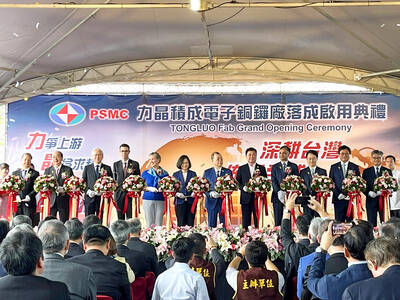
ARTIFICIAL INTELLIGENCE: The chipmaker last month raised its capital spending by 28 percent for this year to NT$32 billion from a previous estimate of NT$25 billion Contract chipmaker Powerchip Semiconductor Manufacturing Corp (力積電子) yesterday launched a new 12-inch fab, tapping into advanced chip-on-wafer-on-substrate (CoWoS) packaging technology to support rising demand for artificial intelligence (AI) devices. Powerchip is to offer interposers, one of three parts in CoWoS packaging technology, with shipments scheduled for the second half of this year, Powerchip chairman Frank Huang (黃崇仁) told reporters on the sidelines of a fab inauguration ceremony in the Tongluo Science Park (銅鑼科學園區) in Miaoli County yesterday. “We are working with customers to supply CoWoS-related business, utilizing part of this new fab’s capacity,” Huang said, adding that Powerchip intended to bridge

Microsoft Corp yesterday said that it would create Thailand’s first data center region to boost cloud and artificial intelligence (AI) infrastructure, promising AI training to more than 100,000 people to develop tech. Bangkok is a key economic player in Southeast Asia, but it has lagged behind Indonesia and Singapore when it comes to the tech industry. Thailand has an “incredible opportunity to build a digital-first, AI-powered future,” Microsoft chairman and chief executive officer Satya Nadella said at an event in Bangkok. Data center regions are physical locations that store computing infrastructure, allowing secure and reliable access to cloud platforms. The global embrace of AI

Qualcomm Inc, the world’s biggest seller of smartphone processors, gave an upbeat forecast for sales and profit in the current period, suggesting demand for handsets is increasing after a two-year slump. Revenue in the three months ended in June will be US$8.8 billion to US$9.6 billion, the company said in a statement Wednesday. Excluding certain items, earnings will be US$2.15 to US$2.35 a share. Analysts had projected sales of US$9.08 billion and earnings of US$2.16 a share. The outlook signals that the smartphone market has begun to bounce back, tracking with Qualcomm’s forecast that demand would gradually recover this year. The San


 RSS
RSS