


To help companies develop international-class brands and promote the domestic "Branding Taiwan" project, the iD SoftCapital Group (智融集團) and the government unveiled the nation's first venture-capital fund to invest in brands.
"As the margins generated by manufacturing have been declining, Taiwan's companies should allocate more resources to brand marketing to create more added value," Stan Shih (
"The knowledge-based economy is brand-based economy," he said.
The government will hold a 49 percent stake in the NT$2 billion (US$61.7 million) fund, with the quasi-official Taiwan External Trade Development Council (TAITRA,
iD SoftCapital, the fund's operator, will invest NT$200 million and look for other private companies to complete the fund by the end of second quarter.
The investment targets are local companies which are making an effort to establish international brands and promote a made-in-Taiwan image, regardless where the firms are based, Shih said.
He said the fund plans to invest in companies involved in digital technology, agri-business and culture-related industries.
Shih plans to complete the deployment of the venture capital within five years with a return of 30 percent.
The venture capital will help the Ministry of Economic Affairs' with its "Branding Taiwan" project, which aims to develop two Taiwanese brands that can crack the world's top 100 list, and five brands with value exceeding US$1 billion by 2012, Vice Minister of Economic Affairs Steve Chen (陳瑞隆) said at the conference.
However, the aim of making Taiwanese brands world renowned is a road full of challenges, said Steve Chang (張明正), chairman of Trend Micro Inc (趨勢科技), at a media gathering yesterday.
The anti-virus software maker has been the nation's top brand for the past three years, with brand valued at more than US$1.077 billion last year.
The first step to branding is quality products or services that cater to market demand, Chang said, citing Google and Skype as examples.
"Taiwanese companies should try to think and do differently, instead of looking for the so-called `correct answers,'" he said.
Creating a successful brand, however, takes huge investment and resources, as well as patience, Vithala Rao, a professor of marketing and quantitative methods at Cornell University, said at the gathering in Taipei.
Rao was invited by Trend Micro to deliver a speech on branding strategies at National Taiwan University yesterday.
Rao suggested Taiwanese firms buy or merge with major international brands to save costs. After acquiring the brand, the company still needs to maintain and keep marketing the brand to stay competitive, he said.
When looking for the right brand to acquire, cultural similarities and
complementarity are key, he said.
BenQ Corp's (明基) acquisition of Simens' handset division, is an example of
the right way to go, Chang said, but BenQ will have to overcome the
difficulty of integrating companies from different cultures before taking
the advantage of the brand.
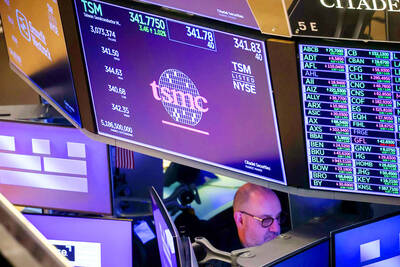
STRONG INTEREST: Analysts have pointed to optimism in TSMC’s growth prospects in the artificial intelligence era as the cause of the rising number of shareholders The number of people holding shares of chipmaker Taiwan Semiconductor Manufacturing Co (TSMC, 台積電) hit a new high last week despite a decline in its stock price, the Taiwan Depository and Clearing Corp (TDCC, 台灣集保) said. The number of TSMC shareholders rose to 2.46 million as of Friday, up 75,536 from a week earlier, TDCC data showed. The stock price fell 1.34 percent during the same week to close at NT$1,840 (US$57.55). The decline in TSMC’s share price resulted from volatility in global tech stocks, driven by rising international crude oil prices as the war against Iran continues. Dealers said
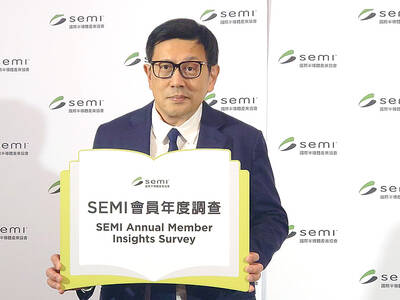
PRICE HIKES: The war in the Middle East would not significantly disrupt supply in the short term, but semiconductor companies are facing price surges for materials Taiwan’s semiconductor companies are not facing imminent supply disruptions of essential chemicals or raw materials due to the war in the Middle East, but surges in material costs loom large, industry association SEMI Taiwan said yesterday. The association’s comments came amid growing concerns that supplies of helium and other key raw materials used in semiconductor production could become a choke point after Qatar shut down its liquefied natural gas (LNG) production and helium output earlier this month due to the conflict. Qatar is the second-largest LNG supplier in the world and accounts for about 33 percent of global helium output. Helium is
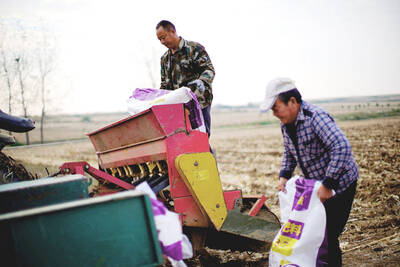
China is clamping down on fertilizer exports to protect its domestic market, industry sources said, putting an additional strain on global markets that were already grappling with shortages caused by the US-Israeli war on Iran. China is among the largest fertilizer exporters — shipping more than US$13 billion of it last year — and it has a history of controlling exports to keep prices low for farmers. Shipments through the war-blocked Strait of Hormuz account for about one-third of the sea-borne supply. This month, Beijing banned exports of nitrogen-potassium fertilizer blends and certain phosphate varieties, sources said. The ban, which has not
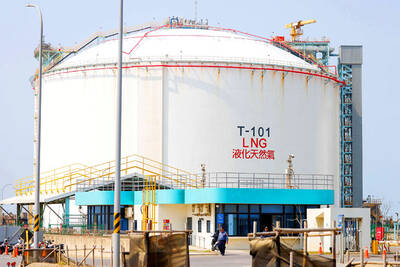
Taiwan’s natural gas supply remains stable through the end of May, despite rising concerns about potential disruptions to Qatari liquefied natural gas (LNG) supplies due to escalating conflicts in the Middle East, the Ministry of Economic Affairs said yesterday. The ministry in a statement said that Taiwan has completed preparations for natural gas supply and shipping schedules through the end of May. It has also made plans to increase natural gas imports from regions outside the Middle East in June to ensure a stable supply, it added. Taiwan sources natural gas from 14 countries and is not solely dependent on the Middle East,


 RSS
RSS