


The nation's computer memory chipmakers, led by Powerchip Semiconductor Corp (力晶半導體), may report sharp declines in quarterly earnings amid falling chip prices and lukewarm back-to-school demand, analysts said yesterday.
Taiwanese memory chipmakers are likely to report weaker third-quarter results than their bigger Korean rival Samsung Electronics Co, which has a wider product portfolio, said Wang Bou-li (
Samsung Electronics, the world's biggest memory chipmaker, yesterday told investors that earnings for the July-September period slid 30 percent from the same period last year on lower chip prices.
"Falling prices also eroded local chipmakers' gross margins," Wang said. "Besides, seasonal back-to-school demand is slower than expected," he said.
Powerchip, Taiwan's biggest maker of dynamic random access memory (DRAM) chips, may report an 80 percent plunge in its third-quarterly earnings, from NT$6.98 billion (US$209 million) to NT$1.5 billion a year earlier, Wang said.
Earnings per share will also decline to NT$0.35 from NT$1.71, according to Wang's projection.
Gross margins could slide to around 20 percent, from some 50 percent during the third quarter of last year, after prices of DRAM chips recently plunged around 44 percent year-on-year to US$2.4 per unit, Wang said.
Powerchip is scheduled to release its third-quarter results on Monday, and rival Nanya Technology Corp's (
Despite the drastic decline, Wang said "the result is not too bad for chipmakers like Powerchip who only make standard DRAM chips -- unlike Samsung, which can rely on NAND flash chips to boost its margins."
DRAM chips are mostly used in personal computers, while NAND flash chips are used in consumer electronics such as digital music players and digital cameras.
Another analyst with Barits International Securities Co (倍利投信), who asked not to be named, said that "at least, profits are recovering after prices of DRAM chips rebounded from the second quarter."
Samsung yesterday said DRAM prices bounced back by around 8 percent in the third quarter from the previous one. Looking forward, it expects prices to drop less than 5 percent in the current quarter on strong demand.
Nanya Technology, Taiwan's No. 2 DRAM maker, may also post lower third-quarter results, down nearly 50 percent to NT$1.1 billion, the Barits analyst said. The decline in earnings may be blunted somewhat by Nanya's memory chipmaking venture Inotera Memory Inc (
Earnings per share will fall to NT$0.29, he said. Nanya Technology mostly supplies chips to computer vendors such as Dell Inc.
Inotera now makes chips at a cutting-edge 300mm (or 12-inch) plant -- so named because circuits are printed on round 300mm wafers which are then sliced into individual chips. Older plants print chips on smaller wafers, which is less cost-effective.
The company plans to build a second plant after raising funds through an initial public offering at home and a share sale overseas next year.
Powerchip yesterday signed a NT$15 billion syndicated loan with local banks led by Cathay United Bank (
Powerchip is aggressive in building such advanced factories. The company plans to build two such fabs every three years, unlike Nanya, which does not have its own 300mm fab.

Cairo’s new monorail slices across the city skyline, running above the familiar chaos of blaring horns and aging buses’ exhaust fumes that mark rush hour below. The US$4.5 billion monorail, opened this month, is among Egypt’s most prominent new transport projects, part of a debt-funded infrastructure drive criticized for sapping state finances while bringing limited benefits to most of the country’s 109 million people. “It feels like you’re in a different country,” said Ramy Sayed, a restaurant manager, aboard a driverless Innovia 300 train. “No noise, no traffic, we’re not used to this.” The eastern line runs 56km from the bustling middle-class
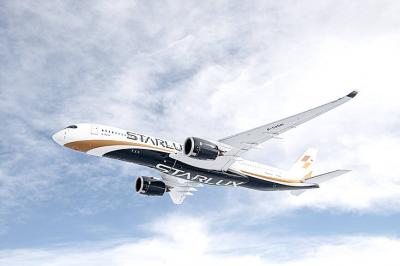
Starlux Airlines Co (星宇航空) today unveiled a long-haul network expansion plan at a shareholders’ meeting in Taipei, including direct flights to Barcelona, Spain, and Zurich, Switzerland, as well as a service connecting Taipei, Sydney and New Zealand. Starlux is to become the first Taiwanese carrier to offer non-stop services to the two European cities, while the inaugural oceanic route is expected to expand transit opportunities within the Australia-New Zealand market, Starlux said. Flight services to Chicago, Dallas, Washington and New York are under evaluation, the airline added. Prior to the shareholders’ meeting, the airline earlier this year announced that it would be

Netherlands-based semiconductor equipment supplier ASML Holding NV yesterday said that it is planning to hire an additional 1,000 people in Taiwan this year in response to growing demand from clients. ASML had previously planned to recruit 600 people this year, but that the plan has been adjusted upward, ASML vice president and ASML Taiwan general manager Grace Wang (汪佳慧) told reporters. ASML has a workforce of more than 4,500 in Taiwan, accounting for about 10 percent of its global total, Wang said. This year’s recruitment campaign would focus on adding people in the customer support, manufacturing and supply chain domains to assist ASML

Nvidia Corp yesterday announced that CEO Jensen Huang (黃仁勳) would attend an employee meeting in Taipei tomorrow to celebrate the launch of the company’s Taiwan headquarters project. Huang would attend a gathering at the site of Nvidia’s planned headquarters in Beitou Shilin Technology Park (北投士林科技園區), the company said in a statement. After arriving in Taiwan on Saturday last week, Huang told reporters that he plans to meet with Quanta Computer Inc (廣達) chairman Barry Lam (林百里) and Taiwan Semiconductor Manufacturing Co (TSMC, 台積電) chairman C.C. Wei (魏哲家), and would attend the groundbreaking ceremony for Nvidia’s Taiwan headquarters tomorrow. Nvidia has not yet applied


 RSS
RSS