


The world's leading contract chip makers, Taiwan Semiconductor Manufacturing Corp (TMSC, 台積電) and United Microelectronics Corp (UMC,
Analysts say the key to Taiwan's foundry strength is the two leading companies' technological leadership and financial strength that have helped them maintain their edge in the highly competitive market.
James Huang (
They managed to keep manufacturing processes at least one generation ahead of their rivals, meaning that the two foundries are basically in a secure position in the world market, Huang said.
TSMC and UMC faced threats from GSMC and SMIC which, with the help of the Chinese government and their foreign partners, have been rapidly expanding their production capabilities and chipping away at the market shares of the Taiwan makers. Still, TSMC and UMC's joint market share in 2005 is forecast to remain at about 70 percent, with TSMC keeping the top spot.
Taiwan's foundry giants are facing unusual pressure for their fourth quarter revenues because of the low-price strategy adopted by SMIC and Chartered Semiconductor as the recovery of the global semiconductor industry has been slower than expected and heavyweight IC designing houses have been unable to bring down their inventory levels, triggering market worries that IC designers will reduce their orders to manufacturers.
Both TSMC and UMC have worked aggressively to maintain their competitive edge by upgrading their technology. In this regard, TSMC announced in Dec. 2004 that it was using the industry-leading Nexsys 90-nanometer process in volume production for such leading companies as Altera Corp and Qualcomm Inc, the only foundry process to feature copper interconnect, low-k dielectrics, and 12-inch wafer production.
In April this year, TSMC unveiled another latest semiconductor manufacturing process -- the 65nm Nexsys Technology for SoC Design -- at a symposium attended by over 400 of the industry's leading companies, and said its first wafers to be produced by this process are expected in December.
The new technology allows designers to build logic devices with double the density of the company's industry leading 65nm technology, enabling market movers across the IC industry to save significant costs.
On Wednesday, TSMC said it has completed prototype runs for its customers drawing on 65nm technology.
Among the customers taking part in the first run were Altera, Broadcom Corp and Freescale Semiconductor Inc, all of the US, TSMC said in a statement.
UMC, for its part, also announced its leadership in the 90nm manufacturing process, an achievement that has won it big orders from such IC designing firms as Texas Instruments, ATi, nVidia, and Qualcomm.
In late August, UMC said it had reached a "milestone" of having shipped over 100,000 wafers using the 90nm process technology, becoming a leader in terms of the total number of 90nm wafers shipped as well as in revenue generated from 90nm sales.
As TSMC enjoys high satisfaction from such key IC designing houses as TI, ATi, nVidia, Microsoft Corp, Freescale, Sony Corp and Altera, it is quite unlikely that it will lose major orders to UMC, market analysts said.
TSMC and UMC's technological lead was further proved when nVidia withdrew all its orders from IBM, which launched an aggressive campaign to wrestle orders from the two Taiwan manufacturers in 2003, and directed them all back to TSMC and UMC.
TSMC has started volume production of nVidia's orders in the third quarter of this year using the 90nm process, and UMC is set to start volume production of nVidia orders in the first quarter of next year.
TSMC's R&D efforts are producing another likely result for 2006 and beyond: merging IC process technology with microelectromechanical systems (MEMS), a platform whose market value researchers estimate will grow from US$8 billion this year to US$14 billion by 2009, analysts said.
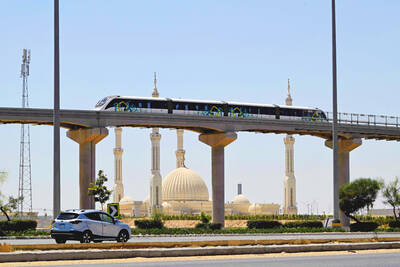
Cairo’s new monorail slices across the city skyline, running above the familiar chaos of blaring horns and aging buses’ exhaust fumes that mark rush hour below. The US$4.5 billion monorail, opened this month, is among Egypt’s most prominent new transport projects, part of a debt-funded infrastructure drive criticized for sapping state finances while bringing limited benefits to most of the country’s 109 million people. “It feels like you’re in a different country,” said Ramy Sayed, a restaurant manager, aboard a driverless Innovia 300 train. “No noise, no traffic, we’re not used to this.” The eastern line runs 56km from the bustling middle-class
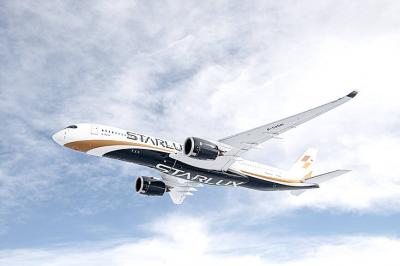
Starlux Airlines Co (星宇航空) today unveiled a long-haul network expansion plan at a shareholders’ meeting in Taipei, including direct flights to Barcelona, Spain, and Zurich, Switzerland, as well as a service connecting Taipei, Sydney and New Zealand. Starlux is to become the first Taiwanese carrier to offer non-stop services to the two European cities, while the inaugural oceanic route is expected to expand transit opportunities within the Australia-New Zealand market, Starlux said. Flight services to Chicago, Dallas, Washington and New York are under evaluation, the airline added. Prior to the shareholders’ meeting, the airline earlier this year announced that it would be
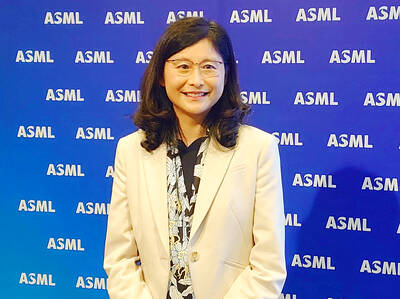
Netherlands-based semiconductor equipment supplier ASML Holding NV yesterday said that it is planning to hire an additional 1,000 people in Taiwan this year in response to growing demand from clients. ASML had previously planned to recruit 600 people this year, but that the plan has been adjusted upward, ASML vice president and ASML Taiwan general manager Grace Wang (汪佳慧) told reporters. ASML has a workforce of more than 4,500 in Taiwan, accounting for about 10 percent of its global total, Wang said. This year’s recruitment campaign would focus on adding people in the customer support, manufacturing and supply chain domains to assist ASML
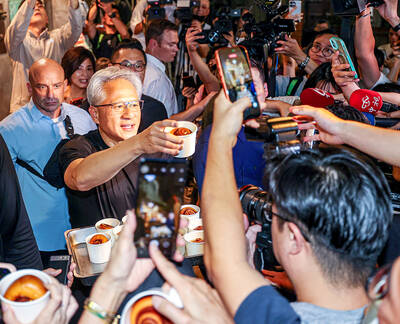
Nvidia Corp yesterday announced that CEO Jensen Huang (黃仁勳) would attend an employee meeting in Taipei tomorrow to celebrate the launch of the company’s Taiwan headquarters project. Huang would attend a gathering at the site of Nvidia’s planned headquarters in Beitou Shilin Technology Park (北投士林科技園區), the company said in a statement. After arriving in Taiwan on Saturday last week, Huang told reporters that he plans to meet with Quanta Computer Inc (廣達) chairman Barry Lam (林百里) and Taiwan Semiconductor Manufacturing Co (TSMC, 台積電) chairman C.C. Wei (魏哲家), and would attend the groundbreaking ceremony for Nvidia’s Taiwan headquarters tomorrow. Nvidia has not yet applied


 RSS
RSS