


Taiwan Semiconductor Manufacturing Co (TSMC, 台積電), the world's biggest contract chipmaker, yesterday said that consumer gadgets such as digital music players are becoming a major force driving forward the increasingly volatile semiconductor industry.
In 1990s and early 2000s, computers were the only engine fueling demand for chips, but now digital consumer products are taking over to drive the semiconductor industry, TSMC's new chief executive and president Rick Tsai (
Most people may have one or two computers, but "they may have 10 digital consumer gadgets," Tsai said. In July he took over from Morris Chang (
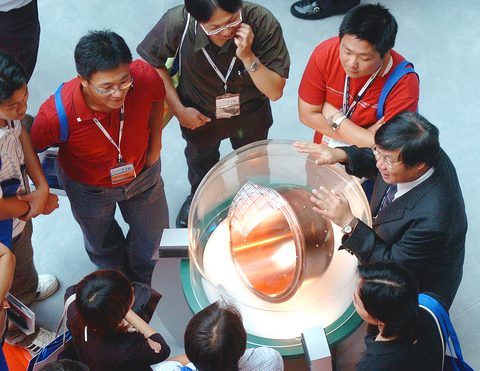
PHOTO: TAIPEI TIMES, FANG BIN-CHAO
Rising demand for mobile phones and other consumer electronic products will boost the company's wafer shipments by up to 16 percent in the current third quarter from the second quarter, Tsai told TSMC investors in July.
But the shift to consumer electronics as a new engine driving growth also brings challenges to the semiconductor industry, which has traditionally gone through a more predictable business cycle.
"Volatility is getting more pronounced. Peak is falling in different quarters," Tsai said.
The chip industry is becoming more diverse and even more cost-sensitive since the life cycle for consumer devices is much shorter than computers, he said.
As a result, inventory management is becoming critical for semiconductor companies' profits as it will be increasingly difficult for them to prepare the appropriate capacity, he added. The industry is just now recovering from the latest downturn due to high inventory.
Tsai yesterday reiterated that the semiconductor industry will no longer enjoy the high growth rates of the past.
"Growth is moderating," Tsai said.
The chip industry will expand by only 10 percent annually in terms of sales in the next five years through 2010, compared to 15 percent growth in the years before 1995, Tsai said.
Though the industry is becoming more closely aligned to consumers' buying activities especially in the US, Tsai declined to comment on whether rising energy costs and Hurricane Katrina would slow US consumption.
The US is the biggest computer market, consuming 30 percent of computers shipped around the world. It consumes about 18 percent of the mobile phones made by the world's handset vendors.
Powerchip Semiconductor Corp (
"At this point, we are not seeing the hurricane significantly hurt consumers' purchases [of electronics]. The US is still enjoying good economic growth," said Powerchip Semiconductor Chairman Frank Huang (
He made the remarks on the sideline of a forum arranged by Semiconductor Equipment and Materials International, an industry group.
"Demand for the annual Christmas shopping season looks quite good," Huang said.
In addition, strong demand from fast-growing emerging markets such as China and India will offset the possible reduction in orders caused by the hurricane, Huang said.

ISSUES: Gogoro has been struggling with ballooning losses and was recently embroiled in alleged subsidy fraud, using Chinese-made components instead of locally made parts Gogoro Inc (睿能創意), the nation’s biggest electric scooter maker, yesterday said that its chairman and CEO Horace Luke (陸學森) has resigned amid chronic losses and probes into the company’s alleged involvement in subsidy fraud. The board of directors nominated Reuntex Group (潤泰集團) general counsel Tamon Tseng (曾夢達) as the company’s new chairman, Gogoro said in a statement. Ruentex is Gogoro’s biggest stakeholder. Gogoro Taiwan general manager Henry Chiang (姜家煒) is to serve as acting CEO during the interim period, the statement said. Luke’s departure came as a bombshell yesterday. As a company founder, he has played a key role in pushing for the

China has claimed a breakthrough in developing homegrown chipmaking equipment, an important step in overcoming US sanctions designed to thwart Beijing’s semiconductor goals. State-linked organizations are advised to use a new laser-based immersion lithography machine with a resolution of 65 nanometers or better, the Chinese Ministry of Industry and Information Technology (MIIT) said in an announcement this month. Although the note does not specify the supplier, the spec marks a significant step up from the previous most advanced indigenous equipment — developed by Shanghai Micro Electronics Equipment Group Co (SMEE, 上海微電子) — which stood at about 90 nanometers. MIIT’s claimed advances last

EUROPE ON HOLD: Among a flurry of announcements, Intel said it would postpone new factories in Germany and Poland, but remains committed to its US expansion Intel Corp chief executive officer Pat Gelsinger has landed Amazon.com Inc’s Amazon Web Services (AWS) as a customer for the company’s manufacturing business, potentially bringing work to new plants under construction in the US and boosting his efforts to turn around the embattled chipmaker. Intel and AWS are to coinvest in a custom semiconductor for artificial intelligence computing — what is known as a fabric chip — in a “multiyear, multibillion-dollar framework,” Intel said in a statement on Monday. The work would rely on Intel’s 18A process, an advanced chipmaking technology. Intel shares rose more than 8 percent in late trading after the

GLOBAL ECONOMY: Policymakers have a choice of a small 25 basis-point cut or a bold cut of 50 basis points, which would help the labor market, but might reignite inflation The US Federal Reserve is gearing up to announce its first interest rate cut in more than four years on Wednesday, with policymakers expected to debate how big a move to make less than two months before the US presidential election. Senior officials at the US central bank including Fed Chairman Jerome Powell have in recent weeks indicated that a rate cut is coming this month, as inflation eases toward the bank’s long-term target of two percent, and the labor market continues to cool. The Fed, which has a dual mandate from the US Congress to act independently to ensure


 RSS
RSS