


Barred Chinese clothing shipments are piling up at European ports, prompting warnings of retail stock shortages and higher store prices just weeks after the EU moved to stem an import surge deemed a threat to jobs.
Amid concern that the European import quotas are doing more economic harm than good, Brussels is facing growing calls for their relaxation, even from France -- one of the strongest supporters of the original textiles clampdown.
Unless the Chinese quotas are loosened, retailers are warning, consumers could end up paying more this autumn for clothes hastily sourced from elsewhere -- as well as enjoying less choice.
The problems in Europe come as Washington is nearing a deal with Beijing on its own temporary import limits aimed at protecting US jobs in the sector. China's textile exports have risen sharply since permanent quotas were abolished on Jan. 1 -- three years after it joined the WTO.
The EU halted Chinese imports of sweaters in July and men's trousers earlier this month after imports met the annual quotas agreed with Beijing in a June 10 deal.
Since then, shipments have been stopped and held at ports of entry, although EU officials say they have not yet been able to determine the size of the stockpiles.
Imports of blouses were also stopped on Friday, the European Commission said, with T-shirts, bras and linen cloth expected to follow within days.
The commission, which drafted the new quotas agreed with the Chinese in June, said it had not anticipated the glut of imports.
"We knew the quotas would fill up one day, but we didn't expect it to happen so quickly," said Rupert Krietemeyer, a spokesman for the EU executive.
Earlier this month, Trade Commissioner Peter Mandelson won backing from EU states to increase the 2005 quotas for pullovers as stranded shipments mounted, and Krietemeyer said possible quota relaxation for other garments would be discussed at a meeting of trade officials next week.
But importers also bear some responsibility for the chaos, he added.
"The retailers knew about the quotas but ... they continued to order articles from China without any licenses," Krietemeyer said.
The CNSH French clothing retailers' association -- which represents retailers including Etam and Kookai -- blamed the EU for the disruption.
Retailers had built the long-agreed liberalization of Chinese textile imports into their sourcing plans, CNSH Executive President Jean-Marc Genis said.
"Companies went to China to buy more goods, then all the rules changed. The orders had been placed and paid for last year," he said.
Some retailers say they managed to anticipate the new temporary quotas and source elsewhere, but others claim the hitch could leave damaging holes in planned autumn and winter lines.

BUSINESS UPDATE: The iPhone assembler said operations outlook is expected to show quarter-on-quarter and year-on-year growth for the second quarter Hon Hai Precision Industry Co (鴻海精密) yesterday reported strong growth in sales last month, potentially raising expectations for iPhone sales while artificial intelligence (AI)-related business booms. The company, which assembles the majority of Apple Inc’s smartphones, reported a 19.03 percent rise in monthly sales to NT$510.9 billion (US$15.78 billion), from NT$429.22 billion in the same period last year. On a monthly basis, sales rose 14.16 percent, it said. The company in a statement said that last month’s revenue was a record-breaking April performance. Hon Hai, known also as Foxconn Technology Group (富士康科技集團), assembles most iPhones, but the company is diversifying its business to
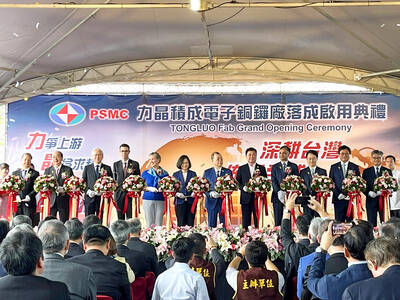
ARTIFICIAL INTELLIGENCE: The chipmaker last month raised its capital spending by 28 percent for this year to NT$32 billion from a previous estimate of NT$25 billion Contract chipmaker Powerchip Semiconductor Manufacturing Corp (力積電子) yesterday launched a new 12-inch fab, tapping into advanced chip-on-wafer-on-substrate (CoWoS) packaging technology to support rising demand for artificial intelligence (AI) devices. Powerchip is to offer interposers, one of three parts in CoWoS packaging technology, with shipments scheduled for the second half of this year, Powerchip chairman Frank Huang (黃崇仁) told reporters on the sidelines of a fab inauguration ceremony in the Tongluo Science Park (銅鑼科學園區) in Miaoli County yesterday. “We are working with customers to supply CoWoS-related business, utilizing part of this new fab’s capacity,” Huang said, adding that Powerchip intended to bridge

Microsoft Corp yesterday said that it would create Thailand’s first data center region to boost cloud and artificial intelligence (AI) infrastructure, promising AI training to more than 100,000 people to develop tech. Bangkok is a key economic player in Southeast Asia, but it has lagged behind Indonesia and Singapore when it comes to the tech industry. Thailand has an “incredible opportunity to build a digital-first, AI-powered future,” Microsoft chairman and chief executive officer Satya Nadella said at an event in Bangkok. Data center regions are physical locations that store computing infrastructure, allowing secure and reliable access to cloud platforms. The global embrace of AI

Qualcomm Inc, the world’s biggest seller of smartphone processors, gave an upbeat forecast for sales and profit in the current period, suggesting demand for handsets is increasing after a two-year slump. Revenue in the three months ended in June will be US$8.8 billion to US$9.6 billion, the company said in a statement Wednesday. Excluding certain items, earnings will be US$2.15 to US$2.35 a share. Analysts had projected sales of US$9.08 billion and earnings of US$2.16 a share. The outlook signals that the smartphone market has begun to bounce back, tracking with Qualcomm’s forecast that demand would gradually recover this year. The San


 RSS
RSS