


A panel of federal appeals-court judges in Manhattan handed the tobacco industry a victory on Friday by striking down a sweeping proposal by a judge in Brooklyn to organize a single high-stakes trial that might have subjected the industry to billions of dollars in damages.
Three judges of the 2nd US Circuit Court of Appeals ruled unanimously against the proposal of Judge Jack Weinstein of Federal District Court in Brooklyn, saying his plan was flawed for technical reasons.
The proposal was returned to Weinstein's court.
Whether the high-stakes trial would ever reach a courtroom turned on technical legal issues such as who had the right to sue and enter what is known as a class action, and whether the proceeding was fundamentally fair by placing a limit on potential damages.
In September 2002, Weinstein proposed presiding over a national trial that would not assess individual claims for compensation, but would decide only whether the cigarette companies should be assessed punitive damages because of the harm done to smokers and their survivors.
A single industry fund to pay potential punitive damages would be established. The class for the trial, with some exceptions, would be all current and former smokers of the defendant companies' cigarettes since April 1993.
In their 37-page ruling released on Friday, the three appeals court judges found flaws in Weinstein's proposal, especially in the membership of the class and the size of potential damages.

Cairo’s new monorail slices across the city skyline, running above the familiar chaos of blaring horns and aging buses’ exhaust fumes that mark rush hour below. The US$4.5 billion monorail, opened this month, is among Egypt’s most prominent new transport projects, part of a debt-funded infrastructure drive criticized for sapping state finances while bringing limited benefits to most of the country’s 109 million people. “It feels like you’re in a different country,” said Ramy Sayed, a restaurant manager, aboard a driverless Innovia 300 train. “No noise, no traffic, we’re not used to this.” The eastern line runs 56km from the bustling middle-class

Taiwanese firms have increased investment in the Philippines in recent years as Manila’s ties with Washington deepen and global supply chains continue to shift away from China, an expert at the Chung-Hua Institution for Economic Research (CIER, 中華經濟研究院) said yesterday. The Philippines had not been among Taiwanese investors’ top choices in Southeast Asia, CIER Taiwan ASEAN Studies Center director Kristy Hsu (徐遵慈) said at a seminar in Taipei. However, Taiwan’s investment in the country has grown significantly since the COVID-19 pandemic, reaching US $257 million last year, a high in recent years, she said. Although Taiwan’s total investment in the Philippines still lags
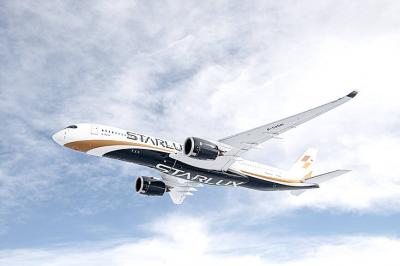
Starlux Airlines Co (星宇航空) today unveiled a long-haul network expansion plan at a shareholders’ meeting in Taipei, including direct flights to Barcelona, Spain, and Zurich, Switzerland, as well as a service connecting Taipei, Sydney and New Zealand. Starlux is to become the first Taiwanese carrier to offer non-stop services to the two European cities, while the inaugural oceanic route is expected to expand transit opportunities within the Australia-New Zealand market, Starlux said. Flight services to Chicago, Dallas, Washington and New York are under evaluation, the airline added. Prior to the shareholders’ meeting, the airline earlier this year announced that it would be

Intel Corp regards Taiwan Semiconductor Manufacturing Co (TSMC, 台積電) as a longstanding partner, as the US chipmaker would continue outsourcing production of advanced chips to TSMC, Intel chief executive officer Lip-Bu Tan (陳立武) said yesterday. “I don’t look at people as competitors. I look at the collaboration... Nvidia is also, you know, a good friend,” Tan told a news conference following his keynote speech at the Computex trade show in Taipei. “It’s a very trusted partnership for us... We are a big, top customer for them, and we’re going to continue doing that,” he said, referring to TSMC, the world’s largest foundry


 RSS
RSS