


Service stations across China are starting to run short on diesel this spring, while electricity blackouts here in southeastern China are growing worse as power stations cut back on purchases of fuel oil.
For truckers and factory owners, the diesel and electricity shortages are a nuisance, sometimes a costly one. The Guangzhou Boaosi Appliance Co., which makes refrigerators here, is without electricity from the municipal grid four days a week, and just bought a costly generator last month to continue operating on diesel.
The diesel and power shortages have one thing in common: they are largely the result of the clash between China's Communist past and its increasingly capitalist present. The government has set retail prices too low for diesel and electricity. So businesses, facing high world oil prices, are supplying less of both.
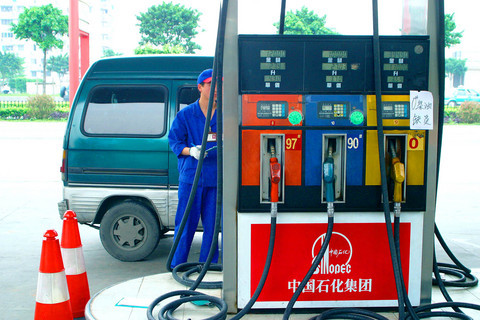
PHOTO: NY TIMES
Disruptions in Chinese markets for fuel oil, diesel and other oil products are causing ripples in global markets in turn, as traders and investors around the world struggle to interpret the effects on international oil supply and demand.
The puzzle for oil analysts is how Chinese households, factory owners and refinery managers will react when the government eventually liberalizes prices, which is expected in the next few weeks. Government officials have already announced that they will raise retail electricity prices for industrial users, although probably not homes, on May 1. An increase in diesel prices is also widely expected.
As buyers of everything from cotton pajamas to construction equipment gathered here from around the world Friday for the opening of the two-week Canton Trade Fair, the nearest Sinopec service station had signs on all its diesel pumps saying they were sold out of fuel, though the gasoline pumps were still flowing. A couple of trucks loitered nearby. In contrast, lines of trucks waiting for diesel have been reported at scattered service stations elsewhere in China over the last few days.
The Chinese government raised the regulated retail price of gasoline by 7 percent on March 23, to US$1.66 a gallon. But it left diesel unchanged at US$1.57 a gallon to avoid antagonizing farmers, who need a lot of diesel in their tractors for spring planting.
Speculators across China have responded by hoarding diesel in the expectation of a price increase after the planting, said Evan Jia, a spokesman for Sinopec, China's main refiner.
To make matters worse, refiners shifted at the end of last year toward producing more gasoline and less diesel from each barrel of oil. They have refused to go back on that decision, even stepping up exports of diesel in response to low prices at home.
"We do not want the marketplace to give us indications" of how much diesel to produce, when it is hoarding that is driving the market, Jia said.
At the same time, half of the fuel oil-fired power stations here in Guangdong province have been closed for part or all of the last month. Global prices for fuel oil, a heavy oil not used much in the West but relied on by the Chinese to power many electric plants, have climbed sharply, but power companies have not been allowed to charge more for the electricity they produce; the government-controlled Shenzhen Daily recently reported that fuel-oil imports had dropped by half last month.
A small increase in diesel and electricity prices could have the counter- intuitive effect of increasing China's oil imports, said Jeff Brown, an oil demand analyst at the International Energy Agency in Paris.
A small increase could make refiners willing to sell more diesel and power companies willing to generate more electricity, while having little effect on residents' desire to buy diesel and power, he explained.
But a larger increase in diesel and electricity prices could dampen over all Chinese demand, by persuading Chinese vehicle owners and factory managers to conserve. This could potentially hurt oil consumption and prices around the world.
Nobody knows how large an increase would be needed to hurt Chinese demand significantly. "It's just a mess trying to forecast this," Brown said.
To be sure, central planning has also had advantages for China's energy markets. Sweeping aside environmental, land use and financial hurdles that can delay power stations in the West for years, China has embarked on a binge of construction of new power plants, many of them coal-fired.
These are already starting to make blackouts less common elsewhere in China and hold the promise of eventually letting the electricity supply catch up with demand even here in the Pearl River Delta, which rivals the Yangtze River Delta around Shanghai as one of China's two main export powerhouses.
Henry Zhang, the general manager of the Shishi Hengyi Textile Product Trade Company in Shishi City in east-central China, said that his factory had already noticed an improvement. The factory was blacked out two days a week in 2003, a day a week last year and this year, none at all.
"This year, we have no problems," he said.
But blackouts have been a serious problem for years here in Guangzhou, the biggest city in the Pearl River Delta, and they are worse this spring as oil-fired plants have shut down, though coal-fired power plants have kept running.
Diesel generators have become a necessity for factories across much of China in the last few years, as electricity demand has soared past supply, and they have helped turn China into the world's second-largest oil importer, after the United States. Factories receive priority in diesel shipments, and 19 representatives of companies from across China said in separate interviews at the trade fair here that they had not had trouble buying enough diesel to refill their fuel tanks periodically.
Yet the generators are costly in many ways.
The diesel alone costs two to three times as much per kilowatt generated as electricity from power plants, managers complain, and on top of that are labor costs for maintenance and operation as well as the cost of the generator and the cost of space to put the generator and its fuel tank.
The generators, particularly older, domestically manufactured models, also rank among the biggest polluters in a country with some of the worst air pollution.
Generator sales are an important barometer of long-term business confidence in the national power grid. But while China has moved ahead of the United States to become the world's largest market for industrial-size generators, there are signs that some businesses are hoping the country's overburdened power stations will catch up.
At Cummins Inc., generator sales surged last year but have evened out at that high level so far this year, said John Watkins, the president of the company's East Asian operations.

China has claimed a breakthrough in developing homegrown chipmaking equipment, an important step in overcoming US sanctions designed to thwart Beijing’s semiconductor goals. State-linked organizations are advised to use a new laser-based immersion lithography machine with a resolution of 65 nanometers or better, the Chinese Ministry of Industry and Information Technology (MIIT) said in an announcement this month. Although the note does not specify the supplier, the spec marks a significant step up from the previous most advanced indigenous equipment — developed by Shanghai Micro Electronics Equipment Group Co (SMEE, 上海微電子) — which stood at about 90 nanometers. MIIT’s claimed advances last

Taiwan Semiconductor Manufacturing Co (TSMC, 台積電) has appointed Rose Castanares, executive vice president of TSMC Arizona, as president of the subsidiary, which is responsible for carrying out massive investments by the Taiwanese tech giant in the US state, the company said in a statement yesterday. Castanares will succeed Brian Harrison as president of the Arizona subsidiary on Oct. 1 after the incumbent president steps down from the position with a transfer to the Arizona CEO office to serve as an advisor to TSMC Arizona’s chairman, the statement said. According to TSMC, Harrison is scheduled to retire on Dec. 31. Castanares joined TSMC in

EUROPE ON HOLD: Among a flurry of announcements, Intel said it would postpone new factories in Germany and Poland, but remains committed to its US expansion Intel Corp chief executive officer Pat Gelsinger has landed Amazon.com Inc’s Amazon Web Services (AWS) as a customer for the company’s manufacturing business, potentially bringing work to new plants under construction in the US and boosting his efforts to turn around the embattled chipmaker. Intel and AWS are to coinvest in a custom semiconductor for artificial intelligence computing — what is known as a fabric chip — in a “multiyear, multibillion-dollar framework,” Intel said in a statement on Monday. The work would rely on Intel’s 18A process, an advanced chipmaking technology. Intel shares rose more than 8 percent in late trading after the

FACTORY SHIFT: While Taiwan produces most of the world’s AI servers, firms are under pressure to move manufacturing amid geopolitical tensions Lenovo Group Ltd (聯想) started building artificial intelligence (AI) servers in India’s south, the latest boon for the rapidly growing country’s push to become a high-tech powerhouse. The company yesterday said it has started making the large, powerful computers in Pondicherry, southeastern India, moving beyond products such as laptops and smartphones. The Chinese company would also build out its facilities in the Bangalore region, including a research lab with a focus on AI. Lenovo’s plans mark another win for Indian Prime Minister Narendra Modi, who tries to attract more technology investment into the country. While India’s tense relationship with China has suffered setbacks


 RSS
RSS