


Each day, 50,000 shiny, fire-engine-red Gala apples work their way through a sprawling factory in Swedesboro, New Jersey. Inside, 26 machines wash them, core them, peel them, seed them, slice them and chill them. At the end of the line they are dunked in a solution of calcium ascorbate and then deposited into little green bags featuring a jogging Ronald McDonald.
From there, the bags make their way in refrigerated trucks to refrigerated containers in cavernous distribution centers, and then to thousands of McDonald's restaurants up and down the Eastern Seaboard. No more than 14 days after leaving the plant, the fruit will take the place of French fries in some child's Happy Meal.
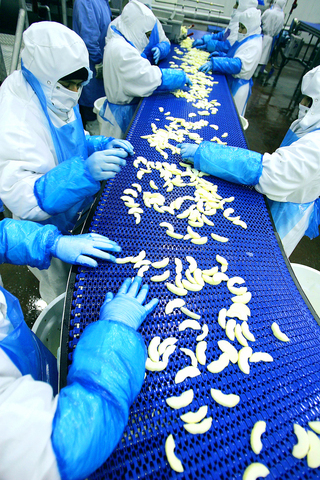
PHOTO: NY TIMES
The apple slices, called Apple Dippers, are one way that McDonald's is trying to offer healthier food to its customers -- and to answer the many critics who contend that almost everything else on its menu is of poor nutritional quality. McDonald's has also introduced "premium" California Cobb, Bacon Ranch and Caesar salads, a lineup that will soon be joined by a salad of grapes, walnuts -- and, of course, apples.
It remains to be seen whether these new offerings will assuage the concerns of public health officials and other critics of McDonald's highly processed fat- and calorie-laden sandwiches, drinks and fries. So far, they have not -- at least not entirely. But this much is already clear: Just as its enormous buying power and its staple burger-and-fries meals have made McDonald's the largest single buyer of beef and potatoes in the country, its new focus on fresh fruits and vegetables is making the company a major player in the US$80 billion American produce industry.
Influence
The potential impact goes beyond dollars and cents. Some people believe that McDonald's could influence not only the volume, variety and prices of fruit and produce in the nation, but also how they are grown.
The company now buys more fresh apples than any other restaurant or food service operation, by far. This year, it expects to buy 54 million pounds of fresh apples -- about 135 million individual pieces of fruit. That is up from zero apples just two years ago. (This does not include fruit used to make juice and pies, which use a different quality of apple.)
And it is not just apples: McDonald's is also among the top five food-service buyers of grape tomatoes and spring mix lettuce -- a combination of greens like arugula, radicchio and frisee. The boom has been so big and so fast that growers of other produce, like carrots and oranges, are scrambling for a piece of the action.
Of course, other fast-food chains have similar salads and fruit choices on their menus, but they have not had a comparable influence on the market because of their size. Burger King, for example, has 7,600 stores in the United States, while Wendy's has 5,900 and Arby's has 3,300. McDonald's has 13,700.
While salads have been offered at McDonald's in some form or another since the late 1980s, this is the first time they have been big sellers, and it is the first time the chain has sold fruit of any kind that did not reside between two layers of pie crust. Missa Bay, the company that runs the Swedesboro plant, which is one of six McDonald's apple slicing facilities around the country, could not be happier about that.
"McDonald's is really pioneering the concept of ready-to-eat sliced apples," said Sal Tedesco, the chief operating officer of Missa Bay, which built the new production line specifically to process apple slices for McDonald's.
In a few months, Missa Bay, owned by Ready Pac Produce of Irwindale, California, will also be supplying roughly one-quarter of McDonald's 13,700 stores with sliced green apples for the new fruit salad, which is scheduled to be introduced in May. Tedesco said that these two items would increase Missa Bay's revenue by at least 10 percent this year.
Power
With those kinds of numbers comes power. Just as the enormous size of McDonald's once helped the company turn the nation's beef, chicken and potato industries into highly mechanized, consistent, efficient and low-cost businesses, McDonald's is using its purchasing decisions to build a reliable supply of fresh fruits and vegetables that meet its exacting specifications.
At the annual Apple Crop Outlook and Marketing Conference of the US Apple Association at the Four Seasons Hotel in Chicago, Mitch Smith, the McDonald's director of quality systems in the United States, told a crowd of apple growers, many from the big apple-producing states of Washington and New York, that if they wanted to work with McDonald's they should grow more Cameo and Pink Lady apples. Historically, growers have produced relatively few apples of these varieties, but McDonald's likes them for their crispness and flavor.
Already, Cameo production in the state of Washington is up 58 percent in the current crop year from a year ago, according to the Yakima Valley Growers-Shippers Association.
Eventually, an increased supply of certain varieties will drive prices down, which will be good for McDonald's. But right now, the presence of a big buyer in the market is keeping prices high. James R. Cranney Jr., vice president of the US Apple Association, said that McDonald's was one of the reasons that apple prices had not declined this year, despite favorable growing conditions that produced an abundant crop. "When you've got such a big buyer like that it's going to keep the prices from falling," Cranney said.
If the new power which McDonald's exerts over the produce industry ends up reducing prices and squeezing margins, Cranney said, it would be a tradeoff that many growers and processors seem willing to accept. "Apple consumption has been flat over the past 10 to 15 years," he said. "This is exactly what the apple industry needs because we think it's going to increase consumption."
J.M. Procacci, chief operating officer of the Procacci Brothers Sales Corp. in Cedarville, New Jersey, said that sales of grape tomatoes, climbing for the past five years, have received a particular boost from their inclusion in the McDonald's premium salads. Since early 2003, grape tomato sales in the United States have risen 25 percent; he attributes a significant part of the gain to McDonald's.
Green Versus Grease
For decades, of course, McDonald's has been buying produce like iceberg lettuce, tomatoes and onions for its hamburgers and other sandwiches. But the premium salads -- unlike their poor-selling predecessors, the Shaker salads that came in plastic cups -- are an entree and have found a considerable following.
Michael Donahue, who is the McDonald's vice president for communication and customer satisfaction, said that the salads now on the company's menu are among the most successful introductions in the past 10 years. While the double cheeseburger is still the most beloved single item -- 1.5 billion of them are ordered every year in the United States -- Donahue said the company has sold more than 300 million of the premium salads since their introduction in March 2003.
At US$4 a salad, that translates to roughly US$600 million a year, or 10 percent of McDonald's domestic revenue last year. "The salads have definitely been a driver for McDonald's sales in the US," said John Glass, an analyst at CIBC. The European versions, called Salads Plus, were introduced in 2004 and have been selling well in some markets, according to Glass.
Donahue conceded that the Shaker salads "did not resonate with customers" -- the company sold only about 20 million in the 18 months they were on sale -- in part because customers did not like the idea of eating salad from a plastic cup.
Changing Minds
The excitement over salads at the McDonald's corporate headquarters in Oak Brook, Ill., has as much to do with public opinion as rising sales. Five months before the salads were introduced, two overweight, burger-loving New York teenagers filed a lawsuit accusing McDonald's of making them fat, prompting a debate over what role the chain has played in the nation's expanding waistlines. Many had already come to see McDonald's as a symbol of everything that is wrong with the American food supply.
"Salads have changed the way people think of our brand," said Wade Thoma, vice president of menu management in the United States. "It tells people that we are very serious about offering things people feel comfortable eating."
It helps if healthy food looks nice, too. The premium salads were designed, in part, for aesthetic appeal. Cheap and reliable iceberg and romaine account for 90 percent of the lettuce in the salad, but the 10 percent smattering of spring mix is intended to make the salads more attractive to the eye as well as the palate.
The carrots in the salads, for example, are sliced so thin that customers are lucky if they end up eating one-quarter of a small carrot, but the delicate slices don't fall to a puddle at the bottom of the bowl. "Women look at the salads and say, `It's beautiful,"' said Spiller, proudly. About 80 percent of McDonald's salad buyers are women, she added.
Healthier fare does not come cheap, for McDonald's or its customers. Fruit and vegetables are much more expensive and complicated to ship and store than are meat and potatoes. Unlike meat patties, chicken breasts, French fries and other items on McDonald's menu, salads and fruit cannot be frozen and stored for a month in distribution centers. Shipments of Apple Dippers and salad components leave McDonald's warehouses several times a week, which is part of the reason salads cost US$4 and everything else can be had for less than US$2.
The care required for perishable food also raises the costs. Spring mix is much more delicate than iceberg and romaine lettuce and is twice as expensive, said Bill Zinke, vice president for marketing at Ready Pac, which supplies McDonald's with all three kinds of lettuce. "It's almost like you have to protect every leaf," he said.
Similarly, grape tomatoes, which dot the lettuce on McDonald's salads, are more than double the price of plum or standard tomatoes.
Despite the fragility of the salads and fruit, McDonald's says that it does not use any artificial preservatives or additives to keep them fresh longer. The calcium ascorbate in the Apple Dippers is not much different from the orange or lemon juice that many people pour on their homemade fruit salad to keep it from browning.
At Ready Pac's plant in Irwindale, California, oxygen is sucked out of the large lettuce packing bags and replaced with nitrogen, an inert gas. This is the same process used on bags of lettuce sold in supermarkets, and, as a result, the McDonald's supply of spring mix lasts about the same as they do: 14 days. Because of that, said Smith, the McDonald's executive, "we have to have a very tight-knit distribution network."
Limited Value
Some critics bristle at the notion that McDonald's has somehow become healthier simply because it uses natural dressings and sell salads and some fruit. "Nearly all the entree choices at McDonald's -- as well as Burger King and Wendy's -- are still all of poor nutritional value," said Margo Wootan, director of nutritional policy at the Center for Science in the Public Interest, a food activist group. "I applaud them for making those changes, but there's still a lot more that needs to be done."
Wootan also points out that the Apple Dipper caramel sauce, which is packaged separately, has nine grams of sugar, which is one-quarter of the total recommended daily limit under the new USDA guidelines.
Other advocacy groups said that they are hopeful that McDonald's will one day use its power not only to get better prices and greater supply, but also to change the way the produce industry operates -- for the better. Ronnie Cummins, national director of the Organic Consumers Association, an advocacy group based in Little Marais, Minnesota, said he would like to see McDonald's buy some organic products, which he believes are more healthful for consumers.
In a 2003 report on pesticides in produce, the Environmental Working Group, a public-policy outfit based in Washington, ranked apples as the third most contaminated produce group, after peaches and strawberries. The findings were based on tests done by the US Department of Agriculture and the Food and Drug Administration from 1992 to 2001.
"McDonald's could have a huge impact," Cummins said. "They could be the company that changes agriculture toward a more organic and sustainable model." It may sound far-fetched, but from a company that's come a long way from the days of selling mainly hamburgers and fries, anything is possible.

China has claimed a breakthrough in developing homegrown chipmaking equipment, an important step in overcoming US sanctions designed to thwart Beijing’s semiconductor goals. State-linked organizations are advised to use a new laser-based immersion lithography machine with a resolution of 65 nanometers or better, the Chinese Ministry of Industry and Information Technology (MIIT) said in an announcement this month. Although the note does not specify the supplier, the spec marks a significant step up from the previous most advanced indigenous equipment — developed by Shanghai Micro Electronics Equipment Group Co (SMEE, 上海微電子) — which stood at about 90 nanometers. MIIT’s claimed advances last

ISSUES: Gogoro has been struggling with ballooning losses and was recently embroiled in alleged subsidy fraud, using Chinese-made components instead of locally made parts Gogoro Inc (睿能創意), the nation’s biggest electric scooter maker, yesterday said that its chairman and CEO Horace Luke (陸學森) has resigned amid chronic losses and probes into the company’s alleged involvement in subsidy fraud. The board of directors nominated Reuntex Group (潤泰集團) general counsel Tamon Tseng (曾夢達) as the company’s new chairman, Gogoro said in a statement. Ruentex is Gogoro’s biggest stakeholder. Gogoro Taiwan general manager Henry Chiang (姜家煒) is to serve as acting CEO during the interim period, the statement said. Luke’s departure came as a bombshell yesterday. As a company founder, he has played a key role in pushing for the

EUROPE ON HOLD: Among a flurry of announcements, Intel said it would postpone new factories in Germany and Poland, but remains committed to its US expansion Intel Corp chief executive officer Pat Gelsinger has landed Amazon.com Inc’s Amazon Web Services (AWS) as a customer for the company’s manufacturing business, potentially bringing work to new plants under construction in the US and boosting his efforts to turn around the embattled chipmaker. Intel and AWS are to coinvest in a custom semiconductor for artificial intelligence computing — what is known as a fabric chip — in a “multiyear, multibillion-dollar framework,” Intel said in a statement on Monday. The work would rely on Intel’s 18A process, an advanced chipmaking technology. Intel shares rose more than 8 percent in late trading after the

GLOBAL ECONOMY: Policymakers have a choice of a small 25 basis-point cut or a bold cut of 50 basis points, which would help the labor market, but might reignite inflation The US Federal Reserve is gearing up to announce its first interest rate cut in more than four years on Wednesday, with policymakers expected to debate how big a move to make less than two months before the US presidential election. Senior officials at the US central bank including Fed Chairman Jerome Powell have in recent weeks indicated that a rate cut is coming this month, as inflation eases toward the bank’s long-term target of two percent, and the labor market continues to cool. The Fed, which has a dual mandate from the US Congress to act independently to ensure


 RSS
RSS