


In almost every panel discussion at the annual meeting of the World Economic Forum, there comes a moment when somebody mentions China.
A hush typically ensues, as panelists draw their breath, gather their thoughts and struggle to put the bewildering vastness of the topic into a few words.
"China is going to be the change agent for the next 20 years," said Bill Gates, the chairman of Microsoft, when asked about the country's future on a panel led by the television interview host Charlie Rose.
China's staggering potential, coupled with the steep language barrier and cultural discomfort of many Chinese who come to this conference, has made it Davos's annual enigma.
After three days of outsiders' dissecting its motives and prospects, China finally took the stage on Saturday, with a speech by its executive vice prime minister, Huang Ju (
"China's development will by no means pose a threat to other countries," Huang declared cheerfully, as if to soothe people here who spent the week fretting about China's lengthening shadow.
Huang, however, said little on the two issues of overriding importance to the investors and business people here: whether China would allow its currency to rise against the US dollar, and whether the Chinese would crack down on the rampant theft of intellectual property.
"We have to maintain the exchange rate at a reasonable level," said Huang, who directs China's finance policy and was billed by the organizers as Beijing's chief operating officer.
Some here interpreted that comment as a signal that China would not allow its currency, the yuan, to rise against the US dollar this year, as some Europeans and Americans have demanded. But Michael S. Dell, the chairman of Dell Inc, who had breakfast with Huang, said he did not draw any conclusions.
Huang also did little to ease investors' concerns about China's regard for intellectual property rights, saying only that through new laws and tougher enforcement, China was trying to achieve in a dozen years what it had taken the Western world a century to do.
At a dinner with the theme of investing in China, several foreign executives said they discerned little progress on the issue. The only way to avoid having their proprietary technology pilfered by Chinese competitors, they said, was to keep most research and development activities at home, and to use China for simple manufacturing.
For the Chinese who trek to this Alpine ski resort, the problem is less one of legal tradition than cultural disconnect. Except for a handful of fluent English speakers with long experience with foreigners, most keep to themselves - shying away from the high-octane networking that is the fuel of Davos.
"Davos's history is as a European and American conference," said Chen Feng (
Chen, an irrepressible entrepreneur who worked the hallways like a Davos regular, is one of only four chief executives of major Chinese companies at this year's conference. He said more of his peers had come to previous meetings, but had found the experience uncomfortable.
Zhao Jianfei, an editor at The Observer, a Shanghai-based magazine, said, "In China, the basic idea is to watch Davos, not take part in it."
People have other theories for why the Chinese do not turn out in droves. "China is not exactly soliciting investment," said Stephan F. Newhouse, the president of Morgan Stanley. "They're turning it away."
Huang dramatized China's potential with forecasts. Its economic output will grow to US$4 trillion by 2020, from US$1.6 trillion today, he said, and its output per capita -- a more accurate measure of wealth -- will triple to US$3,000 per person.
For its part, the World Economic Forum says the Chinese turnout this year has been noteworthy, mostly because of the attendance of Huang, a member of the Politburo's powerful standing committee. The deputy governor of the People's Bank of China also came.
The conference organizers have gone to considerable lengths to make this a congenial place for China. There are no sessions on Taiwan -- a topic sure to drive away Chinese officials. Huang did not take questions from the audience.
"It's understood that some things about China don't come up in polite conversation at Davos," said Orville Schell, the dean of the Graduate School of Journalism at the University of California, Berkeley.
Politesse did break down occasionally. At a lunch held by Schell, several non-Chinese participants confronted the handful of Chinese guests about how Beijing could justify not allowing the Taiwanese people to vote on whether they wanted to be an independent nation.
After an awkward silence, a few Chinese spoke about the passionate feelings in China regarding Taiwan's status. Yuan Ming, the director of the Institute of American Studies at Pekjing University, alluded to the frustration that outsiders might have in seeking to understand China.
"The world needs China to play some roles," Yuan said in a polite yet weary tone. "But it's too early to rank ourselves among world nations. We do need some time to develop ourselves."

Cairo’s new monorail slices across the city skyline, running above the familiar chaos of blaring horns and aging buses’ exhaust fumes that mark rush hour below. The US$4.5 billion monorail, opened this month, is among Egypt’s most prominent new transport projects, part of a debt-funded infrastructure drive criticized for sapping state finances while bringing limited benefits to most of the country’s 109 million people. “It feels like you’re in a different country,” said Ramy Sayed, a restaurant manager, aboard a driverless Innovia 300 train. “No noise, no traffic, we’re not used to this.” The eastern line runs 56km from the bustling middle-class

Taiwanese firms have increased investment in the Philippines in recent years as Manila’s ties with Washington deepen and global supply chains continue to shift away from China, an expert at the Chung-Hua Institution for Economic Research (CIER, 中華經濟研究院) said yesterday. The Philippines had not been among Taiwanese investors’ top choices in Southeast Asia, CIER Taiwan ASEAN Studies Center director Kristy Hsu (徐遵慈) said at a seminar in Taipei. However, Taiwan’s investment in the country has grown significantly since the COVID-19 pandemic, reaching US $257 million last year, a high in recent years, she said. Although Taiwan’s total investment in the Philippines still lags

Intel Corp regards Taiwan Semiconductor Manufacturing Co (TSMC, 台積電) as a longstanding partner, as the US chipmaker would continue outsourcing production of advanced chips to TSMC, Intel chief executive officer Lip-Bu Tan (陳立武) said yesterday. “I don’t look at people as competitors. I look at the collaboration... Nvidia is also, you know, a good friend,” Tan told a news conference following his keynote speech at the Computex trade show in Taipei. “It’s a very trusted partnership for us... We are a big, top customer for them, and we’re going to continue doing that,” he said, referring to TSMC, the world’s largest foundry
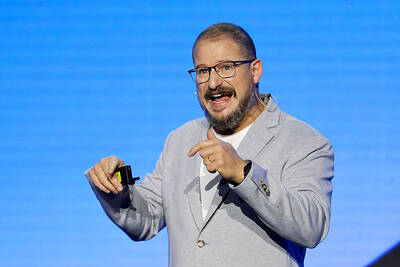
Artificial intelligence (AI) agents would supplant smartphones as the center of people’s digital lives, fundamentally reshaping personal devices and driving a major computing upgrade cycle, Qualcomm Inc CEO Cristiano Amon said yesterday. In his keynote speech for this year’s Computex trade show in Taipei, Amon said that the rise of "agentic AI" — AI systems capable of reasoning, planning and carrying out tasks autonomously — would transform how people interact with technology across phones, PCs, vehicles and wearable devices. Describing the technology as the next major evolution in computing, Amon said that "2026 is the year of agents.” For decades, smartphones have sat


 RSS
RSS