


In politics, Wu Nai-jen (吳乃仁) is a Democratic Progressive Party (DPP) heavyweight who has mas-terminded clearly thought-out campaign strategies and reform plans from behind the scenes. But as chairman of the Taiwan Stock Exchange Corp (台灣證交所), Wu is an undaunted dealmaker and reformer, who vows to stand up against poor corporate performers and to maintain law and order on the bourse.
"I am well-suited to play the role of bad cop since I have a dark complexion, which my Mom is to blame for," said Wu, who likes to joke about his not-so-attractive looks while puffing on a cigarette.
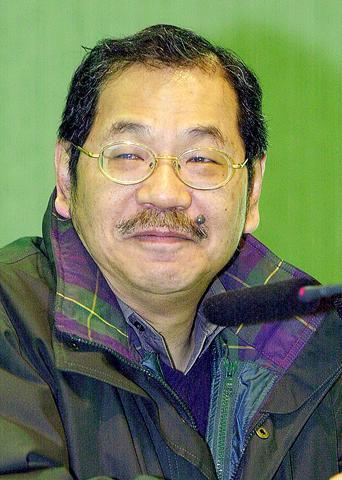
FILE PHOTO: THE TAIPEI TIMES
One month after taking office, Wu shocked his 500 employees by ruthlessly shoving eight vice presidents, all aged over 55, into early retirement without any warning, and announcing 30 older employees would be laid off each year.
"Young talent should be recruited to bring in new ideas," Wu said. "What I place emphasize on for employees is more aggressiveness than experience."
Wu said he was astonished to discover that the Taiwan Stock Exchange Corp had not recruited new employees for 10 years, and so he hopes to inject "new blood" into the quasi-governmental body.
"My goal is to run the bourse like a business -- as far from a quasi-governmental institution as possible," Wu said.
Wu may be a ruthless boss, but his vision is to build a stock exchange platform that uses international standards, and to ensure that all listed companies accurately file accurate financial reports.
In less than five months, Wu has made headway in combating financial crimes. In the wake of the Procomp Informatics Ltd (
"The way he handled these defaulted companies was quite impressive and straightforward," said William Lin (林蒼祥), a finance professor at Tamkang University, praising the move to tighten monitoring rules.
Lin also praised the way Wu took the initiative in disclosing Summit Computer Technology's (皇統科技) financial manipulations, so that individual investors -- who make up 75 percent of the nation's stock investors -- would not be hurt too badly since better-informed institutional investors and traders often dump shares beforehand.
"His efforts to attract talented people to the bourse, accelerate its internationalization and protect individual investors, who are usually less informed, should be recognized," Lin said.
To improve the capital market's health and set up an early-warning system, Wu plans to have the Taiwan Stock Exchange Corp revise its contracts with listed companies in order to impose greater liabilities on everyone who helps compile the companies' financial reports. He also wants the bourse to have more power to review listed company's financial reports for irregularities.
Despite his accomplishments on the job, Wu's outspokenness and his lack of job credentials for the NT$5 million post still raise eyebrows.
Market watchers consider him to be the most powerful exchange chairman in a decade -- because of his political influence, not his professionalism. He is regarded as President Chen Shui-bian's (陳水扁) proxy, keeping an eye on the more than 600 listed companies.
But DPP Legislator Lee Wen-chung (李文忠), who belongs to Wu's New Tide faction (新潮流) in the party, has a different take.
Lee praised Wu as an "idealist who is unlikely to bow to either political or business pressures" while enforcing reforms.
He is also a practical and goal-oriented businessman with leadership ability, who has a great deal of experience in administering the DPP's talent pool, Lee said. He said Wu's political clout and associations should be seen as a positive.
"His close connections [with Chen] will make it easier for him to reform the bourse," Lee said. "Empowered by higher-ups, Wu won't hesitate to eliminate the deep-rooted bad practices in the market."
Wu, 56, was born into a rich family in central Taichung and had never been on a payroll until 2000, when he started getting a paycheck after succeeding political crony Chiu I-jen (邱義仁) to the post of DPP secretary-general.
After witnessing the Chinese Nationalist Party (KMT) tampering with votes at an Ilan polling station, Wu joined the opposition movement in his 20s and devoted himself to the DPP's growth and the nation's democratization.
He was appointed to head state-owned Taiwan Sugar Corp (Taisugar, 台糖) in 2002, but never really quit politics. His decision to leave Taisugar and throw himself into the 2004 presidential campaign led to criticism in July that his appointment was a political payoff.
Some people have questioned how well he can do his job when a controversy hangs over his wife, Chan Tsai-hung (詹彩虹).
Chan rose from a middle-rank employee at the Bank of Taiwan before 2000 to president of the Securities and Futures Investors Protection Center (證券投資人及期貨交易人保護中心).
Such criticism, however, has never bothered Wu, who believes that the couple's performance will eventually silence their critics.

China has claimed a breakthrough in developing homegrown chipmaking equipment, an important step in overcoming US sanctions designed to thwart Beijing’s semiconductor goals. State-linked organizations are advised to use a new laser-based immersion lithography machine with a resolution of 65 nanometers or better, the Chinese Ministry of Industry and Information Technology (MIIT) said in an announcement this month. Although the note does not specify the supplier, the spec marks a significant step up from the previous most advanced indigenous equipment — developed by Shanghai Micro Electronics Equipment Group Co (SMEE, 上海微電子) — which stood at about 90 nanometers. MIIT’s claimed advances last

ISSUES: Gogoro has been struggling with ballooning losses and was recently embroiled in alleged subsidy fraud, using Chinese-made components instead of locally made parts Gogoro Inc (睿能創意), the nation’s biggest electric scooter maker, yesterday said that its chairman and CEO Horace Luke (陸學森) has resigned amid chronic losses and probes into the company’s alleged involvement in subsidy fraud. The board of directors nominated Reuntex Group (潤泰集團) general counsel Tamon Tseng (曾夢達) as the company’s new chairman, Gogoro said in a statement. Ruentex is Gogoro’s biggest stakeholder. Gogoro Taiwan general manager Henry Chiang (姜家煒) is to serve as acting CEO during the interim period, the statement said. Luke’s departure came as a bombshell yesterday. As a company founder, he has played a key role in pushing for the

EUROPE ON HOLD: Among a flurry of announcements, Intel said it would postpone new factories in Germany and Poland, but remains committed to its US expansion Intel Corp chief executive officer Pat Gelsinger has landed Amazon.com Inc’s Amazon Web Services (AWS) as a customer for the company’s manufacturing business, potentially bringing work to new plants under construction in the US and boosting his efforts to turn around the embattled chipmaker. Intel and AWS are to coinvest in a custom semiconductor for artificial intelligence computing — what is known as a fabric chip — in a “multiyear, multibillion-dollar framework,” Intel said in a statement on Monday. The work would rely on Intel’s 18A process, an advanced chipmaking technology. Intel shares rose more than 8 percent in late trading after the

GLOBAL ECONOMY: Policymakers have a choice of a small 25 basis-point cut or a bold cut of 50 basis points, which would help the labor market, but might reignite inflation The US Federal Reserve is gearing up to announce its first interest rate cut in more than four years on Wednesday, with policymakers expected to debate how big a move to make less than two months before the US presidential election. Senior officials at the US central bank including Fed Chairman Jerome Powell have in recent weeks indicated that a rate cut is coming this month, as inflation eases toward the bank’s long-term target of two percent, and the labor market continues to cool. The Fed, which has a dual mandate from the US Congress to act independently to ensure


 RSS
RSS