


France and China signed billions of dollars' worth of trade contracts Friday during a visit to Paris by Chinese Vice Premier Zeng Peiyan (曾培炎), cementing ties that have grown noticeably closer in recent months.
Airbus, the European aircraft maker based in the French city of Toulouse, announced it had inked a US$2 billion deal to supply 20 A330-300 planes to the airline China Eastern.
The aerospace subsidiary of the French telecommunications group Alcatel said it had sold a television satellite to the company ChinaSat to be operational in time for the 2008 Olympic Games in Beijing. Industry sources said that contract was worth around US$120 million.
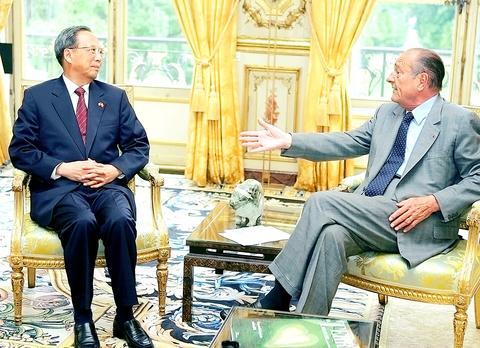
PHOTO: AP
Those and another seven contracts involving technical cooperation in the construction of nuclear energy plants, helicopters, planes and trains were signed in the presence of Zeng and French Prime Minister Jean-Pierre Raffarin.
"If each time we meet we sign as many agreements with so many jobs behind them as these agreements, I believe our cooperation with China will be very fruitful. It already is," Raffarin said.
Zeng, who is vice premier in charge of economy, met later Friday with President Jacques Chirac, who warmly welcomed the new contracts and agreements.
"They demonstrate that our companies are engaged in a true partnership process," he said.
Chirac's office confirmed that he would make a trip to China in October -- his third state visit to the country in seven years -- at the start of the Year of France in China, a series of events celebrating French culture and heritage.
The Chinese official's visit, and the high protocol greeting he was getting, underlined the relationship that is blossoming between France and China.
A known Sinophile, Chirac has pulled out all the stops to woo what has become the world's biggest emerging market, home to 1.2 billion people and boasting a red-hot economy that has expanded by nearly 10 percent this year.
When Chinese President Hu Jintao (
Since then, the two countries have forged closer links in the areas of politics, culture and -- most importantly -- trade.
Paris has moved away from its support of Taiwan and has restricted protests by overseas members of Falun Gong, the spiritual group declared illegal and subversive in China. It has also taken to avoiding criticism of China's poor human rights record.
In March, the two countries' navies carried out the biggest joint exercises China has ever held with a foreign country, near the northeastern Chinese port city of Qingdao.
France has declared this year the "Year of China," making the country the guest of honour at bookfairs, film festivals, and other cultural events -- and the close collaboration will continue throughout the "Year of France" in China, from October until July next year.
Later this year, France is to lend China 50 paintings worth 500 million euros by artists including Claude Monet and Pierre-Auguste Renoir for what will be the largest ever exhibition of impressionist art in Asia.
The upshot has been some sweet opportunities for French businesses looking to grab pieces of the Chinese market from US and other competitors.
The French government said in March it expected China would choose French company Alstom to build a high-speed rail link between Beijing and Shanghai, a US$12 billion project also being sought by Japanese and German groups.
Carrefour, a French supermarket chain that ranks among the world's biggest, has also been aggressively rolling out new stores in China, in fierce competition with Wal-Mart of the US and Metro of Germany.
Other sectors where French firms have been actively chasing opportunities are in aviation, mobile telephones and auto manufacturing.
With business ties growing stronger, France appears keen to further the political tandem developing with China. Both countries, which have permanent seats on the UN Security Council, have shown they are not ready to bow to US hegemony.
In a sign of the importance Chirac gives to the relationship with China, he returned from a G8 summit in the US to see the Chinese vice premier, making no time to pay his last respects to the late US president Ronald Reagan.
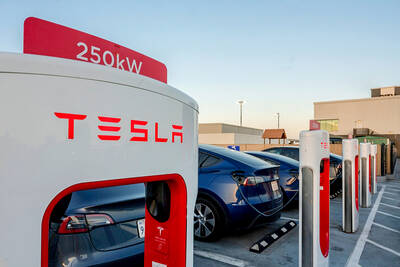
NEW IMPORTS: Car dealer PG Union Corp said it would consider introducing US-made models such as the Jeep Grand Cherokee and Stellantis’ RAM 1500 to Taiwan Tesla Taiwan yesterday said that it does not plan to cut its car prices in the wake of Washington and Taipei signing the Agreement on Reciprocal Trade on Thursday to eliminate tariffs on US-made cars. On the other hand, Mercedes-Benz Taiwan said it is planning to lower the price of its five models imported from the US after the zero tariff comes into effect. Tesla in a statement said it has no plan to adjust the prices of the US-made Model 3, Model S and Model X as tariffs are not the only factor the automaker uses to determine pricing policies. Tesla said

OpenAI has warned US lawmakers that its Chinese rival DeepSeek (深度求索) is using unfair and increasingly sophisticated methods to extract results from leading US artificial intelligence (AI) models to train the next generation of its breakthrough R1 chatbot, a memo reviewed by Bloomberg News showed. In the memo, sent on Thursday to the US House of Representatives Select Committee on China, OpenAI said that DeepSeek had used so-called distillation techniques as part of “ongoing efforts to free-ride on the capabilities developed by OpenAI and other US frontier labs.” The company said it had detected “new, obfuscated methods” designed to evade OpenAI’s defenses
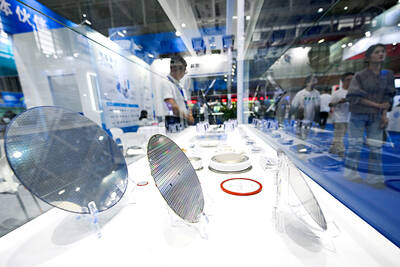
China’s top chipmaker has warned that breakaway spending on artificial intelligence (AI) chips is bringing forward years of future demand, raising the risk that some data centers could sit idle. “Companies would love to build 10 years’ worth of data center capacity within one or two years,” Semiconductor Manufacturing International Corp (SMIC, 中芯) cochief executive officer Zhao Haijun (趙海軍) said yesterday on a call with analysts. “As for what exactly these data centers will do, that hasn’t been fully thought through.” Moody’s Ratings projects that AI-related infrastructure investment would exceed US$3 trillion over the next five years, as developers pour eye-watering sums
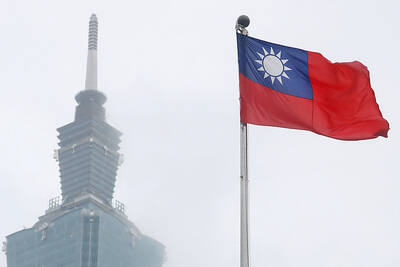
Bank of America Corp nearly doubled its forecast for the nation’s economic growth this year, adding to a slew of upgrades even after a rip-roaring last year propelled by demand for artificial intelligence (AI). The firm lifted its projection to 8 percent from 4.5 percent on “relentless global demand” for the hardware that Taiwanese companies make, according to a note dated yesterday by analysts including Xiaoqing Pi (皮曉青). Taiwan’s GDP expanded 8.63 percent last year, the fastest pace since 2010. The increase “reflects our sustained optimism over Taiwan’s technology driven expansion and is reinforced by several recent developments,” including a more stable currency,


 RSS
RSS