


US special envoy for Iraqi debt, James Baker, will visit Kuwait and Saudi Arabia yesterday after securing promises from the United Arab Emirates (UAE) and Qatar to waive most of Iraq's debts to the two states.
Baker "had a sucessuful and productive meeting in the UAE and in Qatar on the subject of Iraqi debts," a US administration official accompanying the special envoy said, requesting anonymity.
He said Baker would travel to Kuwait before visiting Saudi Arabia on the same issue.
The UAE announced Tuesday it would write off the bulk of some US$4 billion owed by Iraq to the oil-rich Gulf state.
Earlier Tuesday, a Qatari foreign ministry spokesman said Qatar would write off most of the debt owed by Iraq but officials in the gas-rich state were mum on the size of the debt.
The US official would not disclose the amount of debt owed to the UAE and Qatar.
"The UAE committed to forgive the vast majority of the Iraqi debts and aid [and] it was ready to begin negotiation quickly," the US official said.
For its part, "Qatar issued a statement stressing that debts reduction in 2004 is critical for Iraqi people to rebuild the country ... Qatar committed to forgive the vast majority of the Iraqi debts and said it will consider forgiving all of its debts," he said.
The US official welcomed the fact that "Qatar is the first announcing the possibility of forgiving all the debts," adding that Baker hailed the move by both states as an "important step forward" while there was "more work to do."
The White House said Monday Baker would visit Saudi Arabia on a trip lasting to today.
Saudi newspapers, quoting official sources, reported in October that Riyadh would only reschedule, not write off, an estimated US$28 billion owed by Iraq.
Saudi Arabia pledged US$1 billion of aid to Iraq at an international donors conference in Madrid in October. Half would be extended through the Saudi Development Fund and the balance used to "finance and guarantee exports to Iraq."
The former secretary of state has already visited Europe and Asia with Washington's message that Iraq's debt hampers US-led efforts to put that country on course for democracy and prosperity.
Earlier this month, Kuwait said Baker was not expected to include the issue of billions of dollars in war reparations Baghdad owes the emirate for its 1990 invasion and subsequent seven-month occupation.
Kuwait has filed compensation claims worth US$170 billion to the UN Compensation Commission, which has already approved some US$37 billion to the emirate and actually paid about US$9 billion.
Unofficial estimates put the amount of Iraq's debt to Kuwait at around US$15 billion without interest.
Most of the Kuwaiti money was given to Baghdad in the 1980s when Iraq was at war with neighboring Iran.
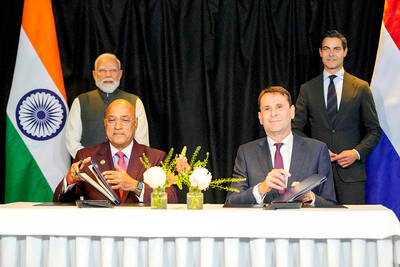
NEW MARKET: The partnership opens up India to the Dutch company, which already has a strong hold in the semiconductor market of South Korea, Taiwan and China ASML Holding NV entered into a partnership agreement with Tata Electronics Pvt Ltd aimed at ramping up India’s goal to develop domestic chip-manufacturing capabilities. The Dutch company’s technology would help power Tata Electronics’ planned 300 millimeter (mm) semiconductor foundry in Gujarat, according to a joint statement from the two companies on Saturday. The signing of a memorandum of understanding coincides with a visit by Indian Prime Minister Narendra Modi to the Netherlands, which is looking to deepen bilateral relations with New Delhi. ASML, whose top customers include Taiwan Semiconductor Manufacturing Co (台積電) and Samsung Electronics Co, makes lithography machines that can print

Tokyo Electron's Taiwan unit today said in a written response that it respects the judicial process, takes the court ruling seriously and would not appeal in the Taiwan Semiconductor Manufacturing Co (TSMC, 台積電) trade secrets case. Last month, a court fined the Taiwan unit of Japan's Tokyo Electron NT$150 million (US$4.74 million) in a case involving trade secrets related to TSMC's sensitive chip technology.
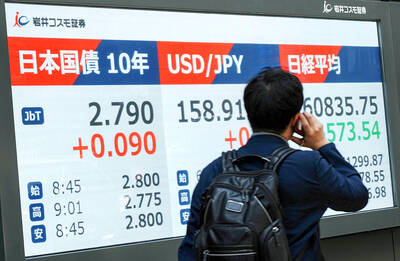
ROUGH RECORDS: Bonds in Japan, as well is in New Zealand, Australia and the US, are seeing the effects of a nervy market as stock exchanges across Asia edge down A deepening slump in Japanese government bonds added fuel to the selloff in global debt markets as rising oil prices stoked inflation fears and pushed yields to multi-decade highs. Japan’s 30-year yield yesterday surged as much as 20 basis points to the highest level since the tenor’s debut in 1999, before paring some of the move. Shorter-maturity Japanese debt was also under pressure, underscored by weak demand at a sale of five-year notes that offered a record-high coupon of 2 percent. Concerns over inflation and government spending rippling through markets including the US, Australia and New Zealand are being amplified in Japan,

TECH RELIANCE: Growth is increasingly reflecting an unequal K-shaped distribution, where technology sectors outperform and other industries struggle, an expert said Standard Chartered Bank has significantly raised its forecast for Taiwan’s economic growth to 9.5 percent this year, up from 7.6 percent previously, citing surging artificial intelligence (AI) demand driving exports, semiconductor production and investment. The upgrade reflects a sustained AI supercycle that continues to fuel demand for advanced chips and technology infrastructure, which form the backbone of Taiwan’s exports, the bank said in a report this week. “We raise our 2026 growth forecast to reflect a much stronger-than-expected first-quarter GDP figure,” Standard Chartered senior economist for greater China and Asia Tommy Wu (胡東安) said in the report. Driven largely by a 35.3 percent


 RSS
RSS