


Johnson & Johnson, the world's fourth-largest drugmaker, became the second overseas company in a month to lose a trademark dispute in China, a nation where as many as nine in 10 of some branded products are fake.
A Beijing court ruled against the US company after a six-year legal battle with a Chinese company that used a brandname resembling one of its own, the official Xinhua news agency said.
Toyota Motor Corp last month lost an 11-month lawsuit against a rival that the Japanese automaker claimed copied its logo.
The ruling against New Brunswick, New Jersey-based Johnson & Johnson comes after Premier Wen Jiabao (
Rampant piracy of overseas consumer goods, auto parts and software has fueled tensions over China's record trade surplus with the US, forecast to reach US$130 billion this year.
"China has come a long way in terms of intellectual property rights protection, but there's still a lot more to be done," said Walker Wallace, a lawyer with O'Melveny & Myers LLP in Shanghai.
US and European trade officials have criticized China for failing to boost lax protection of copyright and trademarks after the country joined the WTO in 2001.
Johnson & Johnson filed a suit against the State Administration for Industry and Commerce last May after the agency refused to revoke a trademark held by an unidentified Chinese company, Xinhua reported.
The private company, based in Wenzhou city in China's eastern Zhejiang province, registered the English language trademark "Careful" for its sanitary towel products in 1997, Xinhua said. Johnson & Johnson sells women's healthcare products under the "Carefree" brand.
Johnson & Johnson has appealed twice in the past six years to the agency to revoke the trademark, the report said.
The Chinese company exports to Europe and has registered its trademark in more than 10 countries, the report said.
The commerce administration's China Trade Mark Review and Adjudication Board ruled that the two trademarks were clearly different in pronunciation, formation and meaning, Xinhua said.
The US company may appeal to a higher court, the news agency quoted an unidentified lawyer representing Johnson & Johnson as saying.
Toyota on Nov. 24 lost a lawsuit against China's Geely Group Co (吉利), which it claimed used a logo on its Merrie cars that resembled the Japanese company's `T' marque.
The case, the first attempt by an overseas automaker to stop copying by domestic competitors, was closely watched by General Motors Corp, Volkswagen AG and Nissan Motor Co, which say their designs have also been copied by Chinese assemblers.
General Motors, the world's largest automaker, is investigating whether a US$5,800 minicar called the QQ made by SAIC Chery Automobile Co copies the design of its Spark, produced at a US$100 million joint venture with two Chinese partners.
Some overseas companies have won copyright cases in Chinese courts.
In February, Nike Inc won a trademark case against three clothing companies based in Zhejiang for unauthorized use of the "Nike" trademark.
In January, Lego A/S, the Danish maker of the namesake plastic toy building blocks, won a case in the Beijing High People's Court against a Chinese toymaker.
In the first 11 months of this year, Chinese courts handled 5,750 intellectual property lawsuits, an increase of 24.6 percent from the same period last year, Xinhua said.
Procter & Gamble Co has complained that copies of its products, such as Pampers diapers and Pantene shampoo, have cost the consumer-goods maker US$150 million in annual sales in China.
Copyright disputes aren't limited to consumer goods and autos. Starbucks Corp has said it may sue Shanghai-based Xingbake for copying the logo and Chinese-language name of the Seattle-based company.
More than 90 percent of software used in China is pirated, according to the Business Software Alliance.
The value of business software sales lost to piracy in China rose 40 percent to US$1.6 billion last year, the International Intellectual Property Alliance said in a report.
About 90 percent of spare car parts sold on the Chinese market are also fake, the official China Daily reported this month.

MAJOR BENEFICIARY: The company benefits from TSMC’s advanced packaging scarcity, given robust demand for Nvidia AI chips, analysts said ASE Technology Holding Co (ASE, 日月光投控), the world’s biggest chip packaging and testing service provider, yesterday said it is raising its equipment capital expenditure budget by 10 percent this year to expand leading-edge and advanced packing and testing capacity amid strong artificial intelligence (AI) and high-performance computing chip demand. This is on top of the 40 to 50 percent annual increase in its capital spending budget to more than the US$1.7 billion to announced in February. About half of the equipment capital expenditure would be spent on leading-edge and advanced packaging and testing technology, the company said. ASE is considered by analysts

TRANSFORMATION: Taiwan is now home to the largest Google hardware research and development center outside of the US, thanks to the nation’s economic policies President Tsai Ing-wen (蔡英文) yesterday attended an event marking the opening of Google’s second hardware research and development (R&D) office in Taiwan, which was held at New Taipei City’s Banciao District (板橋). This signals Taiwan’s transformation into the world’s largest Google hardware research and development center outside of the US, validating the nation’s economic policy in the past eight years, she said. The “five plus two” innovative industries policy, “six core strategic industries” initiative and infrastructure projects have grown the national industry and established resilient supply chains that withstood the COVID-19 pandemic, Tsai said. Taiwan has improved investment conditions of the domestic economy
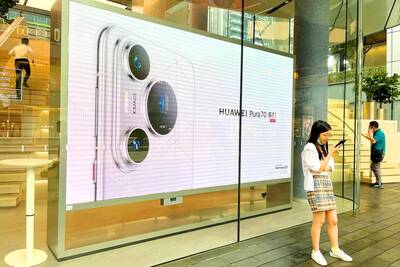
Huawei Technologies Co’s (華為) latest smartphones carry a version of the advanced made-in-China processor it revealed last year, results from an independent analysis showed. This underscored the Chinese company’s ability to sustain production of the controversial chip. The Pura 70 series unveiled last week sports the Kirin 9010 processor, research firm TechInsights found during a teardown of the device. This is a newer version of the Kirin 9000s, made by Semiconductor Manufacturing International Corp (SMIC, 中芯) for the Mate 60 Pro, which had alarmed officials in Washington who thought a 7-nanometer chip was beyond China’s capabilities. Huawei has enjoyed a resurgence since
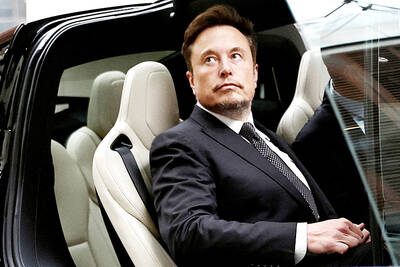
purpose: Tesla’s CEO sought to meet senior Chinese officials to discuss the rollout of its ‘full self-driving’ software in China and approval to transfer data they had collected Tesla Inc CEO Elon Musk arrived in Beijing yesterday on an unannounced visit, where he is expected to meet senior officials to discuss the rollout of "full self-driving" (FSD) software and permission to transfer data overseas, according to a person with knowledge of the matter. Chinese state media reported that he met Premier Li Qiang (李強) in Beijing, during which Li told Musk that Tesla's development in China could be regarded as a successful example of US-China economic and trade cooperation. Musk confirmed his meeting with the premier yesterday with a post on social media platform X. "Honored to meet with Premier Li


 RSS
RSS