


Tesco Stores Co Taiwan said the outlook for the nation's hypermarket sector remains positive and they are planning to open more outlets despite increasingly fierce competition.
The UK company, which entered the local market in 2000, said the sector still has plenty of room for growth and dismissed critics who say that the sector is reaching saturation.
"We plan to increase the number of Tesco outlets in Taiwan to 10 from the current six by the end of 2005," said Sarah Wu (
Tesco hopes the outlet expansion will help it grab a larger market share over the next two years.
The company takes about 4 percent of the NT$100 billion hypermarket retail market in Taiwan.
Wu said Tesco Taiwan is planning to boost its percentage of market share to nearly 10 percent by 2005.
NOT SATURATED
As Tesco expects to create a more than 10 percent increase in annual sales over the NT$4 billion it had last year, the sector is far from saturated, Wu said.
"Saturation is not a problem. What matters to hypermarket operators is how to enhance their competitiveness," she added.
This could be achieved by focusing on four areas, according to Wu: Prices, product range, services and value for money. Tesco has offered two promotions with 5 percent to 15 percent price cuts on 1,500 items this year.
In addition to the more than 45,000 kinds of products placed on the shelves, the company's executives often meet face-to-face with customers in a bid to determine their needs.
"These approaches help us to build up customers' loyalty as well as our competitiveness," Wu said.
COLLECTIVE RESPONSE
France-based hypermarket chain Carrefour also rejected local media reports that growth in the sector has slowed down.
The retailer is planning to open its 31st store in Shulin Township, Taipei County later this month, and predicts more than NT$50 billion in sales this year, up only 2 percent from a year ago, due to the outbreak of SARS earlier this year and the public's deflation concerns.
Due to concern about a tenuous economic recovery, consumers are hesitant to spend money as they prefer to wait for price cuts by retailers, which in turn hurt retailers' bottomlines.
"Hypermarket operators need to work collectively to expand the overall customer base here, instead of engaging in some kind of vicious competition amongst themselves," said Allan Tien (
Tien said operators should ponder effective methods to lure customers who are used to shopping in traditional markets to making purchases in hypermarkets.
"Sales created by traditional food markets and retail outlets reach as much as NT$240 billion annually, which is as twice large as the hypermarkets' annual sales," he said.

MAJOR BENEFICIARY: The company benefits from TSMC’s advanced packaging scarcity, given robust demand for Nvidia AI chips, analysts said ASE Technology Holding Co (ASE, 日月光投控), the world’s biggest chip packaging and testing service provider, yesterday said it is raising its equipment capital expenditure budget by 10 percent this year to expand leading-edge and advanced packing and testing capacity amid strong artificial intelligence (AI) and high-performance computing chip demand. This is on top of the 40 to 50 percent annual increase in its capital spending budget to more than the US$1.7 billion to announced in February. About half of the equipment capital expenditure would be spent on leading-edge and advanced packaging and testing technology, the company said. ASE is considered by analysts

TRANSFORMATION: Taiwan is now home to the largest Google hardware research and development center outside of the US, thanks to the nation’s economic policies President Tsai Ing-wen (蔡英文) yesterday attended an event marking the opening of Google’s second hardware research and development (R&D) office in Taiwan, which was held at New Taipei City’s Banciao District (板橋). This signals Taiwan’s transformation into the world’s largest Google hardware research and development center outside of the US, validating the nation’s economic policy in the past eight years, she said. The “five plus two” innovative industries policy, “six core strategic industries” initiative and infrastructure projects have grown the national industry and established resilient supply chains that withstood the COVID-19 pandemic, Tsai said. Taiwan has improved investment conditions of the domestic economy
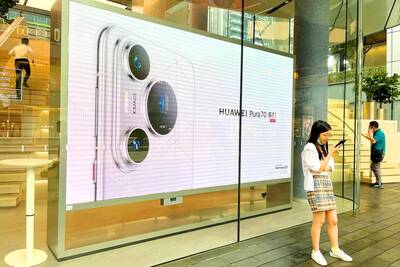
Huawei Technologies Co’s (華為) latest smartphones carry a version of the advanced made-in-China processor it revealed last year, results from an independent analysis showed. This underscored the Chinese company’s ability to sustain production of the controversial chip. The Pura 70 series unveiled last week sports the Kirin 9010 processor, research firm TechInsights found during a teardown of the device. This is a newer version of the Kirin 9000s, made by Semiconductor Manufacturing International Corp (SMIC, 中芯) for the Mate 60 Pro, which had alarmed officials in Washington who thought a 7-nanometer chip was beyond China’s capabilities. Huawei has enjoyed a resurgence since
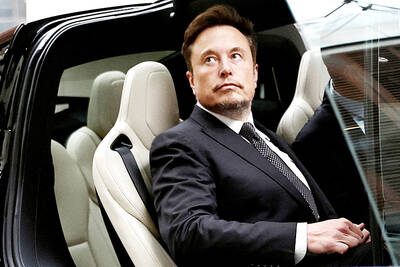
purpose: Tesla’s CEO sought to meet senior Chinese officials to discuss the rollout of its ‘full self-driving’ software in China and approval to transfer data they had collected Tesla Inc CEO Elon Musk arrived in Beijing yesterday on an unannounced visit, where he is expected to meet senior officials to discuss the rollout of "full self-driving" (FSD) software and permission to transfer data overseas, according to a person with knowledge of the matter. Chinese state media reported that he met Premier Li Qiang (李強) in Beijing, during which Li told Musk that Tesla's development in China could be regarded as a successful example of US-China economic and trade cooperation. Musk confirmed his meeting with the premier yesterday with a post on social media platform X. "Honored to meet with Premier Li


 RSS
RSS