


A local consumer advocacy group yesterday warned the public that cold noodles may pose a health risk, with the majority of cold noodles sold in convenience stores containing harmful bacteria.
In a investigation report unveiled by the Consumers' Foundation (
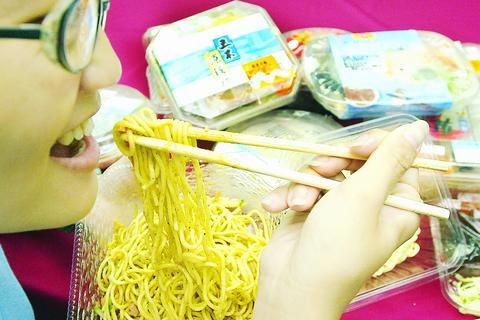
PHOTO: LIAO CHENG-HUEI, LIBERTY TIMES
"Cold noodles, among other things, are hot items in Taiwan during the summer," said Shyu Yuan-tay (
According to Shyu, the foundation collected 22 types of cold noodles from five convenience-store chains in the Greater Taipei area in late May to conduct hygiene checks.
Based on its investigation, the foundation singled out two convenience store chains: Family Mart Co (全家) and OK Mart Co, as the most unsanitary retailers, with nearly three-fourths of the chilled noodles in their outlets failing to meet hygienic standards, followed by Niko Mart Co's (福客多) 67 percent, while President Chain Store Corp (統一超商), which runs 7-Eleven, was at 60 percent and Hi-Life International Co's (萊爾富) 33 percent.
All of the cold noodles contain over-standard Escherichia coli, which can result in such health problems as severe stomach pains and diarrhea, said Shyu, who is also a professor of horticulture at National Taiwan University.
Actually, any chilled foods, such as cold noodles, sushi and sandwiches should be refrigerated at temperatures below 7?C throughout the distribution process, Shyu noted.
But many convenience stores simply failed to follow the guidelines, allowing refrigerated foods to become breeding grounds for bacteria, he said.
Shyu stressed that with increasing numbers of people turning to convenience stores for quick meals, the food sanitation issue is more important than ever.
"Nonetheless, our report's goal is to raise public awareness and hopefully place pressure on retailers to improve food quality control," Shyu stressed.
In accordance with business ethics and the nation's Food Management Law (
In response, retailers said they would make improvements to comply with the law.
"We will ask cold-noodle makers, transport companies and store employees to closely monitor the temperature of food containers," said Wang Pao-yu (
Currently, sales of hot snacks and fresh food account for some 7 percent of the chain's total sale every month, of which cold noodles comprise nearly 20 percent, Wang said.
The foundation also reminded the public that cold noodles sold by street vendors can be even more dangerous.
"Without a centralized production process, the quality control of the food is more difficult to maintain," Shyu said.
He suggested consumers buy chilled noodles from retailers with sanitary environments and preserve the products in refrigerators.

China has claimed a breakthrough in developing homegrown chipmaking equipment, an important step in overcoming US sanctions designed to thwart Beijing’s semiconductor goals. State-linked organizations are advised to use a new laser-based immersion lithography machine with a resolution of 65 nanometers or better, the Chinese Ministry of Industry and Information Technology (MIIT) said in an announcement this month. Although the note does not specify the supplier, the spec marks a significant step up from the previous most advanced indigenous equipment — developed by Shanghai Micro Electronics Equipment Group Co (SMEE, 上海微電子) — which stood at about 90 nanometers. MIIT’s claimed advances last

ISSUES: Gogoro has been struggling with ballooning losses and was recently embroiled in alleged subsidy fraud, using Chinese-made components instead of locally made parts Gogoro Inc (睿能創意), the nation’s biggest electric scooter maker, yesterday said that its chairman and CEO Horace Luke (陸學森) has resigned amid chronic losses and probes into the company’s alleged involvement in subsidy fraud. The board of directors nominated Reuntex Group (潤泰集團) general counsel Tamon Tseng (曾夢達) as the company’s new chairman, Gogoro said in a statement. Ruentex is Gogoro’s biggest stakeholder. Gogoro Taiwan general manager Henry Chiang (姜家煒) is to serve as acting CEO during the interim period, the statement said. Luke’s departure came as a bombshell yesterday. As a company founder, he has played a key role in pushing for the

EUROPE ON HOLD: Among a flurry of announcements, Intel said it would postpone new factories in Germany and Poland, but remains committed to its US expansion Intel Corp chief executive officer Pat Gelsinger has landed Amazon.com Inc’s Amazon Web Services (AWS) as a customer for the company’s manufacturing business, potentially bringing work to new plants under construction in the US and boosting his efforts to turn around the embattled chipmaker. Intel and AWS are to coinvest in a custom semiconductor for artificial intelligence computing — what is known as a fabric chip — in a “multiyear, multibillion-dollar framework,” Intel said in a statement on Monday. The work would rely on Intel’s 18A process, an advanced chipmaking technology. Intel shares rose more than 8 percent in late trading after the

GLOBAL ECONOMY: Policymakers have a choice of a small 25 basis-point cut or a bold cut of 50 basis points, which would help the labor market, but might reignite inflation The US Federal Reserve is gearing up to announce its first interest rate cut in more than four years on Wednesday, with policymakers expected to debate how big a move to make less than two months before the US presidential election. Senior officials at the US central bank including Fed Chairman Jerome Powell have in recent weeks indicated that a rate cut is coming this month, as inflation eases toward the bank’s long-term target of two percent, and the labor market continues to cool. The Fed, which has a dual mandate from the US Congress to act independently to ensure


 RSS
RSS