


The local biotechnology industry is expected to grow rapidly in the coming years, but companies need to pair up with overseas partners to ensure growth and an international presence, industry experts said yesterday.
"We expect to see more than 25 percent growth in the local biotechnology industry over the next few years," said Johnsee Lee (
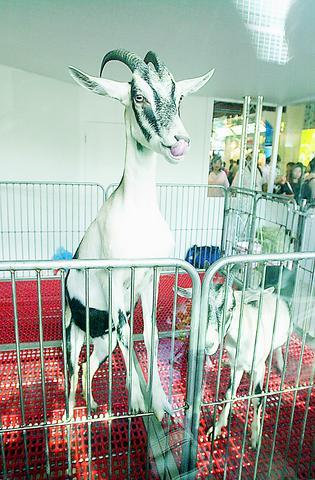
PHOTO: GEORGE TSORNG, TAIPEI TIMES
In 2001, there were 750 biotechnology companies in Taiwan generating US$3 billion in revenue. In the past two years combined, private companies invested more than NT$20 billion in biotechnology enterprises, Lee said.
"The industry has become three to four times bigger than it used to be, and we are seeing many new companies setting up," Lee said.
But the key for companies to continue to grow is finding overseas partners.
"Small companies need to collaborate and build alliances internationally," he said.
One of the venture capital companies working to bring overseas and Taiwanese companies together is the Taipei-based Cheng Xin Technology Development Corp (
"Part of what we do is tying up local companies with overseas partners for licensing and technology transfers," said Adeline Wong (
To encourage more local-international pair-ups, the government planned a themed month of biotechnology events for this month. Unfortunately SARS disrupted most of the international participation, forcing the organizers to postpone two core events to the fall.
The APEC Biotechnology Conference 2003 is now scheduled to take place on Sept. 28 and Sept. 29, and BioBusiness Asia 2003 will follow directly afterwards on Sept. 30 and Oct. 1. Twenty-four foreign biotech companies have been invited to present their business models to local hopefuls at the second event, Lee said yesterday.
The Bio Taiwan exhibition will start as planned today at the World Trade Center. The event is open only to trades, with no entry fee, everyday from 10:30am to 5pm until Sunday.
"The exhibition's 500 booths are all fully booked and we are expecting 100,000 visitors, making this the largest biotechnology event in Taiwan ever," Lee said.
One focus of the exhibition will be a SARS area, featuring companies that have worked on the genomic analysis and identification of the virus, diagnostic tools to detect the virus and possible vaccines and therapeutic treatments for sufferers.
At least one investor was looking forward to the exhibition.
"This is a very good opportunity to look at the better biotechnology companies in Taiwan all at once," said Willie Lin (
But one industry watcher was disappointed by the high proportion of government involvement in the exhibition.
"Of the 500 companies exhibiting, around 200 are government bodies or research institutes," said David Silver, director of Biotech-east.com, a Web site that promotes Taiwan's biotechnology and pharmaceutical industries. "I think it's a pity there aren't more private companies, but the SARS-related area will certainly be an interesting part of the event."
The government is banking on the success of the local biotechnology industry. Last May, President Chen Shui-bian (
But making money out of biotechnology may be a gamble.
"Sadly the investments so far have not been generating as much income as we had expected," Huang said. But Lin was much more upbeat.
"So far biotechnology companies are performing well compared with international standards. We are seeing pretty good results and are satisfied," he said.

Elon Musk’s lieutenants have reached out to chip industry suppliers, including Applied Materials Inc, Tokyo Electron Ltd and Lam Research Corp, for his envisioned Terafab, early steps in an audacious and likely arduous attempt to break into the production of cutting-edge chips. Staff working for the joint venture between Tesla Inc and Space Exploration Technologies Corp (SpaceX) have sought price quotes and delivery times for an array of chipmaking gear, people familiar with the matter said. In past weeks, they’ve contacted makers of photomasks, substrates, etchers, depositors, cleaning devices, testers and other tools, according to the people, who asked not to

JET JUICE: The war on Iran’s secondary effects have seen fuel prices skyrocket, knocking flight schedules down to earth in return as airlines struggle with costs Airline passengers should brace for more irritation in the next few months as carriers worldwide cancel flights and ground planes to cope with stratospheric increases in jet-fuel prices. Dutch flag carrier KLM is the latest company to cut its schedule, saying on Thursday that it would scrap 80 return flights at Amsterdam’s Schiphol Airport in the coming month. That puts it in the same league as United Airlines Holdings Inc, Deutsche Lufthansa AG and Cathay Pacific Airways Ltd, which have all pruned itineraries to mitigate costs. Global capacity for next month has been reduced by about 3 percentage points, with all
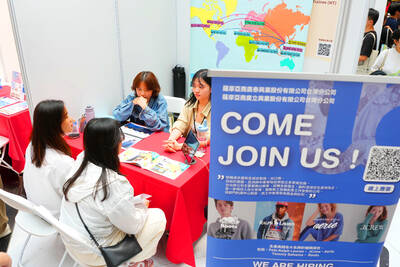
Taiwan is attracting a growing number of foreign jobseekers as companies increasingly recruit overseas talent to ease labor shortages and expand global reach, recruitment platform 104 Job Bank (104人力銀行) said yesterday. More than 40,000 foreign nationals searched for jobs in Taiwan through the platform last year, a 28 percent increase from a year earlier, the company said. Malaysians accounted for the largest share of overseas jobseekers at 12.2 percent, followed by Indonesians at 11.9 percent and Vietnamese at 10.8 percent. Indonesian applicants surged more than 50 percent year-on-year, while Vietnamese jobseekers rose by more than 30 percent. Applicants from the
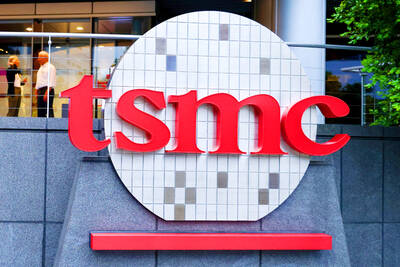
NO SHORTCUTS: Asked about Elon Musk’s Terafab initiative, TSMC CEO C.C. Wei said it takes two to three years to build a fab and another one to two to ramp it up Taiwan Semiconductor Manufacturing Co (TSMC, 台積電) yesterday raised its revenue growth forecast for this year to above 30 percent, up from the 25 percent it estimated three months earlier, citing extremely robust artificial intelligence (AI)-related chip demand. “Our customers and customers’ customers, who are mainly cloud service providers, continue to send us very positive signals and outlook,” TSMC chairman and CEO C.C. Wei (魏哲家) said at an earnings conference. The company also hiked its capital expenditure for this year toward the higher end of its forecast, or US$56 billion, as it aims to step up advanced chip capacity expansions, such as


 RSS
RSS