


European stocks, whose declines this week drove some benchmark indexes to the lowest in more than five years, may fall further amid concern that a slide in the dollar's value will stunt profit growth.
"Europe gets a kick in the teeth from a weak dollar," because so much of companies' sales and earnings stem from the US, said David Ballance, who oversees US$800 million as head of European equities at Rothschild Asset Management in London. He bought shares of Suedzucker AG, the world's largest sugar maker, partly because almost all of its revenue comes from Europe.
The Dow Jones Stoxx 50 Index this week slumped 6.6 percent, the biggest weekly decline since July, to its lowest since May 1997. The Stoxx 600 Index lost 5.6 percent, its third straight weekly loss.
Speculation that the US may be headed for war with Iraq, damping economic growth and curbing demand in the world's biggest economy, drove the dollar lower against European currencies. The drop may cut the value of US sales by companies such as Bayer AG, Royal Philips Electronics NV and GlaxoSmithKline Plc.
All of Western Europe's 17 national benchmark indexes fell except for Greece's ASE and Austria's ATX. The UK's FTSE 100 extended a losing streak to 10 days, the longest since its 1984 inception, and reached a seven-year low. France's CAC Index sank 5.2 percent and Germany's DAX fell 6.9 percent.
Bayer, Germany's biggest drugmaker, fell 12 percent this week. Philips, Europe's largest consumer-electronics company, dropped 7 percent. GlaxoSmithKline, the world's second-biggest drugmaker, lost 8 percent. Each gets more than one-quarter of sales in the US or North America.
"The mood in Europe is very dark," said Patrick Nielsen, who oversees US$1 billion at Mapfre Inversion in Madrid. "People are worried about how much the dollar's fall is going to hurt exporters."
Earnings at companies in the 12 countries sharing the euro decline by about 6 percent during a year when the dollar drops 10 percent against the euro, according to Deutsche Bank AG. The US currency has lost about 11 percent against the euro since August.
The US currency has dropped against the euro every day since Jan. 14, the longest losing streak since the European currency started trading four years ago. The dollar sank to a three-year low against the British pound and is the lowest in four years against the Swiss franc.
Reports on business confidence in Germany and France next week and earnings from Pechiney SA, Hennes & Mauritz AB and Stora Enso Oyj may give investors more evidence about the prospects for the economy and profits.
Confidence among German executives improved in January for the first time in eight months, according to economists surveyed by Bloomberg News. The report is scheduled for release Tuesday.
As for their French counterparts, a report due Thursday may indicate that confidence this month rose to a seven-month high, according to economists surveyed by Bloomberg.
Pechiney, the world's fourth-largest aluminum producer, will likely report that 2002 profit dropped 42 percent to 173 million euros (US$186 million), according to the average forecast of six analysts surveyed by Bloomberg News. The French company said in October that the dollar's drop will hurt earnings in the fourth quarter. Pechiney releases its figures on Thursday.
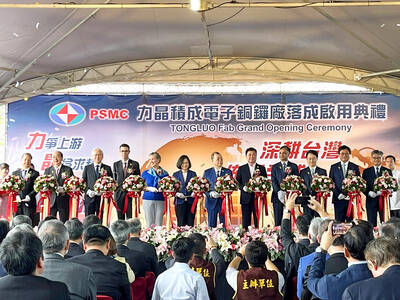
ARTIFICIAL INTELLIGENCE: The chipmaker last month raised its capital spending by 28 percent for this year to NT$32 billion from a previous estimate of NT$25 billion Contract chipmaker Powerchip Semiconductor Manufacturing Corp (力積電子) yesterday launched a new 12-inch fab, tapping into advanced chip-on-wafer-on-substrate (CoWoS) packaging technology to support rising demand for artificial intelligence (AI) devices. Powerchip is to offer interposers, one of three parts in CoWoS packaging technology, with shipments scheduled for the second half of this year, Powerchip chairman Frank Huang (黃崇仁) told reporters on the sidelines of a fab inauguration ceremony in the Tongluo Science Park (銅鑼科學園區) in Miaoli County yesterday. “We are working with customers to supply CoWoS-related business, utilizing part of this new fab’s capacity,” Huang said, adding that Powerchip intended to bridge

BUSINESS UPDATE: The iPhone assembler said operations outlook is expected to show quarter-on-quarter and year-on-year growth for the second quarter Hon Hai Precision Industry Co (鴻海精密) yesterday reported strong growth in sales last month, potentially raising expectations for iPhone sales while artificial intelligence (AI)-related business booms. The company, which assembles the majority of Apple Inc’s smartphones, reported a 19.03 percent rise in monthly sales to NT$510.9 billion (US$15.78 billion), from NT$429.22 billion in the same period last year. On a monthly basis, sales rose 14.16 percent, it said. The company in a statement said that last month’s revenue was a record-breaking April performance. Hon Hai, known also as Foxconn Technology Group (富士康科技集團), assembles most iPhones, but the company is diversifying its business to

Microsoft Corp yesterday said that it would create Thailand’s first data center region to boost cloud and artificial intelligence (AI) infrastructure, promising AI training to more than 100,000 people to develop tech. Bangkok is a key economic player in Southeast Asia, but it has lagged behind Indonesia and Singapore when it comes to the tech industry. Thailand has an “incredible opportunity to build a digital-first, AI-powered future,” Microsoft chairman and chief executive officer Satya Nadella said at an event in Bangkok. Data center regions are physical locations that store computing infrastructure, allowing secure and reliable access to cloud platforms. The global embrace of AI

Qualcomm Inc, the world’s biggest seller of smartphone processors, gave an upbeat forecast for sales and profit in the current period, suggesting demand for handsets is increasing after a two-year slump. Revenue in the three months ended in June will be US$8.8 billion to US$9.6 billion, the company said in a statement Wednesday. Excluding certain items, earnings will be US$2.15 to US$2.35 a share. Analysts had projected sales of US$9.08 billion and earnings of US$2.16 a share. The outlook signals that the smartphone market has begun to bounce back, tracking with Qualcomm’s forecast that demand would gradually recover this year. The San


 RSS
RSS