

A coalition of Japanese firms and universities plans to develop an optical disc that can store 1.5 terabytes, the equivalent of about 300 DVDs, a report said yesterday.
The optical disc would be able to record 300 two-hour films and the player to use it would be compatible with standard DVDs, the Nihon Keizai Shimbun reported.
Japanese electronics giant Matsushita Electric Industrial Co, office equipment maker Ricoh Co and Osaka University will start developing the optical disc with plans to have it on the market by 2010.
Audio-visual equipment maker Pioneer Corp, Mitsubishi Chemical Corp, Aishin Seiki Co, Kyushu University and Shizuoka University will also be involved.
The coalition will invest Japanese Yen 2 billion to Japanese Yen 3 billion (US$16.6 million to US$24.9 million) over five years, starting April, to develop the disc.
The disc, 12cm in diameter, will introduce 3D multilayer optical memory technology and storing data in a 10-layer structure, according to the newspaper report.
This year's Fortune Global 500 ranking listed Taiwan Semiconductor Manufacturing Co (TSMC, 台積電) among its top 100 companies for the first time. TSMC climbed 44 places to 82nd, with revenue of US$122.26 billion, a report published on Tuesday by New York-based Fortune magazine said. TSMC's entry into the top 100 for the first time underscored how surging demand for advanced chips is reshaping the scale and influence of companies in Asia and around the world, the report said. Besides TSMC, Taiwanese electronics manufacturer Wistron Corp (緯創) climbed 298 places to 198th on this year's list — the largest jump among all companies ranked
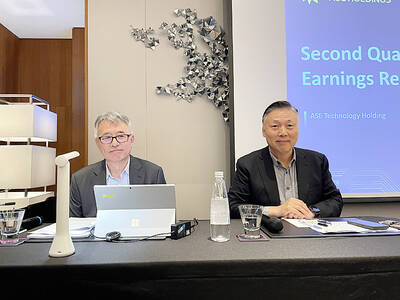
‘STRONGER DEMAND’ : Company executives said that a lot of new investments are needed, although there are capacity bottlenecks for automation and innovation ASE Technology Holding Co (日月光投控) yesterday increased its capital expenditure for this year to US$10.5 billion, up 23.5 percent from its previous budget of US$8.5 billion, amid robust demand for artificial intelligence (AI) applications. The world’s largest supplier of packaging and testing services plans to allocate about 70 percent of the increased spending to capacity expansion, mainly for leading-edge advanced packaging (LEAP) technology, with LEAP revenue forecast to exceed US$3.5 billion this year, ASE said. “Obviously we are seeing a stronger demand ... from not just customers, but also our foundry partner,” ASE chief financial officer Joseph Tung (董宏思) told an earnings

When rival hedge funds face catastrophic losses, billionaire investor Ken Griffin has a habit of identifying opportunities and showing up with a checkbook. Citadel’s founder last week reprised his role as one of Wall Street’s rescue buyers, stepping in to salvage California hedge fund Situational Awareness as it buckled under souring bets on artificial intelligence (AI) stocks. Amid market rumblings that at least one firm was in trouble, Griffin, 57, assembled his top lieutenants to investigate, five people with knowledge of the matter said. By Wednesday morning, Citadel executives had reached out to Situational Awareness, and Griffin spoke directly with Leopold Aschenbrenner,
RUNNING HOT: The contract chipmaker is planning to both deepen and broaden its capacity, with more facility space and more advanced chips on offer United Microelectronics Corp (UMC, 聯電), the world’s fourth-largest contract chipmaker, plans to invest US$5 billion over the next two to three years to expand silicon photonics and advanced packaging capacity as artificial intelligence (AI)-driven demand accelerates. The company views silicon photonics and advanced packaging as vital businesses to its growth, and expects AI-related revenue to reach about US$300 million this year and surpass US$1 billion in three years, it said yesterday. “We actually feel pretty optimistic about advanced packaging, and that’s why we started facility deployment,” UMC CEO Jason Wang (王石) said at an earnings conference. “The overall [advanced packaging] addressable market


 RSS
RSS