


The economic downturn and local political instability sparked a 73 percent surge in China investment by Taiwanese high-tech companies last year, according to a report issued yesterday by the Taipei Computer Association (TCA) and the Chinese-language E-Business Weekly.
The past two months have seen investment across the Taiwan Strait slowing, however, thanks to signs of an economic turnaround and more cooperation among politicians, according to the association, the largest information-technology industry association in Taiwan with over 4,000 member companies.
The association said over half the nation's tech firms are now invested in China, up sharply from last year. Of the firms already in operating there, 45 percent reported that the production value of their China operations outstripped that of factories in Taiwan last year.
"These are surprising numbers, I don't know how they came up with them ... [but] it sounds unreasonably high," said an official at the Ministry of Economic Affairs who preferred to maintain anonymous.
The association sent surveys to all of its members and received 423 back, a response rate of around 11 percent. Officials at TCA would not give an exact number of members.
China has grown in importance to Taiwan over the years, both as a place to set up manufacturing plants and as a trade partner.
Exports to China accounted for 19.6 percent of Taiwan's total export trade value last year, according to the ministry.
Many firms operating in China are not making money, according to the report. It said 81.7 percent of the nation's high-tech firms did not turn a profit in their China operations last year, up slightly from 77.1 percent the year before.
It also indicated Taiwanese firms need to boost R&D spending before they are overtaken by China in terms of manufacturing expertise.
Over half of the components, semi-finished products and other materials China-based companies formerly required from their Taiwanese parent company or partner are now easy to find in China, it said, up from only a third last year.
Frank Huang (
Huang, also head of Powerchip Semiconductor Corp (
Such a withdrawal would send shockwaves through the market, since the shares of Taiwan's two leading chip firms, Taiwan Semiconductor Manufacturing Co (TSMC, 台積電) and United Microelectronics Corp (UMC, 聯電), make up nearly 20 percent of the entire value of Taiwan's stock market.
A foreign analyst who requested anonymity said a failure to allow chipmakers to invest in China might impact share prices in the short term, but not in the long run, unless the government continues to drag its feet.
Local companies believe now is the time to set up older plants in China to take advantage of cheap land and labor and a growing market there.

BUSINESS UPDATE: The iPhone assembler said operations outlook is expected to show quarter-on-quarter and year-on-year growth for the second quarter Hon Hai Precision Industry Co (鴻海精密) yesterday reported strong growth in sales last month, potentially raising expectations for iPhone sales while artificial intelligence (AI)-related business booms. The company, which assembles the majority of Apple Inc’s smartphones, reported a 19.03 percent rise in monthly sales to NT$510.9 billion (US$15.78 billion), from NT$429.22 billion in the same period last year. On a monthly basis, sales rose 14.16 percent, it said. The company in a statement said that last month’s revenue was a record-breaking April performance. Hon Hai, known also as Foxconn Technology Group (富士康科技集團), assembles most iPhones, but the company is diversifying its business to
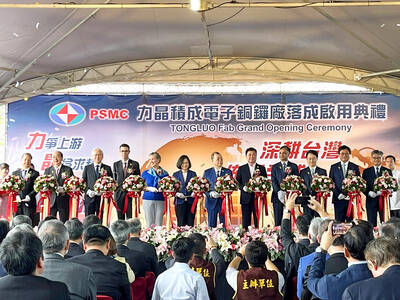
ARTIFICIAL INTELLIGENCE: The chipmaker last month raised its capital spending by 28 percent for this year to NT$32 billion from a previous estimate of NT$25 billion Contract chipmaker Powerchip Semiconductor Manufacturing Corp (力積電子) yesterday launched a new 12-inch fab, tapping into advanced chip-on-wafer-on-substrate (CoWoS) packaging technology to support rising demand for artificial intelligence (AI) devices. Powerchip is to offer interposers, one of three parts in CoWoS packaging technology, with shipments scheduled for the second half of this year, Powerchip chairman Frank Huang (黃崇仁) told reporters on the sidelines of a fab inauguration ceremony in the Tongluo Science Park (銅鑼科學園區) in Miaoli County yesterday. “We are working with customers to supply CoWoS-related business, utilizing part of this new fab’s capacity,” Huang said, adding that Powerchip intended to bridge

Microsoft Corp yesterday said that it would create Thailand’s first data center region to boost cloud and artificial intelligence (AI) infrastructure, promising AI training to more than 100,000 people to develop tech. Bangkok is a key economic player in Southeast Asia, but it has lagged behind Indonesia and Singapore when it comes to the tech industry. Thailand has an “incredible opportunity to build a digital-first, AI-powered future,” Microsoft chairman and chief executive officer Satya Nadella said at an event in Bangkok. Data center regions are physical locations that store computing infrastructure, allowing secure and reliable access to cloud platforms. The global embrace of AI

Qualcomm Inc, the world’s biggest seller of smartphone processors, gave an upbeat forecast for sales and profit in the current period, suggesting demand for handsets is increasing after a two-year slump. Revenue in the three months ended in June will be US$8.8 billion to US$9.6 billion, the company said in a statement Wednesday. Excluding certain items, earnings will be US$2.15 to US$2.35 a share. Analysts had projected sales of US$9.08 billion and earnings of US$2.16 a share. The outlook signals that the smartphone market has begun to bounce back, tracking with Qualcomm’s forecast that demand would gradually recover this year. The San


 RSS
RSS