


One month before he goes on trial, former French trader Jerome Kerviel is making his case in a tell-all book that likens trading to prostitution and hits out at the “big banking orgy.”
Now an employee at a computer firm outside Paris, Kerviel depicts himself as a scapegoat of an out-of-control banking world in L’Engrenage: Memoires d’un trader (The Spiral: Memoirs of a Trader) that hits bookshops today.
The 33-year-old ex-trader at Societe Generale (SocGen) bank describes the money-crazed atmosphere of trading rooms where managers congratulate top earners at the end of the day by comparing them to prostitutes.
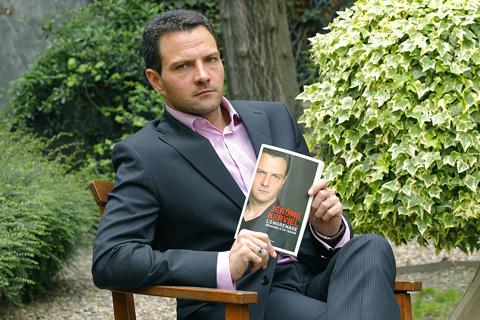
PHOTO: REUTERS
“Bravo, you have been a good hooker today,” is what bank managers would tell Kerviel on most nights, the former trader wrote in the book, excerpts of which have been released in the French press.
“In this big banking orgy, traders have the right to the same consideration afforded to any low-level prostitute: a quick recognition that the day’s earnings were good,” he said.
Kerviel goes on trial on June 8, accused of gambling away billions of euros of SocGen’s money in risky dealings that ended up costing the French bank 4.9 billion euros (US$6.5 billion) in losses.
He faces a maximum sentence of five years in prison and a fine of 375,000 euros if convicted on charges of breach of trust, falsifying and using fake documents and tampering with computer information.
Kerviel has long maintained that his bank managers knew of his dealings and turned a blind eye as long as he was making a profit.
“I am just a man who made mistakes as an employee of a bank that for a long time allowed such errors, because they yielded a profit,” he said.
In a series of interviews to promote his book, Kerviel has pointed to the global financial crisis as vindication, arguing that it shows how banks encourage traders to take reckless risks.
“I am struck by the fact that nothing has been done during the past two years of the financial crisis so that the causes of the crisis are addressed and a situation like mine does not happen again,” he told Le Journal du Dimanche weekly.
“Banks work in a virtual world. There are financial products that are so complex that only one or two people understand how they work. Who controls these people?” he asked.
Since the Kerviel affair, attention has turned to another French trader, 31-year-old Fabrice Tourre from Goldman Sachs, dubbed “Fabulous Fab,” who has been charged with fraud by the US Securities and Exchange Commission.
Tourre is accused of concocting some of the “Frankenstein products” that led to the 2008-2009 financial meltdown.
Following his arrest, Kerviel was released from jail pending trial and has sought to build a life far removed from the high-rollers of finance and the media.
He found a job in a computer firm, earns 2,300 euros a month, lives in a small flat and claims he never goes on holidays.
“I thought I was invulnerable,” Kerviel wrote of his time at SocGen. “The truth about how I made my earnings was an open secret.”
Kerviel’s trial winds up on June 23 and a verdict is expected soon after.

‘NO SECURITY RISK’: The Railway Bureau reassured the public that the technicians’ activities were limited to technical guidance and did not involve sensitive systems The Railway Bureau yesterday said it had invited eight Chinese technicians to assist with an airport MRT construction project. The bureau issued the confirmation after an Internet user said Chinese nationals had entered the construction zone of Taiwan Taoyuan International Airport’s Terminal 3 project. They asked why “individuals from an enemy state” were allowed access to such a major national infrastructure project, which raised serious concerns over Taiwan’s industrial safety, sensitive systems and information security. The bureau’s Northern Region Engineering Branch Office said subcontractor Taiwan Handle Industrial Co (台灣手把工業) of the Taoyuan airport MRT’s “Contract No. CU05 Project A14 Station Civil, MEP &

A US uncrewed surface vessel (USV) encountered multiple Chinese warships during an autonomous transit of the Taiwan Strait, US defense company Seasats said in a statement on Wednesday. Seasats announced that a Lightfish USV had completed the first autonomous transit of the Taiwan Strait. Over five days, the USV traversed the entire length of the Strait while constantly monitoring surface vessel traffic, the company said. The Lightfish encountered multiple Chinese warships, one of which was a Chinese People’s Liberation Army Navy (PLAN) Type 056 corvette, it said. The Chinese vessels were operating “well within Taiwan’s exclusive economic zone without transmitting their identity via the
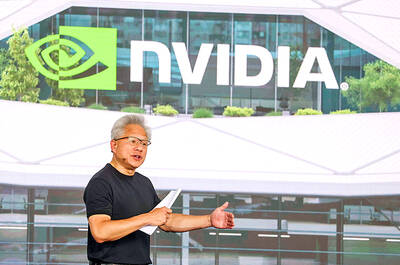
‘BOOMING’: ’ The number of partners we have here is incredible. You can see from their stock prices. They’re doing so well, they’re so happy,’ Jensen Huang said Nvidia Corp’s spending in Taiwan has ballooned to about US$150 billion a year, 10 times the US$10 billion to US$15 billion the company spent five years ago, Nvidia chief executive officer Jensen Huang (黃仁勳) said yesterday, suggesting Taiwan’s strategic importance in the global artificial intelligence (AI) supply chain. “Taiwan is the epicenter of the AI revolution. This is where the chips come, packaging comes. This is where the systems are made. This is where AI supercomputers were created,” Huang said at a meeting for the company’s employees in Beitou-Shilin Technology Park (北投士林科技園區) in Taipei, the planned site of Nvidia’s Taipei headquarters. “Taiwan
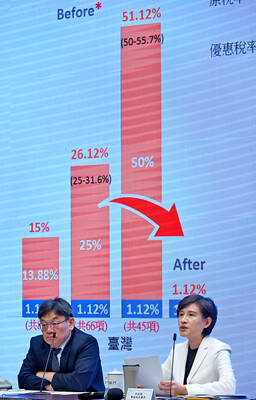
GREATER REACH? Auto parts and wood products would face tariffs of up to 15%, matching those targeting the EU, Japan and South Korea, Vice Premier said The US has announced that preferential tariff treatment for Taiwan’s non-semiconductor Section 232 goods would take effect retroactively from May 1, the Executive Yuan said yesterday. The US government yesterday posted a notice on the Federal Register’s public inspection Web site previewing tariff concessions for Taiwan under a memorandum of understanding (MOU) on Taiwan-US investment after two months of negotiations. The MOU signed on Jan. 15 stipulated three major preferential tariff arrangements: a 15 percent “reciprocal” tariff rate for Taiwan without stacking most-favored nation (MFN) rates; preferential Section 232 treatment for semiconductors and related products; and preferential Section 232 treatment for non-semiconductor


 RSS
RSS