


Asian shares fell last week, dragging the benchmark MSCI Asia Pacific Index to its biggest weekly drop since March, on concern the pace of economic growth will prompt central banks from China to India to curb price increases.
Aluminum Corp of China Ltd, the country’s largest producer of the metal, sank 9.1 percent in Hong Kong. Rio Tinto Group, the world’s third-largest mining company, slid 7.2 percent in Sydney as metal prices fell. Nomura Holdings Inc, Japan’s biggest investment bank, lost 8.8 percent in Tokyo after Credit Suisse Group AG cut its rating. Nissan Motor Co, which gets about 35 percent of its sales from North America, retreated 6.4 percent as US consumer confidence trailed estimates.
The MSCI Asia Pacific Index fell 3.5 percent to 122.39 for the first weekly drop in five. The gauge has jumped 48 percent in the past 12 months as growth in China helped the global economy emerge from the worst slowdown since World War II.
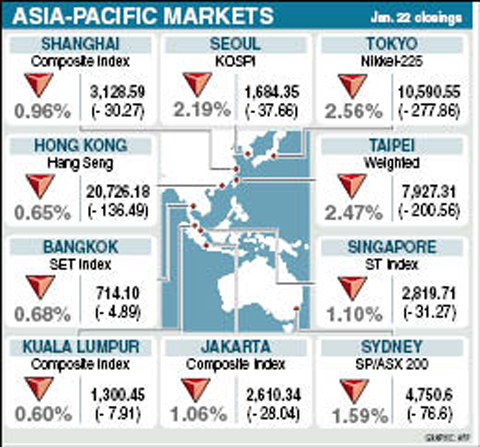
Japan’s Nikkei 225 Stock Average declined 3.6 percent this week, the steepest drop since the period ended on Nov. 27. Hong Kong’s Hang Seng Index lost 4.3 percent. Australia’s S&P/ASX 200 Index fell 3 percent amid concern the nation may raise taxes on mining projects.
Asian equities also fell in the week as US President Barack Obama proposed measures to reduce risk-taking at banks, raising concerns the plans would curb lenders’ profits and hurt the country’s economic recovery.
The Shanghai Composite Index dropped 3 percent as government reports on Thursday showed the country’s fourth-quarter GDP grew 10.7 percent, more than economists estimated, while inflation accelerated to a more-than-forecast 1.9 percent last month.
TAIPEI
Taipei was also dragged down by news from Wall Street, closing down 2.47 percent, or 200.56 points, to 7,927.31.
Other regional markets:
KUALA LUMPUR: The Composite Index lost 7.91 points, or 0.60 percent to close at 1,300.45.
JAKARTA: Indonesian shares fell1.06 percent, or 28.04 points, to 2,610.34.
WELLINGTON: New Zealand shares fell 1.08 percent, or 34.86 points, to 3,190.43.
MANILLA: Philippine shares fell 2.01 percent, or 62.11 points, to 3,023.47.
MUMBAI: Indian shares fell 1.12 percent with the 30-share benchmark SENSEX down 191.46 points at 16,859.68.
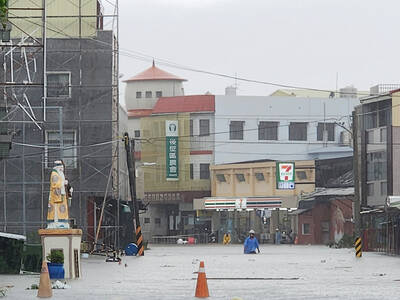
Rainfall is expected to become more widespread and persistent across central and southern Taiwan over the next few days, with the effects of the weather patterns becoming most prominent between last night and tomorrow, the Central Weather Administration (CWA) said yesterday. Independent meteorologist Daniel Wu (吳德榮) said that based on the latest forecast models of the combination of a low-pressure system and southwesterly winds, rainfall and flooding are expected to continue in central and southern Taiwan from today to Sunday. The CWA also warned of flash floods, thunder and lightning, and strong gusts in these areas, as well as landslides and fallen
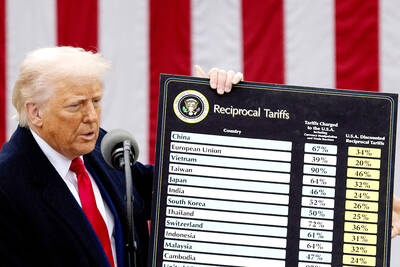
WAITING GAME: The US has so far only offered a ‘best rate tariff,’ which officials assume is about 15 percent, the same as Japan, a person familiar with the matter said Taiwan and the US have completed “technical consultations” regarding tariffs and a finalized rate is expected to be released soon, Executive Yuan spokeswoman Michelle Lee (李慧芝) told a news conference yesterday, as a 90-day pause on US President Donald Trump’s “reciprocal” tariffs is set to expire today. The two countries have reached a “certain degree of consensus” on issues such as tariffs, nontariff trade barriers, trade facilitation, supply chain resilience and economic security, Lee said. They also discussed opportunities for cooperation, investment and procurement, she said. A joint statement is still being negotiated and would be released once the US government has made
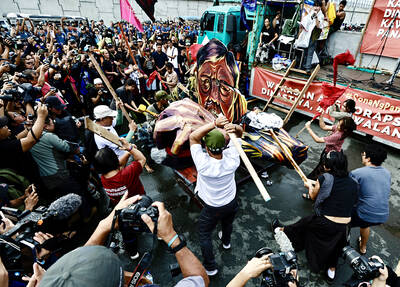
SOUTH CHINA SEA? The Philippine president spoke of adding more classrooms and power plants, while skipping tensions with China over disputed areas Philippine President Ferdinand Marcos Jr yesterday blasted “useless and crumbling” flood control projects in a state of the nation address that focused on domestic issues after a months-long feud with his vice president. Addressing a joint session of congress after days of rain that left at least 31 dead, Marcos repeated his recent warning that the nation faced a climate change-driven “new normal,” while pledging to investigate publicly funded projects that had failed. “Let’s not pretend, the people know that these projects can breed corruption. Kickbacks ... for the boys,” he said, citing houses that were “swept away” by the floods. “Someone has

‘CRUDE’: The potential countermeasure is in response to South Africa renaming Taiwan’s representative offices and the insistence that it move out of Pretoria Taiwan is considering banning exports of semiconductors to South Africa after the latter unilaterally downgraded and changed the names of Taiwan’s two representative offices, the Ministry of Foreign Affairs (MOFA) said yesterday. On Monday last week, the South African Department of International Relations and Cooperation unilaterally released a statement saying that, as of April 1, the Taipei Liaison Offices in Pretoria and Cape Town had been renamed the “Taipei Commercial Office in Johannesburg” and the “Taipei Commercial Office in Cape Town.” Citing UN General Assembly Resolution 2758, it said that South Africa “recognizes the People’s Republic of China (PRC) as the sole


 RSS
RSS