


Saleswomen paid 5 euros (US$6.6) an hour, Asian subcontractors with dubious practices and counters in the shape of swastikas — in Germany the success of textile discounter Kik has kicked up a storm.
The latest example: A court in the western city of Hamm recently ruled as “indecent” the salaries paid to saleswomen Martina K, 47, and Ursula Grunwald, 62, who received 5.20 euros per hour.
Kik will have to pay them between 8,900 euros and 10,500 euros in back pay and raise their salaries to 8.21 euros an hour.
In all, 3,500 Kik workers in Germany, of a total 15,000 worldwide, are paid 5 euros per hour and receive the strict minimum in state health and pension benefits, services trade union Verdi said.
“Our workers might have to do more than others, but in exchange they have a secure job,” the co-founder of Kik, Stefan Heinig, told German media.
Heinig has a reputation of an obsessive cost-cutter. In his 2,700 stores, the decoration is minimal and there is no music and no air conditioning.
Kik, a German acronym for “client is king,” deals with low cost suppliers, including many in Asia, and changes them often if needed. Goods arrive directly at a center in Boenen, western Germany, and there are no middlemen.
Kik’s prices are therefore hard to beat. In a Frankfurt store, goods are piled high or are still in boxes and customers can find a pair of kids’ jeans for 2.99 euros or a military print T-shirt for 3.99 euros.
A small black and white cotton dress, the origin of which could not be determined, cost 4.99 euros.
In nearly 15 years of activity, Kik, which is majority owned by the German distributor Tengelmann, has steadily gained market share and posted sales of 1.4 billion euros last year.
In Germany or in eastern Europe, where the company is expanding, the group targets families with kids, “thrifty people and socially weak people,” its Internet site said.
Heinig was asked by the German daily Die Welt in 2007 about his models and replied: “I call them McAlKea. McDonalds, Aldi and Ikea are model businesses for me.”
Aldi is a hard-discount German supermarket chain.
Like those companies, however, Kik’s social policies are criticized by unions and non-governmental organizations.
In Germany there is no works committee, a spokeswoman confirmed, while one attempt in Austria ended up in court.
Testimony provided by Verdi member Henrike Greven showed staff were watched closely, their bags and even their cars were regularly inspected. The management has also hung posters urging workers to turn in others who steal.
At suppliers, such as in Bangladesh, clothing sewers must sometimes work seven days a week at jobs that do not pay a living wage. Some are said to employ children.
Kik rejects charges by antifascist Internet sites which call it “a Nazi store.”
In 2007, clients were shocked to find counters were shaped like swastikas, a symbol used by Nazis and which could be seen in Frankfurt.
“It is a completely normal presentation in retail,” a spokeswoman said.

Japan has deployed long-range missiles in a southwestern region near China, the Japanese defense minister said yesterday, at a time when ties with Beijing are at their lowest in recent years. The missiles were installed in Kumamoto in the southern region of Kyushu, as Japan is attempting to shore up its military capacity as China steps up naval activity in the East China Sea. “Standoff defense capabilities enable us to counter the threat of enemy forces attempting to invade our country ... while ensuring the safety of our personnel,” Japanese Minister of Defense Shinjiro Koizumi said. “This is an extremely important initiative for

The nation’s fastest supercomputer, Nano 4 (晶創26), is scheduled to be launched in the third quarter, and would be used to train large language models in finance and national defense sectors, the National Center for High-Performance Computing (NCHC) said. The supercomputer, which would operate at about 86.05 petaflops, is being tested at a new cloud computing center in the Southern Taiwan Science Park in Tainan. The exterior of the server cabinet features chip circuitry patterns overlaid with a map of Taiwan, highlighting the nation’s central position in the semiconductor industry. The center also houses Taiwania 2, Taiwania 3, Forerunner 1 and

MORE POPULAR: Taiwan Pass sales increased by 59 percent during the first quarter compared with the same period last year, the Tourism Administration said The Tourism Administration yesterday said that it has streamlined the Taiwan Pass, with two versions available for purchase beginning today. The tourism agency has made the pass available to international tourists since 2024, allowing them to access the high-speed rail, Taiwan Railway Corp services, four MRT systems and four Taiwan Tourist Shuttles. Previously, five types of Taiwan Pass were available, but some tourists have said that the offerings were too complicated. The agency said only two types of Taiwan Pass would be available, starting from a three-day pass with the high-speed rail and a three-day pass with Taiwan Railway Corp. The former costs NT$2,800
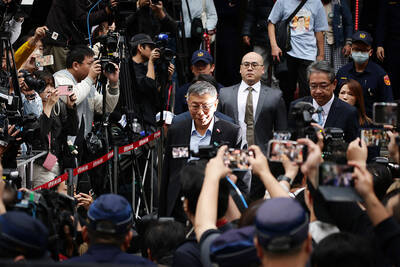
FIRST TRIAL: Ko’s lawyers sought reduced bail and other concessions, as did other defendants, but the bail judge denied their requests, citing the severity of the sentences Former Taipei mayor Ko Wen-je (柯文哲) was yesterday sentenced to 17 years in prison and had his civil rights suspended for six years over corruption, embezzlement and other charges. Taipei prosecutors in December last year asked the Taipei District Court for a combined 28-year, six-month sentence for the four cases against Ko, who founded the Taiwan People’s Party (TPP). The cases were linked to the Core Pacific City (京華城購物中心) redevelopment project and the mismanagement of political donations. Other defendants convicted on separate charges included Chinese Nationalist Party (KMT) Taipei City Councilor Angela Ying (應曉薇), who was handed a 15-year, six-month sentence; Core Pacific


 RSS
RSS