


Standard & Poor's Corp, in a continuing sign of loss of confidence in investment banks' eroding profitability, put Goldman Sachs Group Inc and Lehman Brothers Holdings Inc on negative outlook on Friday.
Although the rating agency didn't change ratings on Goldman's AA- and Lehman Brothers' A+ senior debt, it brought its view of the likelihood of a precipitous decline in profits at the firms during the next few quarters to the same negative levels it had previously assigned to Merrill Lynch & Co and Morgan Stanley.
The outlook changes are appropriate in spite of the fact that recent actions by the Federal Reserve have instilled confidence in the capital markets, S&P added.
A negative outlook implies a one-in-three likelihood of a rating downgrade over an intermediate period of about two years, S&P said.
"We believe that negative rating outlooks are broadly appropriate for the independent securities firms, reflecting the potential for a more substantial decline in profitability from capital market activities," S&P said in a report whose principal authors are managing director Scott Sprinzen and analyst Diane Hinton.
"Our current expectation is that net revenues could decline 20 percent to 30 percent year-on-year," adjusting for write-downs, the report said.
Moody's Investors Service continues to rate Goldman Sachs and Lehman with stable outlooks, and has no plans to respond to S&P's change.
"We remain comfortable with the outlooks," senior vice president and lead securities industry analyst Peter Nerby said.
Investment banks have written down more than US$100 billion of securities and loans since the middle of last year, and are still finding it difficult to sell the assets to large investors.
The 20 percent to 30 percent decline in profitability will erode investment banks' "margin of safety" this year, but S&P said it expects to sustain current debt ratings because of the Fed's move last week to let investment banks borrow directly from the central bank at low rates against some of their battered securities.
"Nonetheless, we see some possibility, were there to be persisting capital markets turmoil and sharply weakening economic conditions, that financial performance could deteriorate significantly more than we now assume, which would call the current ratings into question," S&P said.
During a conference call, Sprinzen said S&P expects to decide within 30 days on whether or not to change Morgan Stanley's AA- rating. The firm, in many ways, has the best business diversity of the five large investment banks, he added.
However, the "virtual collapse" of Bear Stearns Cos last week "highlights the extent to which securities firms are exposed to capital market sentiments and explains the Federal Reserve's actions to support the US securities industry directly," S&P said. The Fed arranged for JPMorgan Chase & Co to buy Bear, which S&P rates BBB, at a fire-sale price of US$2 a share and guaranteed the bank against US$30 billion of losses on Bear Stearns' problem assets.
Lehman's business model is closer to Bear Stearns' and less diversified than the other three firms, but Lehman's funding capability and liquidity are among the strongest on Wall Street, Sprinzen said. Lehman and Morgan Stanley in their fiscal first-quarter earnings earlier in the week demonstrated strength across their businesses, while Goldman -- the most profitable broker -- had higher write-offs than in the past. Merrill Lynch doesn't report its first-quarter results until April.
Indeed, S&P has no great concerns in the near -- or even long -- term about profitability or funding for Goldman or Lehman and is relatively confident about core businesses at most firms.
"We are not saying there is some fundamental flaw or business disadvantage compared to what we've seen before," Sprinzen said.
However, he repeated that the capital-markets environment remains so volatile and uncertain that the agency's across-the-board caution on investment banks is justified.
"We don't feel it hurts to have negative outlooks even on the best-positioned players," he said.

SECURITY: As China is ‘reshaping’ Hong Kong’s population, Taiwan must raise the eligibility threshold for applications from Hong Kongers, Chiu Chui-cheng said When Hong Kong and Macau citizens apply for residency in Taiwan, it would be under a new category that includes a “national security observation period,” Mainland Affairs Council (MAC) Minister Chiu Chui-cheng (邱垂正) said yesterday. President William Lai (賴清德) on March 13 announced 17 strategies to counter China’s aggression toward Taiwan, including incorporating national security considerations into the review process for residency applications from Hong Kong and Macau citizens. The situation in Hong Kong is constantly changing, Chiu said to media yesterday on the sidelines of the Taipei Technology Run hosted by the Taipei Neihu Technology Park Development Association. With

CARROT AND STICK: While unrelenting in its military threats, China attracted nearly 40,000 Taiwanese to over 400 business events last year Nearly 40,000 Taiwanese last year joined industry events in China, such as conferences and trade fairs, supported by the Chinese government, a study showed yesterday, as Beijing ramps up a charm offensive toward Taipei alongside military pressure. China has long taken a carrot-and-stick approach to Taiwan, threatening it with the prospect of military action while reaching out to those it believes are amenable to Beijing’s point of view. Taiwanese security officials are wary of what they see as Beijing’s influence campaigns to sway public opinion after Taipei and Beijing gradually resumed travel links halted by the COVID-19 pandemic, but the scale of
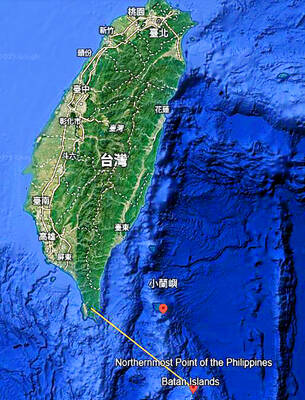
A US Marine Corps regiment equipped with Naval Strike Missiles (NSM) is set to participate in the upcoming Balikatan 25 exercise in the Luzon Strait, marking the system’s first-ever deployment in the Philippines. US and Philippine officials have separately confirmed that the Navy Marine Expeditionary Ship Interdiction System (NMESIS) — the mobile launch platform for the Naval Strike Missile — would take part in the joint exercise. The missiles are being deployed to “a strategic first island chain chokepoint” in the waters between Taiwan proper and the Philippines, US-based Naval News reported. “The Luzon Strait and Bashi Channel represent a critical access

Pope Francis is be laid to rest on Saturday after lying in state for three days in St Peter’s Basilica, where the faithful are expected to flock to pay their respects to history’s first Latin American pontiff. The cardinals met yesterday in the Vatican’s synod hall to chart the next steps before a conclave begins to choose Francis’ successor, as condolences poured in from around the world. According to current norms, the conclave must begin between May 5 and 10. The cardinals set the funeral for Saturday at 10am in St Peter’s Square, to be celebrated by the dean of the College


 RSS
RSS