


If it succeeds in its lofty aims, the first shop in Palermo showcasing goods from businesses who refuse to pay Mafia extortion fees will eventually be forced out of business.
"If everyone was like him [a neighboring baker who broke the omerta code of silence and spoke out in court against the Mafia], I'd be out of business," co-owner Fabio Messina said at the store opening on Saturday night.
That would mean "everyone [refusing] to pay the pizzo."
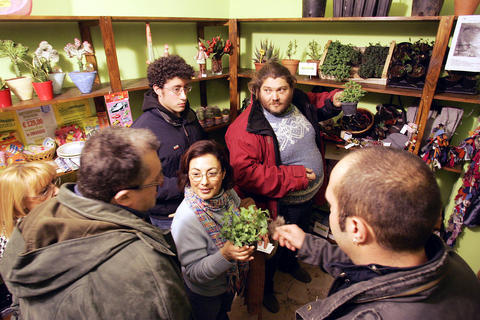
PHOTO: AFP
But that is the symbolic value behind the appearance of this unusual store on one of the Sicilian capital's main streets.
It comes four years after a grassroots revolt when mysterious stickers appeared on walls throughout the city, reading simply: "People who pay racketeers are people without dignity."
The movement started by enterprising students later spawned "Addiopizzo," a Sicilian trade grouping of companies who refuse to pay protection money, of which Messina and girlfriend partner Valeria Di Leo, 28, are members.
"Even the tiniest purchase, no matter how inexpensive, is enough to send out a signal so that things can change," Di Leo said.
Curious onlookers can browse offerings such as oil, honey, pasta, wine or handicrafts and jewelry, produced by some 30 distinct businesses, in the 55m2 store.
"We haven't received any political backing, and in any case, I never expected we would get that," Messina said.
The baker, Vincenzo Conticello, operates just a few hundred meters from the shop inevitably dubbed "Pizzo-free" by locals.
And Messina believes that forcing consumers to address the issue in such a provocative fashion is the best way to trigger a change in attitudes to the Cosa Nostra.
According to one study published in January, nearly 1 billion euros (US$1.5 billion) finds its way into the hands of the Mafia each year, 1.3 percent of Sicily's GDP.
Figures from Palermo University, show the pizzo averages 457 euros a month for retail traders and 578 euros for hotels and restaurants, but construction companies are asked to pay more than 2,000 euros per month according to economic daily figures in the Il Sole-24 Ore.
"The idea of such a shop is as delicious as it is simple," said Enrico Colaianni, president of another association of entrepreneurs and business figures fighting the racketeers' demands.
"All you need to do is introduce consumers to producers, neither of whom want to pay the pizzo, and bring about a common bond, a more ethical consumption and a client loyalty which is absolutely guaranteed," he said.
His organization, Libero Futuro, is named after one such entrepreneur, Libero Grassi, assassinated in 1991 for having dared to speak out publicly against Mafia extortion.

‘NO SECURITY RISK’: The Railway Bureau reassured the public that the technicians’ activities were limited to technical guidance and did not involve sensitive systems The Railway Bureau yesterday said it had invited eight Chinese technicians to assist with an airport MRT construction project. The bureau issued the confirmation after an Internet user said Chinese nationals had entered the construction zone of Taiwan Taoyuan International Airport’s Terminal 3 project. They asked why “individuals from an enemy state” were allowed access to such a major national infrastructure project, which raised serious concerns over Taiwan’s industrial safety, sensitive systems and information security. The bureau’s Northern Region Engineering Branch Office said subcontractor Taiwan Handle Industrial Co (台灣手把工業) of the Taoyuan airport MRT’s “Contract No. CU05 Project A14 Station Civil, MEP &

The National Chungshan Institute of Science and Technology yesterday showcased its locally developed variants of the Vision 60 robotic patrol dog, which it plans to deploy on the nation’s outlying territories in the South China Sea. The variants were produced under the Joint Lab project — created by the institute and domestic companies — and assembled with domestically produced motors, lenses and artificial intelligence (AI) systems alongside licensed tech from the US, Missile and Rocket Systems Research Division deputy director Jen Kuo-kang (任國光) told the media event at a military base in Taipei’s Dazhi (大直) area. Taiwan has built up its strengths

NOT IMMEDIATE: Taiwan has a chance to appeal the proposed 10 percent tariff before it starts, while other countries face a 12.5 percent tariff from the trade office Taiwan is among 60 economies determined by the US to have failed to impose or enforce a ban on the importation of goods produced with forced labor, according to a notice released on Tuesday by the Office of the US Trade Representative (USTR), which proposed imposing an additional 10 percent or more tariff on them. The USTR in a statement said that following an investigation, it had determined under Section 301 of the Trade Act of 1974 that the failure of the 60 economies to impose and effectively enforce a prohibition on the importation of goods produced with forced labor is

RIGHT DIRECTION: Taiwan’s efforts to prevent forced labor include a proposal to ‘fully prohibit’ employers from withholding workers’ documents, an official said Taiwan is to establish a mechanism to restrict imports of goods linked to forced labor, the Executive Yuan said yesterday, after the US proposed imposing additional tariffs on Taiwanese goods over labor concerns. “The Ministry of Labor and the Ministry of Economic Affairs are to establish an interministerial review procedure,” Executive Yuan spokesperson Michelle Lee (李慧芝) said at a news briefing in Taipei. “The government is to use the Foreign Trade Act [貿易法] as the legal basis to restrict imports of goods produced with forced labor” and bring its supply chain governance more in line with international standards on human rights, resilience


 RSS
RSS