


A US$7 billion pipeline to be laid across northern Malaysia will divert up to a third of oil now being carried through the Malacca Strait, ensuring a secure supply from the Middle East to East Asia, officials said yesterday.
Work on the 300km pipeline from Kedah state on the northwestern coast to Kelantan state in the northeast will begin next year finish in 2014, said Rahim Kamil Sulaiman, chairman of the project owner, Trans-Peninsula Petroleum Sdn Bhd.
"This is not a political project. It is a commercial undertaking. The project is economically viable," he told a news conference.
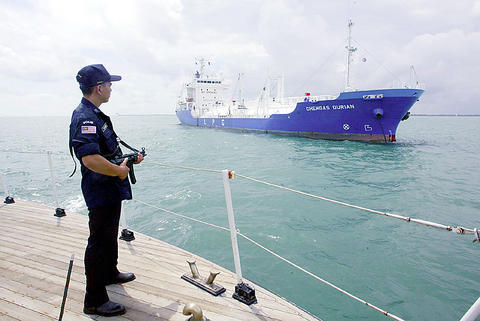
PHOTO: AFP
He said the pipeline will be a substitute for the Strait of Malacca, through which half the world's oil is shipped.
The strait is also notorious for robberies and hijackings, although the number of attacks has fallen since Malaysia, Indonesia and Singapore, which share the waterway, increased patrols in 2005.
Rahim said the timing of the pipeline was perfect as more oil is headed to China, which has become the world's second largest importer of oil.
Earlier yesterday, the Trans-Peninsula company signed an agreement with Malaysia's Ranhill Engineers and Constructors as well as Indonesia's PT Tripatra for the design and construction of the pipeline.
The signing was witnessed by Malaysian Prime Minister Abdullah Ahmad Badawi and Indonesian President Susilo Bambang Yudhoyono.
Trans-Penisula has also tied up with Saudi Arabia's Al-Banader International Group for oil supplies but has given no details.
Funds for the construction of the pipeline will come from local and foreign investors, Rahim said, declining to reveal details.
Under the plan, crude oil would be refined in Kedah, pumped through the pipe to Kelantan and then loaded onto tankers bound for Japan, China and South Korea, completely bypassing Singapore and the Malacca Strait.
Kedah Chief Minister Mahdzir Khalid told reporters that two refineries, costing a total of US$9 billion, will be built in Kedah by 2010 with a combined refining capacity of 450,000 barrels a day.
Malaysian companies SKS Ventures and Merapoh Resources Corp are expected to unveil details of the refineries in August, he said.
In a statement, Trans-Peninsula said the project will create reserve oil facilities for Asia, which accounts for about a third of world oil consumption.
It said offshore mooring facilities will be built in Yan in Kedah and Bachok in Kelantan to accommodate very large crude carriers, while a major storage tank will be built in Jeli in Kelantan.
In the first phase, which is to become operational by mid-2011, it said the pipeline can carry 2 million barrels of oil a day with a 60 million barrels of storage capacity.
This would triple to 6 million barrels a day of throughput and 180 million barrels in storage when fully completed in 2014, it added.
"There will be a faster turn around of oil tankers. Congestion in the Straits [sic] of Malacca will be eased. There will be ample strategic reserve of crude oil reachable within seven days to East Asia," it said.
It takes oil tankers up to three weeks to sail through the strait to reach east Asia.
Rahim said construction will abide by environmental guidelines and will be designed to traverse through the least settled areas to minimize social impact.
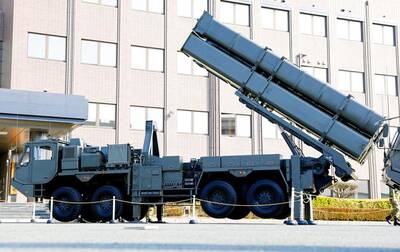
Japan has deployed long-range missiles in a southwestern region near China, the Japanese defense minister said yesterday, at a time when ties with Beijing are at their lowest in recent years. The missiles were installed in Kumamoto in the southern region of Kyushu, as Japan is attempting to shore up its military capacity as China steps up naval activity in the East China Sea. “Standoff defense capabilities enable us to counter the threat of enemy forces attempting to invade our country ... while ensuring the safety of our personnel,” Japanese Minister of Defense Shinjiro Koizumi said. “This is an extremely important initiative for

Chinese Nationalist Party (KMT) Chairwoman Cheng Li-wun (鄭麗文) today accepted an invitation from Chinese President Xi Jinping (習近平) to lead a delegation to China next month, saying she hopes to promote the peaceful development of cross-strait relations and bring stability to the Taiwan Strait. “I am grateful and happy to accept this invitation,” Cheng said in a statement from the KMT chairperson’s office. Cheng said she hopes both sides can work together to promote the peaceful development of cross-strait relations, enhance exchange and cooperation, bring stability to the Taiwan Strait and improve people’s livelihoods. At today's news conference, Cheng said any efforts to

MORE POPULAR: Taiwan Pass sales increased by 59 percent during the first quarter compared with the same period last year, the Tourism Administration said The Tourism Administration yesterday said that it has streamlined the Taiwan Pass, with two versions available for purchase beginning today. The tourism agency has made the pass available to international tourists since 2024, allowing them to access the high-speed rail, Taiwan Railway Corp services, four MRT systems and four Taiwan Tourist Shuttles. Previously, five types of Taiwan Pass were available, but some tourists have said that the offerings were too complicated. The agency said only two types of Taiwan Pass would be available, starting from a three-day pass with the high-speed rail and a three-day pass with Taiwan Railway Corp. The former costs NT$2,800

The nation’s fastest supercomputer, Nano 4 (晶創26), is scheduled to be launched in the third quarter, and would be used to train large language models in finance and national defense sectors, the National Center for High-Performance Computing (NCHC) said. The supercomputer, which would operate at about 86.05 petaflops, is being tested at a new cloud computing center in the Southern Taiwan Science Park in Tainan. The exterior of the server cabinet features chip circuitry patterns overlaid with a map of Taiwan, highlighting the nation’s central position in the semiconductor industry. The center also houses Taiwania 2, Taiwania 3, Forerunner 1 and


 RSS
RSS