


For some engineers in this Sri Lankan industrial town, making women happy is their main job -- they design sexy bras that are comfortable, too.
Ranil Vitarana is one of hundreds of Sri Lankans developing exotic undergarments for top international brands including Victoria's Secret, Marks and Spencer and Triumph -- making Sri Lanka a global hot spot for lingerie.
"The perfect bra is all about getting the cup size right," said Vitarana, a technical director attached to MAS Holdings, one of the country's top clothing firms that ships millions of articles to shops in the US and Europe.
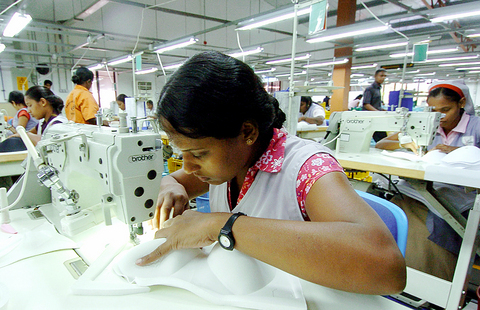
PHOTO: AFP
Sri Lanka, better known for tea and a 35-year old ethnic conflict, is remaking its image. The private sector is investing heavily in the lingerie market so it can remain competitive with China, India and Vietnam.
"We would like to be known as the lingerie capital, a place where you can get the most intricate designs done," says Ajith Dias, chairman of the Joint Apparel Association Forum.
The clothing industry is a lifeline for Sri Lanka, earning US$2.9 billion in revenue last year. It accounts for over 50 percent of the country's total exports and provides jobs to nearly one million people.
Dias said women's intimate wear has boosted Sri Lanka's prospects in the price-sensitive global apparel market, with the US alone buying US$256 million worth last year.
"Lingerie is one of our best secrets, where we have invested millions to develop high-tech plants, accessories and a sound raw material base to ensure the country remains competitive, amidst intense competition," Dias said.
Local heavyweights like MAS Holdings and Brandix Lanka are expanding in the region, which offers good opportunities thanks to rich raw material supply bases and skilled workers.
"It's a process where we take part in shaping the entire product from conceptualizing designs to making it. It is the only way we can stay competitive," said Dias, who is also a director at Brandix.
In 2004, MAS Holdings set up Silueta, a fully-integrated foam lamination and bra cup moulding plant, enabling local clothing manufacturers to turn out bras that could reach overseas markets in just five weeks.
"A cup is a very integral part of a bra, which in turn is an integral part of any women's basic garment," Silueta CEO Yusuf Saleem said.
Saleem, who trained as a mechanical engineer, spends hours with more than two dozen engineers to dream up ideas for the next-generation bra.
At the plant in Biyagama, 25km outside Colombo, 800 workers use state-of-the-art techniques to produce more than 1 million bra cups each month for overseas clients.
Giant posters of models in lingerie adorn the walls of the factory.
The Silueta team is now working on a design called "Bellissima" which involves a moulding process to attach lace to padded bra cups without a single stitch.
"It's slightly expensive, but we are trying to get buyers interested because Bellissima lasts more washes. Cups where the lace is stitched on tend to lose their shape after a few dozen washes," Yusuf said.
An average bra is made up of 30 to 40 components. Nearly 70 percent of women wear the wrong size, industry figures showed.

‘NO SECURITY RISK’: The Railway Bureau reassured the public that the technicians’ activities were limited to technical guidance and did not involve sensitive systems The Railway Bureau yesterday said it had invited eight Chinese technicians to assist with an airport MRT construction project. The bureau issued the confirmation after an Internet user said Chinese nationals had entered the construction zone of Taiwan Taoyuan International Airport’s Terminal 3 project. They asked why “individuals from an enemy state” were allowed access to such a major national infrastructure project, which raised serious concerns over Taiwan’s industrial safety, sensitive systems and information security. The bureau’s Northern Region Engineering Branch Office said subcontractor Taiwan Handle Industrial Co (台灣手把工業) of the Taoyuan airport MRT’s “Contract No. CU05 Project A14 Station Civil, MEP &

The National Chungshan Institute of Science and Technology yesterday showcased its locally developed variants of the Vision 60 robotic patrol dog, which it plans to deploy on the nation’s outlying territories in the South China Sea. The variants were produced under the Joint Lab project — created by the institute and domestic companies — and assembled with domestically produced motors, lenses and artificial intelligence (AI) systems alongside licensed tech from the US, Missile and Rocket Systems Research Division deputy director Jen Kuo-kang (任國光) told the media event at a military base in Taipei’s Dazhi (大直) area. Taiwan has built up its strengths

NOT IMMEDIATE: Taiwan has a chance to appeal the proposed 10 percent tariff before it starts, while other countries face a 12.5 percent tariff from the trade office Taiwan is among 60 economies determined by the US to have failed to impose or enforce a ban on the importation of goods produced with forced labor, according to a notice released on Tuesday by the Office of the US Trade Representative (USTR), which proposed imposing an additional 10 percent or more tariff on them. The USTR in a statement said that following an investigation, it had determined under Section 301 of the Trade Act of 1974 that the failure of the 60 economies to impose and effectively enforce a prohibition on the importation of goods produced with forced labor is

TIT-FOR-TAT: The US allegedly revoked the visa of a Chinese national working at Xinhua News Agency in the US in response to Beijing’s expulsion of Vivian Wang The Presidential Office yesterday condemned China for expelling a New York Times correspondent from Beijing following the newspaper’s interview with President William Lai (賴清德), saying the move highlighted Beijing’s suppression of press freedom and its threat to international news media. Taiwan has noted a series of recent incidents in which Beijing used similar tactics to “threaten and pressure international media outlets and journalists,” Presidential Office spokeswoman Karen Kuo (郭雅慧) said in a statement. “This concerns not only press freedom and freedom of expression, but also the safety of journalists, and Taiwan and relevant partners are paying close attention to the situation,” she


 RSS
RSS