


Veteran Swedish hotelier Sven Wermelin has traveled across Europe and Asia for his career, but also in search of a place to spend his retirement.
What he found was a 276m2 house in Thailand's southern resort town of Hua Hin.
"I sold my house in Spain, which is very expensive, to buy a house here where I get everything at a reasonable price. I can play golf and my wife can enjoy the beach, while my 15-year-old son can get a very good education," said the 65-year-old, referring to the international schools in town.
"Hua Hin is my first home now. It is a perfect destination for those who want to enjoy life after retirement," he said.
Wermelin is among the increasing number of foreigners buying property in Thai resort towns for their retirement.
Many are taking advantage of a new "retirement visa," which Thailand began issuing in February to foreigners older than 50.
The move has spurred strong demand for property, said George Mastronikolis, managing director of Hua Hin property developer Regal Thailand.
"For the past few years, expats living in Asia were the main buyers. Now this is changing with more and more individuals, mostly retiring people with the majority of them northern Europeans, discovering the benefits of living in Thailand," he said.
In the upmarket tourist town of Hua Hin, residential units run from 2 million to 30 million baht (US$52,500 to US$790,000), but most of the demand is for mid-range houses costing 5 million to 10 million baht.
Patti Tomaitrichitr, property analyst at KGI Securities, said the demand among European expats and retirees is greatest in the resort areas of Phuket, Pattaya and Hua Hin.
"Compared to other Asian markets like Hong Kong, Thailand's property prices and costs of living are relatively competitive," she said.
Pattaya, still best known for its raucous red-light district, has seen sales double since the middle of last year, with prices jumping by 50 percent since the third quarter of last year, she said.
Phuket tends to attract higher-income foreigners, with sales rebounding since late last year, after a slump following the December 2004 tsunami.
"Retirees can afford to live a lifestyle in Thailand that would not be affordable in the West, with many employing staff for driving, cleaning and nursing," said Charlotte Filleul, the Phuket-based sales manager of CB Richard Ellis (Thailand).
Recreation activities such as yachting and golfing are among the most affordable in the region, making the island an attractive destination for retirees, she said.
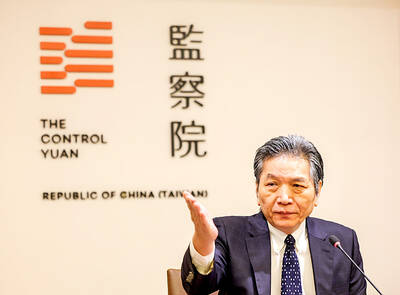
‘ABUSE OF POWER’: Lee Chun-yi allegedly used a Control Yuan vehicle to transport his dog to a pet grooming salon and take his wife to restaurants, media reports said Control Yuan Secretary-General Lee Chun-yi (李俊俋) resigned on Sunday night, admitting that he had misused a government vehicle, as reported by the media. Control Yuan Vice President Lee Hung-chun (李鴻鈞) yesterday apologized to the public over the issue. The watchdog body would follow up on similar accusations made by the Chinese Nationalist Party (KMT) and would investigate the alleged misuse of government vehicles by three other Control Yuan members: Su Li-chiung (蘇麗瓊), Lin Yu-jung (林郁容) and Wang Jung-chang (王榮璋), Lee Hung-chun said. Lee Chun-yi in a statement apologized for using a Control Yuan vehicle to transport his dog to a
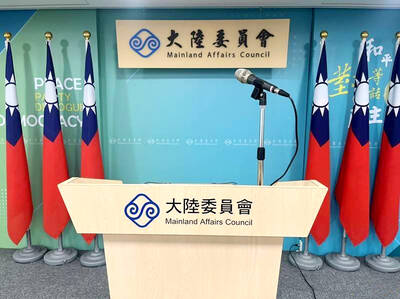
BEIJING’S ‘PAWN’: ‘We, as Chinese, should never forget our roots, history, culture,’ Want Want Holdings general manager Tsai Wang-ting said at a summit in China The Mainland Affairs Council (MAC) yesterday condemned Want Want China Times Media Group (旺旺中時媒體集團) for making comments at the Cross-Strait Chinese Culture Summit that it said have damaged Taiwan’s sovereignty, adding that it would investigate if the group had colluded with China in the matter and contravened cross-strait regulations. The council issued a statement after Want Want Holdings (旺旺集團有限公司) general manager Tsai Wang-ting (蔡旺庭), the third son of the group’s founder, Tsai Eng-meng (蔡衍明), said at the summit last week that the group originated in “Chinese Taiwan,” and has developed and prospered in “the motherland.” “We, as Chinese, should never

‘A SURVIVAL QUESTION’: US officials have been urging the opposition KMT and TPP not to block defense spending, especially the special defense budget, an official said The US plans to ramp up weapons sales to Taiwan to a level exceeding US President Donald Trump’s first term as part of an effort to deter China as it intensifies military pressure on the nation, two US officials said on condition of anonymity. If US arms sales do accelerate, it could ease worries about the extent of Trump’s commitment to Taiwan. It would also add new friction to the tense US-China relationship. The officials said they expect US approvals for weapons sales to Taiwan over the next four years to surpass those in Trump’s first term, with one of them saying
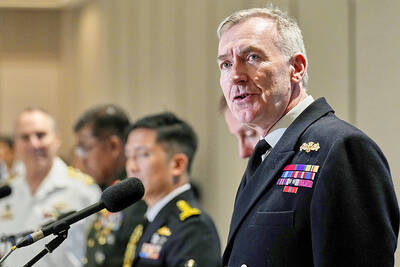
INDO-PACIFIC REGION: Royal Navy ships exercise the right of freedom of navigation, including in the Taiwan Strait and South China Sea, the UK’s Tony Radakin told a summit Freedom of navigation in the Indo-Pacific region is as important as it is in the English Channel, British Chief of the Defence Staff Admiral Tony Radakin said at a summit in Singapore on Saturday. The remark came as the British Royal Navy’s flagship aircraft carrier, the HMS Prince of Wales, is on an eight-month deployment to the Indo-Pacific region as head of an international carrier strike group. “Upholding the UN Convention on the Law of the Sea, and with it, the principles of the freedom of navigation, in this part of the world matters to us just as it matters in the


 RSS
RSS