


A Chinese animator has won a court battle against the US footwear and apparel maker Nike Inc over the company's use of a stick figure illustration, state media reported yesterday.
Internet cartoonist Zhu Zhiqiang had asked for 2 million yuan (US$240,000) in compensation from Nike as well as a public apology for allegedly copying his "Little Match Man" illustration in one of its worldwide ad campaigns.
A Beijing court ruled on Wednesday in Zhu's favor, ordering Nike to pay 300,000 yuan (US$36,000) in compensation and issue a public apology to Zhu, the China Daily newspaper said.
"I got what I wanted -- confirmation on my copyright over my stickman," Zhu was quoted as saying.
Zhang Zaiping, a lawyer for the Beaverton, Oregon-based Nike, had argued that the image used by Nike was a common symbol not entitled to protection under copyright law.
"From mural and stone paintings in ancient times to Sherlock Holmes stories, the logo has been used repeatedly," Zhang was quoted as saying in an earlier China Daily report.
The stick figure logo for Nike's "Creativity in Sports" campaign was designed by an American advertising company in 2002 at a cost of 25 million yuan (US$3 million).
Nike plans to appeal the ruling, the paper said.
The case is an unusual reversal of roles for China, which has frequently been criticized by the US for being lax about protecting patents and other intellectual property.
The country's thriving industry in product piracy routinely violates copyrights, trademarks and patents on movies, designer clothes and other goods, despite promises by Beijing to crack down.

A Chinese aircraft carrier group entered Japan’s economic waters over the weekend, before exiting to conduct drills involving fighter jets, the Japanese Ministry of Defense said yesterday. The Liaoning aircraft carrier, two missile destroyers and one fast combat supply ship sailed about 300km southwest of Japan’s easternmost island of Minamitori on Saturday, a ministry statement said. It was the first time a Chinese aircraft carrier had entered that part of Japan’s exclusive economic zone (EEZ), a ministry spokesman said. “We think the Chinese military is trying to improve its operational capability and ability to conduct operations in distant areas,” the spokesman said. China’s growing
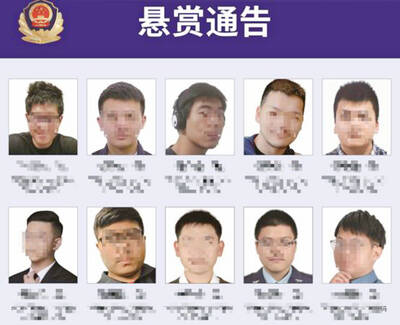
Taiwan yesterday denied Chinese allegations that its military was behind a cyberattack on a technology company in Guangzhou, after city authorities issued warrants for 20 suspects. The Guangzhou Municipal Public Security Bureau earlier yesterday issued warrants for 20 people it identified as members of the Information, Communications and Electronic Force Command (ICEFCOM). The bureau alleged they were behind a May 20 cyberattack targeting the backend system of a self-service facility at the company. “ICEFCOM, under Taiwan’s ruling Democratic Progressive Party, directed the illegal attack,” the warrant says. The bureau placed a bounty of 10,000 yuan (US$1,392) on each of the 20 people named in

Nine retired generals from Taiwan, Japan and the US have been invited to participate in a tabletop exercise hosted by the Taipei School of Economics and Political Science Foundation tomorrow and Wednesday that simulates a potential Chinese invasion of Taiwan in 2030, the foundation said yesterday. The five retired Taiwanese generals would include retired admiral Lee Hsi-min (李喜明), joined by retired US Navy admiral Michael Mullen and former chief of staff of the Japan Self-Defense Forces general Shigeru Iwasaki, it said. The simulation aims to offer strategic insights into regional security and peace in the Taiwan Strait, it added. Foundation chair Huang Huang-hsiung

PUBLIC WARNING: The two students had been tricked into going to Hong Kong for a ‘high-paying’ job, which sent them to a scam center in Cambodia Police warned the public not to trust job advertisements touting high pay abroad following the return of two college students over the weekend who had been trafficked and forced to work at a cyberscam center in Cambodia. The two victims, surnamed Lee (李), 18, and Lin (林), 19, were interviewed by police after landing in Taiwan on Saturday. Taichung’s Chingshui Police Precinct said in a statement yesterday that the two students are good friends, and Lin had suspended her studies after seeing the ad promising good pay to work in Hong Kong. Lee’s grandfather on Thursday reported to police that Lee had sent


 RSS
RSS