


A Las Vegas tycoon raised the stakes in Macau's gambling industry yesterday with a new casino that will bring competition to the tiny enclave's top industry for the first time in more than 40 years.
The operator of the Venetian on the Las Vegas Strip, Sheldon Adelson, hopes that a big dose of Nevada's glitter and glitz will attract the mainly Chinese gamblers who drop billions of dollars every year at casinos run by the Hong Kong billionaire Stanley Ho.
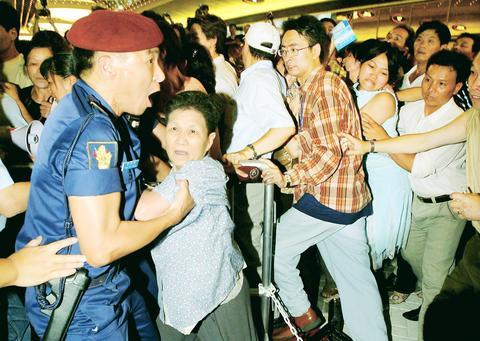
PHOTO: REUTERS
The Las Vegas Sands, which was to open its doors to gamblers yesterday afternoon, cost US$240 million and will feature 277 gaming tables and 405 slot machines.
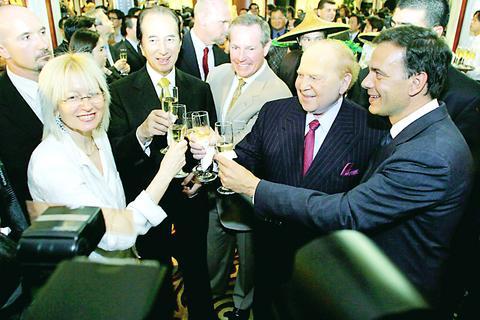
PHOTO: EPA
"It looks so grand. I'll definitely go there and have a look," said Vincent Zhao, a 20-year-old hotel clerk in Macau.
Adelson made his mark in Las Vegas with the Venetian, a replica of Venice complete with canals and singing gondoliers, and wants to create an Asian version of the Strip later in Macau with another artificial Venice.
Adelson won one of three gaming licenses when Macau decided in 2002 to open its industry to competition after Ho held a monopoly for four decades.
Ho will stay in the game, and the other license went to Vegas mogul Steve Wynn, who has been holding off on his plans while waiting for Macau to changes its laws and let casinos provide credit to players.
Ho said he welcomes the competition.
Macau's casinos are just 60km west of Hong Kong, and they attract Hong Kong gamblers -- who have no casinos at home -- in droves. A boom in business from the growing mainland Chinese economy is also anticipated.
The entry of the Las Vegas operators into Macau is already reshaping this formerly sleepy territory that was returned to Chinese sovereignty in 1999 after more than four centuries of rule from Portugal.
The economy is booming in double digits and Ho's company last year paid Macau unprecedented profit taxes of 10.1 billion patacas (US$1.3 billion), a 31 percent increase from 2002.
But critics say Ho coasted for too long with no competition and the industry needs to spiff up.
"Macau has nothing to offer right now," said Ted Loh, managing director of the online gambling consultancy Orientgaming.com. The arrival of the Sands -- which is "much more spectacular than the Lisboa" -- will force changes, he said.
Ho is responding by polishing up his flagship Lisboa and he plans a 40-story luxury hotel-casino -- along with an amusement park.
"As long as he can keep up with the competition, he's still going to be the major player in Macau. He's unavoidable," Loh said.
But service will have to improve, Loh said. One practice that should stop: Dealers in Ho's casinos trying to give themselves tips when they hand over winnings to lucky players.

The National Chungshan Institute of Science and Technology yesterday showcased its locally developed variants of the Vision 60 robotic patrol dog, which it plans to deploy on the nation’s outlying territories in the South China Sea. The variants were produced under the Joint Lab project — created by the institute and domestic companies — and assembled with domestically produced motors, lenses and artificial intelligence (AI) systems alongside licensed tech from the US, Missile and Rocket Systems Research Division deputy director Jen Kuo-kang (任國光) told the media event at a military base in Taipei’s Dazhi (大直) area. Taiwan has built up its strengths

RIGHT DIRECTION: Taiwan’s efforts to prevent forced labor include a proposal to ‘fully prohibit’ employers from withholding workers’ documents, an official said Taiwan is to establish a mechanism to restrict imports of goods linked to forced labor, the Executive Yuan said yesterday, after the US proposed imposing additional tariffs on Taiwanese goods over labor concerns. “The Ministry of Labor and the Ministry of Economic Affairs are to establish an interministerial review procedure,” Executive Yuan spokesperson Michelle Lee (李慧芝) said at a news briefing in Taipei. “The government is to use the Foreign Trade Act [貿易法] as the legal basis to restrict imports of goods produced with forced labor” and bring its supply chain governance more in line with international standards on human rights, resilience

NOT IMMEDIATE: Taiwan has a chance to appeal the proposed 10 percent tariff before it starts, while other countries face a 12.5 percent tariff from the trade office Taiwan is among 60 economies determined by the US to have failed to impose or enforce a ban on the importation of goods produced with forced labor, according to a notice released on Tuesday by the Office of the US Trade Representative (USTR), which proposed imposing an additional 10 percent or more tariff on them. The USTR in a statement said that following an investigation, it had determined under Section 301 of the Trade Act of 1974 that the failure of the 60 economies to impose and effectively enforce a prohibition on the importation of goods produced with forced labor is

TIT-FOR-TAT: The US allegedly revoked the visa of a Chinese national working at Xinhua News Agency in the US in response to Beijing’s expulsion of Vivian Wang The Presidential Office yesterday condemned China for expelling a New York Times correspondent from Beijing following the newspaper’s interview with President William Lai (賴清德), saying the move highlighted Beijing’s suppression of press freedom and its threat to international news media. Taiwan has noted a series of recent incidents in which Beijing used similar tactics to “threaten and pressure international media outlets and journalists,” Presidential Office spokeswoman Karen Kuo (郭雅慧) said in a statement. “This concerns not only press freedom and freedom of expression, but also the safety of journalists, and Taiwan and relevant partners are paying close attention to the situation,” she


 RSS
RSS