


Chuck Taylor basketball shoes are getting a Nike swoosh.
Nike Inc announced Wednesday it had agreed to buy Converse Inc, which dominated the basketball shoe market from the 1920s to the 1970s and is best known for its famed "Chuck Taylor All Star" sneakers, for US$305 million, plus the assumption of certain liabilities.
By the 1980s, Beaverton, Oregon-based Nike had overtaken Converse's rubber-toed product as the dominant basketball shoe. Converse filed for bankruptcy in January 2001, shifting production from Lumberton, North Carolina, to Asia.
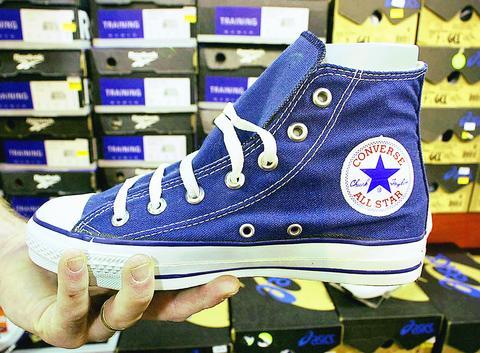
PHOTO: AP
Later that year, the North Andover-based company was bought by private investors who have tried to revive the brand.
Last year, Nike had US$10.7 billion in revenue, while Converse reported US$205 million.
Robert Toomey, an analyst for RBC Dain Rauscher in Seattle, said Nike was probably looking to cash in on the popularity of "retro" shoes and Converse's close brand association with basketball, particularly for Americans who grew up in the 1950s and 1960s.
Earlier this year, New Balance relaunched its PF Flyers canvas sneakers, jumping on the retro bandwagon.
"Retro styling has come back so strong, a lot stronger than I would have expected," Toomey said.
When asked if Nike would pay cash, Nike spokeswoman Joani Komlos said the payment process would not be revealed until after the deal is closed.
"Converse is one of the strongest footwear brands in the world with great heritage and a long history of success," said Tom Clarke, Nike's president of new business ventures.
Converse invented basketball shoes in the early days of the game, and "Chucks" got their name from Chuck Taylor, a Converse salesman who traveled the country from the 1920s until the 1960s, evangelizing the game and selling shoes.
But by the 1970s it was crippled by internal problems -- including the disastrous acquisition of apparel-maker ApexOne.
There was also bad luck. While Nike signed Michael Jordan, who became the NBA's greatest star, Converse signed Latrell Sprewell, who once tried to choke his coach during a practice and was dropped as an endorser.
During the 1980s, Chuck Taylor shoes, which the company still sells, enjoyed a renaissance.
But this time the customers were grunge rockers and baby boomers, not basketball players. Its "Grandma-ma" ads with basketball player Larry Johnson were a hit, but the sneakers continued to struggle.
Apparel-industry veterans Marsden Cason and William Simon bought the company out of bankruptcy and tried to rebuild Converse's reputation as a maker of top-of-the-line basketball shoes.
Converse did expand its brands with the Jack Purcell and One Star brands, and the company has made some progress. The year before bankruptcy, sales were US$145 million.
The deal, which remains subject to regulatory approval, would give Converse the deep-pocketed backing and marketing depth to push its brand worldwide, while offering Nike a fashion niche it may have been missing.
Toomey said the deal was the latest "selective acquisition" for Nike, which has expanded its portfolio to include Cole Haan, Bauer and Hurley International, a teen line.
"They're always on the lookout for building their market share and strengthening their stable of products and brands," Toomey said.

‘NO SECURITY RISK’: The Railway Bureau reassured the public that the technicians’ activities were limited to technical guidance and did not involve sensitive systems The Railway Bureau yesterday said it had invited eight Chinese technicians to assist with an airport MRT construction project. The bureau issued the confirmation after an Internet user said Chinese nationals had entered the construction zone of Taiwan Taoyuan International Airport’s Terminal 3 project. They asked why “individuals from an enemy state” were allowed access to such a major national infrastructure project, which raised serious concerns over Taiwan’s industrial safety, sensitive systems and information security. The bureau’s Northern Region Engineering Branch Office said subcontractor Taiwan Handle Industrial Co (台灣手把工業) of the Taoyuan airport MRT’s “Contract No. CU05 Project A14 Station Civil, MEP &

A US uncrewed surface vessel (USV) encountered multiple Chinese warships during an autonomous transit of the Taiwan Strait, US defense company Seasats said in a statement on Wednesday. Seasats announced that a Lightfish USV had completed the first autonomous transit of the Taiwan Strait. Over five days, the USV traversed the entire length of the Strait while constantly monitoring surface vessel traffic, the company said. The Lightfish encountered multiple Chinese warships, one of which was a Chinese People’s Liberation Army Navy (PLAN) Type 056 corvette, it said. The Chinese vessels were operating “well within Taiwan’s exclusive economic zone without transmitting their identity via the
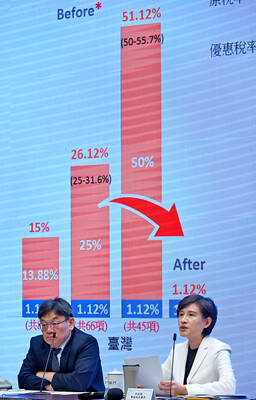
GREATER REACH? Auto parts and wood products would face tariffs of up to 15%, matching those targeting the EU, Japan and South Korea, Vice Premier said The US has announced that preferential tariff treatment for Taiwan’s non-semiconductor Section 232 goods would take effect retroactively from May 1, the Executive Yuan said yesterday. The US government yesterday posted a notice on the Federal Register’s public inspection Web site previewing tariff concessions for Taiwan under a memorandum of understanding (MOU) on Taiwan-US investment after two months of negotiations. The MOU signed on Jan. 15 stipulated three major preferential tariff arrangements: a 15 percent “reciprocal” tariff rate for Taiwan without stacking most-favored nation (MFN) rates; preferential Section 232 treatment for semiconductors and related products; and preferential Section 232 treatment for non-semiconductor
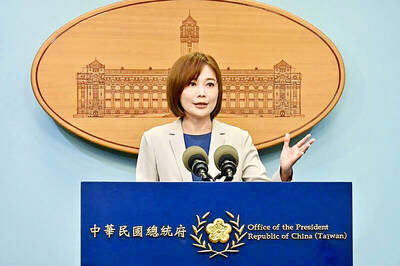
TIT-FOR-TAT: The US allegedly revoked the visa of a Chinese national working at Xinhua News Agency in the US in response to Beijing’s expulsion of Vivian Wang The Presidential Office yesterday condemned China for expelling a New York Times correspondent from Beijing following the newspaper’s interview with President William Lai (賴清德), saying the move highlighted Beijing’s suppression of press freedom and its threat to international news media. Taiwan has noted a series of recent incidents in which Beijing used similar tactics to “threaten and pressure international media outlets and journalists,” Presidential Office spokeswoman Karen Kuo (郭雅慧) said in a statement. “This concerns not only press freedom and freedom of expression, but also the safety of journalists, and Taiwan and relevant partners are paying close attention to the situation,” she


 RSS
RSS