


The US economy remained weak in the past two months with some signs it was beginning to rebound from the first recession in a decade, the Federal Reserve's latest survey of regional economic activity said.
"While there are still indications of caution, there are also scattered reports of improvement," said the report, commonly known as the "beige book."
The recession that began in March shows signs of ending by June, the report said, citing evidence gathered from the Fed's 12 regional banks. That may signal that Fed policy-makers are close to ending a yearlong series of reductions in the benchmark US interest rate.
"Many districts indicate that their contacts believe a recovery will begin by midyear or earlier, but the timing and strength are uncertain," the report said.
As a result, "that uncertainty has led some businesses to budget conservatively for the first quarter."
Retail sales "picked up in late December and early January but for the period overall posted generally weak results," the report said.
Consumers benefited from "aggressive promotions and unusually large discounting that reduced profit margins for retailers."
Manufacturing "was weak or down in most reports, but showed signs of stabilizing or rebounding," the report said.
In some areas manufacturers had "increases in new orders" during the period, the report said, but the employment situation "remained soft."
"There are numerous reports of shrinking wage and benefit packages," it said, and some employee benefits have been cut.
Housing "continued to hold up in most districts, although there were pockets of weakness" such as higher-price homes, the report said. The commercial real-estate markets "were softer" because of rising vacancy rates, it said.
Prices were declining for most goods and services except security, health care and insurance, it said. Energy costs, though higher than a year earlier, fell during the period, and "firms have reduced or eliminated energy surcharges" in at least one region, it said.
The beige book was compiled by the Fed Bank of Dallas and was based on information collected before Jan. 9. The report -- a collection of anecdotes reported to the regional Fed banks from businesses -- gives central bankers and idea of economic developments beyond what statistics show.
The central bank's rate-setting Open Market Committee next meets on Jan. 29-30. At the last meeting, on Dec. 11, central bankers cut the benchmark overnight bank lending rate by a quarter percentage point to 1.75 percent, the lowest in 40 years.
In their deliberations, Fed policy makers consult the beige book and other confidential documents on the economy and potential policy actions.
Investors are betting there's about a 50-50 chance of an additional quarter-point cut at the end of the month, judging by trading in federal funds futures contracts. The fed funds future for February, tied directly to the next meeting, has an implied yield of 1.64 percent, 11 basis points below the current target rate. A Commerce Department report yesterday showed signs that consumers are helping limit the depth of the recession.
Retail sales fell 0.1 percent last month, reflecting declines at auto dealers and cheaper gasoline, while business increased at electronics, department and furniture stores. Sales grew at an 11.3 percent annual rate in the fourth quarter, the strongest since the first three months of 2000.
Better-than-expected sales at retailers suggest that consumers were optimistic enough to keep shopping.

SECURITY: As China is ‘reshaping’ Hong Kong’s population, Taiwan must raise the eligibility threshold for applications from Hong Kongers, Chiu Chui-cheng said When Hong Kong and Macau citizens apply for residency in Taiwan, it would be under a new category that includes a “national security observation period,” Mainland Affairs Council (MAC) Minister Chiu Chui-cheng (邱垂正) said yesterday. President William Lai (賴清德) on March 13 announced 17 strategies to counter China’s aggression toward Taiwan, including incorporating national security considerations into the review process for residency applications from Hong Kong and Macau citizens. The situation in Hong Kong is constantly changing, Chiu said to media yesterday on the sidelines of the Taipei Technology Run hosted by the Taipei Neihu Technology Park Development Association. With

CARROT AND STICK: While unrelenting in its military threats, China attracted nearly 40,000 Taiwanese to over 400 business events last year Nearly 40,000 Taiwanese last year joined industry events in China, such as conferences and trade fairs, supported by the Chinese government, a study showed yesterday, as Beijing ramps up a charm offensive toward Taipei alongside military pressure. China has long taken a carrot-and-stick approach to Taiwan, threatening it with the prospect of military action while reaching out to those it believes are amenable to Beijing’s point of view. Taiwanese security officials are wary of what they see as Beijing’s influence campaigns to sway public opinion after Taipei and Beijing gradually resumed travel links halted by the COVID-19 pandemic, but the scale of
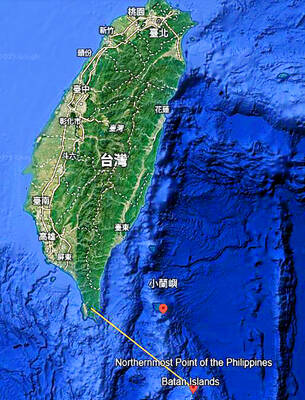
A US Marine Corps regiment equipped with Naval Strike Missiles (NSM) is set to participate in the upcoming Balikatan 25 exercise in the Luzon Strait, marking the system’s first-ever deployment in the Philippines. US and Philippine officials have separately confirmed that the Navy Marine Expeditionary Ship Interdiction System (NMESIS) — the mobile launch platform for the Naval Strike Missile — would take part in the joint exercise. The missiles are being deployed to “a strategic first island chain chokepoint” in the waters between Taiwan proper and the Philippines, US-based Naval News reported. “The Luzon Strait and Bashi Channel represent a critical access
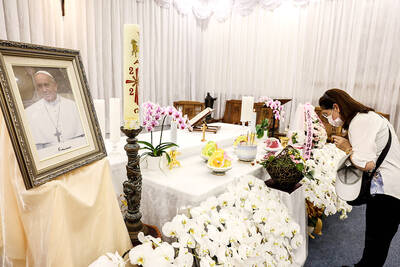
Pope Francis is be laid to rest on Saturday after lying in state for three days in St Peter’s Basilica, where the faithful are expected to flock to pay their respects to history’s first Latin American pontiff. The cardinals met yesterday in the Vatican’s synod hall to chart the next steps before a conclave begins to choose Francis’ successor, as condolences poured in from around the world. According to current norms, the conclave must begin between May 5 and 10. The cardinals set the funeral for Saturday at 10am in St Peter’s Square, to be celebrated by the dean of the College


 RSS
RSS