


The US economy probably contracted in the third quarter as business spending plunged and consumer spending cooled, pushing the nation toward its first recession in a decade, analysts said in advance of a government report yesterday.
Gross domestic product, the value of all goods and services produced, probably fell at a 1 percent annual rate from July through September after growing at a 0.3 percent pace in the second quarter, according to the median of 57 forecasts in a Bloomberg News survey.
The decline would be the largest since the first three months of 1991, when the economy was last in recession. Officials from such companies as Procter & Gamble Co and analysts say the economy may shrink again this quarter as fallout from the Sept. 11 terrorist attacks spreads through the nation.
"We are in recession," said Mark Zandi, chief economist at Economy.com in West Chester, Pennsylvania. "The ripple effects of the attacks are significant, and until a sense of personal safety is restored, the economy is going to struggle." A recession is commonly defined as two straight quarters of economic contraction.
The Commerce Department releases its GDP report at 8:30am Washington time. In the 1991 first quarter, the economy shrank at a 2 percent annual rate.
The report may give Federal Reserve policy makers more reason to push down interest rates at their Nov. 6 meeting. A reduction would be the third since terrorists crashed planes into the World Trade Center and the Pentagon, killing thousands and disrupting business nationwide. The Fed's target rate on overnight loans between banks, currently at 2.5 percent, is already the lowest since May 1962.
Also yesterday, the National Association of Purchasing Man-agement-Chicago may report that its regional manufacturing index contracted for the 12th consecutive month, falling to 43 in October from 46.6 during September, analysts said. That report is set for release at 10am Washington time. A reading below 50 in the index suggests that orders, production and other factory activity are declining.
Business investment in new facilities and equipment, which has fallen all year, probably plunged in the third quarter because companies already have more than enough computers and office space to meet existing demand, analysts said. Nortel Networks Corp, the biggest maker of phone equipment, reported that sales fell 45 percent during the July-September quarter as customers ordered less phone equipment.
Analysts also say that consumer spending, which has held up so far this year, probably cooled in the third quarter after the terrorist attacks kept shoppers away from malls, restaurants and airports. In September, retail sales fell 2.4 percent, the largest drop in almost 10 years, Commerce Department figures showed.
"We are sure there will be economic recession," said Alan Lafley, chief executive of Procter & Gamble, in a conference call yesterday after the largest US maker of household products reported a 4.4 percent drop in fiscal first-quarter earnings.
The looming recession has probably kept inflation from accelerating. The GDP price deflator, a measure of inflation tied to economic growth, probably rose at a 1.6 percent annual rate in the third quarter, the smallest gain since the final three months of 1999, after increasing at a 2.1 percent pace in the second quarter.

AIR SUPPORT: The Ministry of National Defense thanked the US for the delivery, adding that it was an indicator of the White House’s commitment to the Taiwan Relations Act Deputy Minister of National Defense Po Horng-huei (柏鴻輝) and Representative to the US Alexander Yui on Friday attended a delivery ceremony for the first of Taiwan’s long-awaited 66 F-16C/D Block 70 jets at a Lockheed Martin Corp factory in Greenville, South Carolina. “We are so proud to be the global home of the F-16 and to support Taiwan’s air defense capabilities,” US Representative William Timmons wrote on X, alongside a photograph of Taiwanese and US officials at the event. The F-16C/D Block 70 jets Taiwan ordered have the same capabilities as aircraft that had been upgraded to F-16Vs. The batch of Lockheed Martin
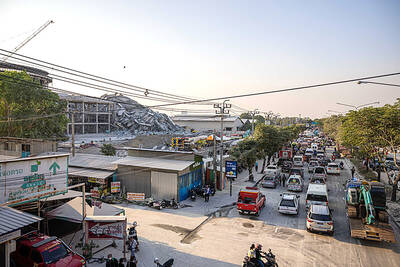
GRIDLOCK: The National Fire Agency’s Special Search and Rescue team is on standby to travel to the countries to help out with the rescue effort A powerful earthquake rocked Myanmar and neighboring Thailand yesterday, killing at least three people in Bangkok and burying dozens when a high-rise building under construction collapsed. Footage shared on social media from Myanmar’s second-largest city showed widespread destruction, raising fears that many were trapped under the rubble or killed. The magnitude 7.7 earthquake, with an epicenter near Mandalay in Myanmar, struck at midday and was followed by a strong magnitude 6.4 aftershock. The extent of death, injury and destruction — especially in Myanmar, which is embroiled in a civil war and where information is tightly controlled at the best of times —
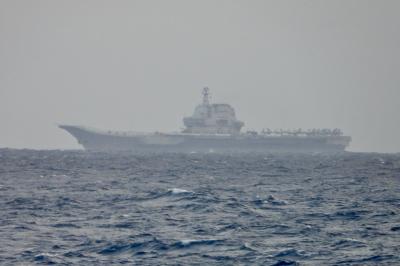
China's military today said it began joint army, navy and rocket force exercises around Taiwan to "serve as a stern warning and powerful deterrent against Taiwanese independence," calling President William Lai (賴清德) a "parasite." The exercises come after Lai called Beijing a "foreign hostile force" last month. More than 10 Chinese military ships approached close to Taiwan's 24 nautical mile (44.4km) contiguous zone this morning and Taiwan sent its own warships to respond, two senior Taiwanese officials said. Taiwan has not yet detected any live fire by the Chinese military so far, one of the officials said. The drills took place after US Secretary

THUGGISH BEHAVIOR: Encouraging people to report independence supporters is another intimidation tactic that threatens cross-strait peace, the state department said China setting up an online system for reporting “Taiwanese independence” advocates is an “irresponsible and reprehensible” act, a US government spokesperson said on Friday. “China’s call for private individuals to report on alleged ‘persecution or suppression’ by supposed ‘Taiwan independence henchmen and accomplices’ is irresponsible and reprehensible,” an unnamed US Department of State spokesperson told the Central News Agency in an e-mail. The move is part of Beijing’s “intimidation campaign” against Taiwan and its supporters, and is “threatening free speech around the world, destabilizing the Indo-Pacific region, and deliberately eroding the cross-strait status quo,” the spokesperson said. The Chinese Communist Party’s “threats


 RSS
RSS